An official website of the United States government



Adjusted Ranking Metric (ARM)
Accounting for Differences in Exposure
- The Adjusted Ranking Metric (ARM) is a measure available for Acute Care Hospitals (ACHs).
- The ARM accounts for differences in volume of exposure (specifically denominator) between facilities and is preferable for ranking facilities.
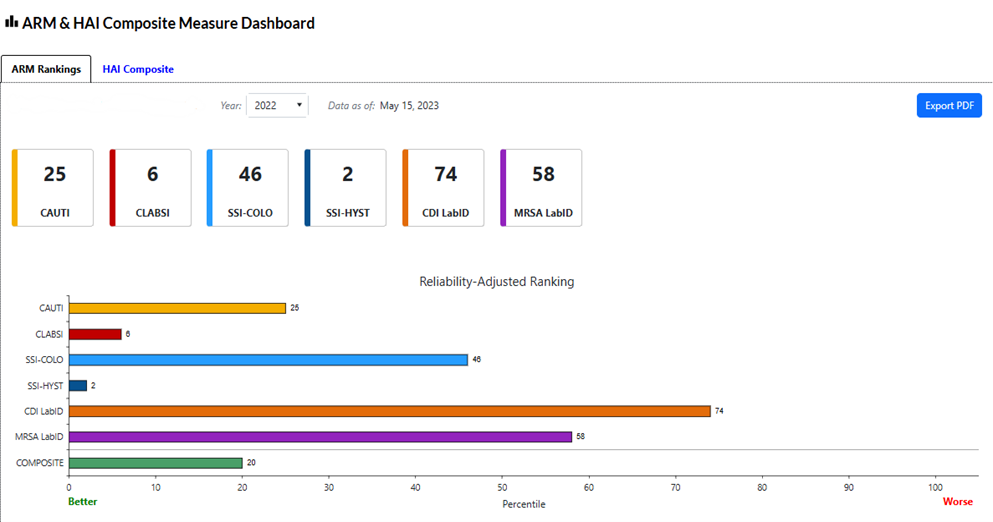
- Annual, facility-specific Reliability-Adjusted Rankings based on the ARM are displayed as percentiles on the ARM & HAI Composite Measure Dashboard within NHSN.
- A lower ranking percentile is better, so if your facility’s ranking is 1, your facility has a better outcome than 99% of facilities after accounting risk factors and overall volume of exposure.

- Reliability-Adjusted Rankings for CLABSI, CAUTI, MRSA, CDI, SSI-COLO, and SSI-HYST will be displayed only for acute care hospitals at this time.
The ARM provides complementary information to NHSN’s primary summary measure, the Standardized Infection Ratio (SIR). The ARM and SIR are separate measures that serve different purposes in healthcare-associated infection (HAI) analysis.
| Adjusted Ranking Metric (ARM) | Standardized Infection Ratio (SIR) |
|---|---|
|
|
|
|
|
|
|
|
|
|
|
|
The ARM is calculated as a ratio of numerator divided by denominator, where the ARM denominator is identical to that of the SIR denominator. Explicitly, the ARM is the reliability-adjusted number of events divided by the risk-adjusted predicted number of events, whereas the SIR is the number of reported events divided by the risk-adjusted predicted number of events.
ARM
ARM
SIR
SIR


Reliability-Adjustment
The type of reliability-adjustment incorporated into the ARM relies on methodological concepts dating back to 1977, and more specifically, has been used in CMS performance measurement since 2007 (for instance hospital 30-day mortality following acute myocardial infarction). Furthermore, the need for reliability-adjustment in assessing hospital performance has been recommended in a (white paper published by a Committee of Presidents of Statistical Societies commissioned and published by CMS. [PDF – 694 KB]).
Calculation of ARM Scores
NHSN calculates ARM scores from all acute care hospitals for six HAIs (CLABSI, CAUTI, MRSA, CDI, SSI-COLO, SSI-HYST). Individual hospitals are ranked against all other acute care hospitals for the same year. The ARM is presented as a percentile called the Reliability-Adjusted Ranking and is available to hospitals within the NHSN application.
Facilities with zero events and ARM Score
Facilities with zero events for a specific HAI may still receive an ARM. The ARM numerator adjusts for the volume of exposure between facilities such that facilities with lower exposure are shifted toward the mean. For ranking purposes, a facility with lower exposure or reliability will have their “zero” SIR (zero events) shifted toward the center of the distribution, and thus, be less distinguishable from the “middle of the pack.” Therefore, for a facility with low exposure (relative to all other facilities) that reported zero events, the ARM model shifts the numerator toward the mean such that the adjusted number of events is greater than zero.
Another way to look at this is by considering two separate sets of fictitious facility scenarios:
1) First, facilities A and B both have zero CLABSI SIRs; however, facility A has 1,000 central line days while facility B has 10,000 central line days. These facilities’ SIRs would be ranked at the same lowest end on a percentile distribution and would be considered the same, despite facility B having a more reliable estimate due to the larger volume of central line days (exposure). So, facility A would be shifted more toward the center of the distribution than facility B. Thus, the ARM therefore ranks the facility with a more reliable zero-estimate higher than the facility with the less reliable zero-estimate. This ranking is further presented as a percentile, where a lower score is better.
2) Suppose a second set of facilities C and D both have the same high CLABSI SIR with facility C having 1,000 central line days and facility D having 10,000 central line days. Again, facility C has less reliability than facility D. Therefore, facility C would be shifted further downward toward the center of the distribution since it has lower exposure and reliability compared to facility D.
Facilities with No ARM Score
Facilities predicted to have fewer than one event in five years (based on the expected number of events for that HAI) are currently not given an ARM for that HAI because this suggests that the facility should have zero events in the current year. Instead, the number of events for that year is shown.
In June 2025, the ARM & HAI Composite Measure Dashboard became available for ACHs. This release will include results for 2022 and 2023, with additional years added in future releases. Reliability-adjusted rankings for six HAIs (CLABSI, CAUTI, MRSA, CDI, SSI-COLO, and SSI-HYST) are displayed in a bar graph (example below). During this initial release, the rankings are available for use by ACHs only and are not made available to groups within NHSN, nor used by CMS pay-for-reporting or pay-for- performance programs.
ACHs are encouraged to review their reliability-adjusted rankings.
For more information, please contact NHSN@cdc.gov.
ARM values are appropriate for use in a composite measure, combining scoring for multiple HAI event types into a single measure. The HAI Composite ranking presents that measure in the form of a percentile, ranked against all other ACHs.
The HAI Composite is calculated using the geometric mean of your facility’s ARM scores. The geometric mean is found by multiplying all eligible ARMs together and then taking the root of how many numbers were eligible (e.g., if there are 3 eligible ARMs you will multiply all 3 together and take the cubed root; if there are 6, you multiply all 6 together and take the 6th root).
Composite=√(n&x_1*x_2*x_3*…*x_n )where n is the number of eligible ARM scores.
A geometric mean is preferable for summarizing scores on a multiplicative scale, compared to an arithmetic mean, which uses an additive scale and equates to a simple average. This is optimal for ARM scores, which are ratios.
All of the available ARM scores for a facility are used to calculate the HAI composite score for the facility. Then, that score is converted to a ranking by comparing the score against other facilities nationally and is presented as a percentile between 0 and 100, with a lower score meaning better outcome. For example, a ranking of 12 indicates that your hospital has a better outcome than 88% of hospitals, after accounting for the various HAI-specific risk factors and overall volume of exposure.
Keep in mind that the ARM and HAI composite rankings display percentiles between 0 to 100, whereas the actual ARM and HAI Composite score values are closer to 1, with possible scores ranging from greater than 0 to 6.
ARM = 1 means there were exactly as many outcomes as predicted.
An ARM = 2 means there were TWICE as many outcomes as predicted.
This is different from the SIR, however, as the exposure of facilities is incorporated into the ARM calculation.
Example of how the geometric mean works in an HAI composite score:
- Consider a hospital that has 2 ARM measures:
- ARM for CLABSI = 5 (Hospital has 5x more events than predicted)
- ARM for CAUTI = 0.2 {or 1/5} (Hospital has 5x fewer events than predicted)
- ARM2 (CAUTI) is EQUALLY as “good” as ARM1 (CLABSI) is “poor.”
An arithmetic mean or simple average would provide a higher aggregated score (worse) than the geometric mean.
This looks like there were 2.6 times as many events as predicted.
This looks like overall, there were as many events as expected between the two scores, which is more accurate in this scenario.
The geometric mean gives equal weight to each HAI type included in the HAI composite score.
The HAI Composite will be presented to users in multiple ways in the ARM & HAI Composite Measure Dashboard.
The ARM Rankings tab of the ARM & HAI Composite Measure Dashboard shows the HAI composite ranking in a bar graph demonstrating where the HAI composite for the facility fits between the best and worst rankings.

On the HAI Composite tab of the dashboard, the composite will be presented as a number, showing the percentile ranking for the facility between 0 and 100.

Additionally, the individual ARM scores which are used to calculate the HAI composite will be presented in the form of a spider plot comparing the scores to the national 50th percentile for each ARM score available.

This plot, often referred to as a spider plot, is useful to evaluate scoring among all included HAIs in visual manner. It may be helpful to identify areas for improvement simultaneously. Please keep in mind this plot displays actual scores (a number around 1 within a range of 0-6. This is different than the rankings shown in the ARM and HAI Composite Dashboard, where scores are converted into a percentile from 0 to 100 where lower numbers, where scores closer to 0 are better).
For more information, please contact NHSN@cdc.gov.