 An official website of the United States government



Drug Overdose Deaths in the United States, 2023–2024
Data from the National Vital Statistics System
- The age-adjusted drug overdose death rate decreased between 2022 and 2024, with the largest decrease, 26.2%, occurring from 2023 to 2024, from 31.3 deaths per 100,000 standard population to 23.1.
- From 2023 to 2024, rates of drug overdose deaths declined for all age groups, with the largest decreases occurring for younger age groups.
- From 2023 to 2024, rates declined for each race and Hispanic-origin group, with the largest decreases occurring for Black non-Hispanic people.
- Between 2023 and 2024, the drug overdose death rate involving synthetic opioids other than methadone decreased by 35.6% (from 22.2 to 14.3).
- Between 2023 and 2024, the rates of drug overdose deaths involving psychostimulants with abuse potential and cocaine both declined.
Introduction
Drug overdoses are one of the leading causes of injury death in adults (1). Drug overdose death rates, including those involving synthetic opioids (such as fentanyl) and stimulants (such as cocaine and methamphetamine) rose over the past several decades in the United States, becoming a topic of national importance (2–4). In recent years, rates have leveled off and then declined from 2022 to 2023 (2). This report presents rates of drug overdose deaths from the National Vital Statistics System by demographic group and by the type of drugs involved, specifically opioids and stimulants, with a focus on changes from 2023 to 2024.
Sex
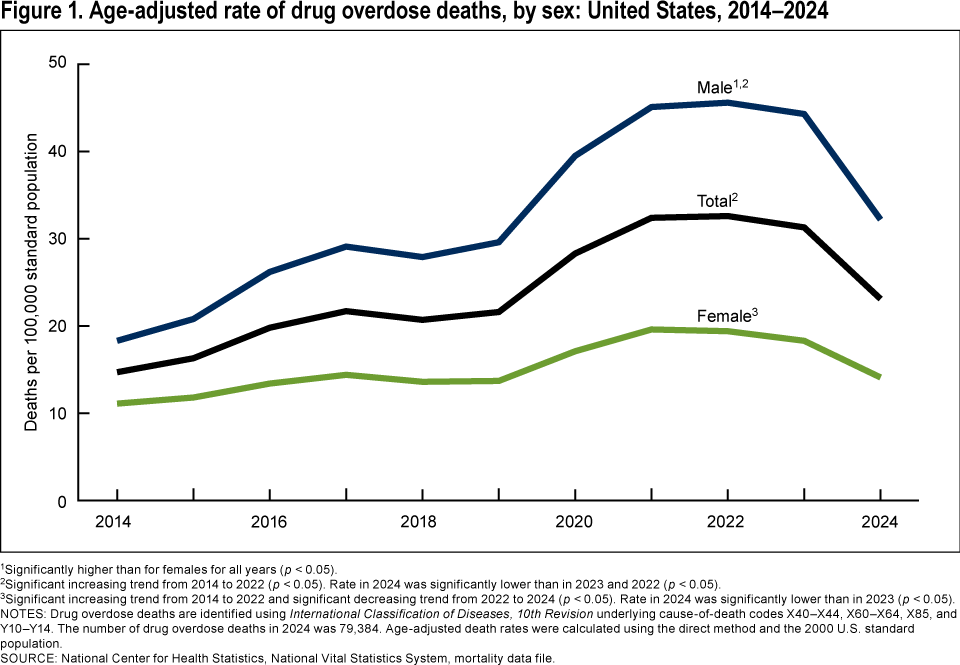
- In 2024, 79,384 drug overdose deaths occurred, resulting in an age-adjusted rate of 23.1 deaths per 100,000 standard population (Figure 1, Table 1).
- The U.S. drug overdose death rate increased from 2014 (14.7) to 2022 (32.6) and then decreased through 2024. The largest decrease, 26.2%, occurred between 2023 and 2024, from 31.3 to 23.1.
- From 2023 to 2024, the rate decreased 27.3% for males (from 44.3 to 32.2) and 23.0% for females (from 18.3 to 14.1). For both men and women, this decrease was the single largest annual decrease observed across the 10-year period.
Age
- Between 2023 and 2024, the drug overdose death rate declined for all age groups (Figure 2, Table 2).
- Younger age groups had the largest decreases, with rates declining 37.0% among ages 15–24 (from 13.5 to 8.5 deaths per 100,000 population).
- Adults age 65 and older had the smallest rate decrease between 2023 (14.7) and 2024 (13.4).
- In both 2023 and 2024, the drug overdose death rate was highest for adults ages 35–44 (60.8 and 44.2, respectively) and lowest for those ages 15–24 (13.5 and 8.5, respectively).

Race and Hispanic origin
- Between 2023 and 2024, the age-adjusted rates of drug overdose deaths declined for each race and Hispanic-origin group (Figure 3, Table 3).
- The rate decreased most (30.9%) for Black non-Hispanic (subsequently, Black) people, from 48.9 to 33.8 deaths per 100,000 standard population between 2023 and 2024.
- In both 2023 and 2024, the age-adjusted drug overdose death rate was highest for American Indian and Alaska Native non-Hispanic people (65.0 and 51.6, respectively), and lowest for Asian non-Hispanic people (5.1 and 4.4, respectively).

Opioid type
- Between 2023 and 2024, the age-adjusted rates of drug overdose deaths decreased for each opioid type category examined (Figure 4, Table 4).
- Drug overdose deaths involving synthetic opioids other than methadone decreased the most (35.6%) from 2023 (22.2 deaths per 100,000 standard population) to 2024 (14.3).
- A 20.7% decrease was observed in drug overdose deaths involving natural and semisynthetic opioids, declining from 2.9 to 2.3 between 2023 and 2024. Heroin death rates also decreased 33.3% during this period, from 1.2 to 0.8.
- For drug overdose deaths involving methadone, the rate decreased by 10.0% from 2023 (1.0) to 2024 (0.9).

Stimulant type
- For drug overdose deaths involving psychostimulants with abuse potential, the age-adjusted rate decreased by 19.8% from 2023 (10.6 deaths per 100,000 standard population) to 2024 (8.5) (Figure 5, Table 5).
- For drug overdose deaths involving cocaine, the rate decreased by 26.7% from 2023 (8.6) to 2024 (6.3).

Summary
The national age-adjusted drug overdose death rate decreased by 26.2% between 2023 and 2024. This decrease was the largest percentage drop across the 2014–2024 period and continues a period of decline that began in 2022. Rates decreased between 2023 and 2024 for all examined subgroups by sex, age, and race and Hispanic origin as well as by drug type.
From 2023 to 2024, the age-adjusted rate declined for both males and females. Younger age groups showed larger declines, with ages 15–24 showing the largest decline (37.0%), while adults age 65 and older showed a smaller decline (8.8%). In addition, between 2023 and 2024, the rate decreased most for Black people compared with other race and Hispanic-origin groups.
The age-adjusted rate declined for all reported drug types from 2023 to 2024. Compared with other reported drug types, synthetic opioids other than methadone showed the largest decline.
Definitions
Drug poisoning (overdose) deaths: Includes deaths resulting from unintentional or intentional overdose of a drug, being given the wrong drug, taking a drug in error, or taking a drug inadvertently.
Natural and semisynthetic opioids: Includes drugs such as morphine, codeine, hydrocodone, and oxycodone.
Psychostimulants with abuse potential: Includes drugs such as methamphetamine, amphetamine, and methylphenidate.
Synthetic opioids other than methadone: Includes drugs such as fentanyl, fentanyl analogs, and tramadol.
Data source and methods
Estimates are based on the National Vital Statistics System multiple-cause-of-death mortality files (1). Drug poisoning (overdose) deaths were defined as having an International Classification of Diseases, 10th Revision underlying cause-of-death code of X40–X44 (unintentional), X60–X64 (suicide), X85 (homicide), or Y10–Y14 (undetermined intent). Of the drug overdose deaths in 2024, 91.6% were unintentional, 5.6% were suicides, 2.7% were of undetermined intent, and less than 1.0% were homicides. The type of drug(s) involved was indicated by International Classification of Diseases, 10th Revision multiple-cause-of-death codes: T40.1 (heroin), T40.2 (natural and semisynthetic opioids), T40.3 (methadone), T40.4 (synthetic opioids other than methadone), T40.5 (cocaine), and T43.6 (psychostimulants with abuse potential).
Age-adjusted death rates were calculated using the direct method and adjusted to the 2000 U.S. standard population (5). Population estimates for 2023–2024 were estimated as of July 1, based on the blended base produced by the U.S. Census Bureau instead of the April 1, 2020, decennial population count. The blended base consists of the blend of vintage 2020 population estimates for April 1 2020, (based on April 1, 2010 decennial census), blended with the 2020 Demographic Analysis Estimates, and the 2020 Census Edited File (see https://www2.census.gov/programs-surveys/popest/technical-documentation/methodology/2020-2023/methods-statement-v2023.pdf). Population data are July 1 postcensal census estimates.
Race and Hispanic origin were categorized based on the 1997 Office of Management and Budget standards for federal statistical and administrative reporting (6). All of the race categories are single race, meaning that only one race was reported on the death certificate. Data shown for the Hispanic population include people of any race. Death rates for Asian, American Indian and Alaska Native, and Hispanic people are affected by misclassification of race and Hispanic origin on death certificates (7). This misclassification results in underestimation of death rates for these groups by about 3% for Asian and Hispanic people and about 34% for American Indian and Alaska Native people (8). Misclassification for Native Hawaiian or Other Pacific Islander people has not been evaluated. The extent of misclassification has not been evaluated by cause of death for all race and Hispanic-origin groups. As a result, rates of drug overdose deaths presented in this report are not adjusted for race and Hispanic-origin misclassification on death certificates.
Significant patterns reported in trend analyses may differ from previous reports that use a different time period, particularly with a different start and end year. Trends in age-adjusted death rates were evaluated using the Joinpoint Regression Program (Version 5.0.2) (9). Joinpoint software fitted weighted least-squares regression models to the rates on the log-transform scale. The permutation tests for model (number of joinpoints) significance were set at an overall alpha level of 0.05 (9,10). Pairwise comparisons of rates (for example, age-adjusted rates for males compared with females and year-to-year comparisons) were conducted using the z test with an alpha level of 0.05 (10).
Several factors related to death investigation and reporting may affect the measurement of death rates involving specific drugs. At autopsy, the substances tested for and the circumstances under which the toxicology tests are performed vary by jurisdiction. This variability is more likely to affect substance-specific death rates than the overall drug overdose death rate. The percentage of drug overdose deaths that identified the specific drugs involved varied by year, increasing from 81% in 2014 to 96% in 2024. Additionally, drug overdose deaths may involve multiple drugs; therefore, a death might be included in more than one category when describing the drug overdose death rate involving specific drugs. For example, a death that involved both fentanyl and cocaine would be included in both the drug overdose death rate involving synthetic opioids other than methadone and the drug overdose death rate involving cocaine.
About the authors
The authors are with the National Center for Health Statistics: Matthew F. Garnett is with the Division of Analysis and Epidemiology and Arialdi M. Miniño is with the Division of Vital Statistics.
References
- National Center for Health Statistics. Mortality multiple cause files. 2024.
- Garnett MF, Miniño AM. Drug overdose deaths in the United States, 2003–2023. NCHS Data Brief. 2024 Dec;(522):1–12. DOI: https://dx.doi.org/10.15620/cdc/170565.
- The White House. Overdose Prevention Week, 2025. 2025 Aug. Available from: https://www.whitehouse.gov/presidential-actions/2025/08/overdose-prevention-week-2025/.
- U.S. Department of Health and Human Services, Office of Disease Prevention and Health Promotion. Healthy People 2030. Reduce drug overdose deaths—SU-03. Healthy People 2030. 2025. Available from: https://odphp.health.gov/healthypeople/objectives-and-data/browse-objectives/drug-and-alcohol-use/reduce-drug-overdose-deaths-su-03.
- Kochanek KD, Murphy SL, Xu JQ, Arias E. Deaths: Final data for 2020. Natl Vital Stat Rep. 2023 Sep 22;72(10):1–92. DOI: https://dx.doi.org/10.15620/cdc:131355.
- Office of Management and Budget. Revisions to the standards for the classification of federal data on race and ethnicity. Fed Regist. 1997 Oct 30;62(210):58782–90.
- Arias E, Heron M, Hakes JK. The validity of race and Hispanic-origin reporting on death certificates in the United States: An update. National Center for Health Statistics. Vital Health Stat 2 2016;(172)1–29.
- Arias E, Xu JQ, Curtin S, Bastian B, Tejada-Vera B. Mortality profile of the non-Hispanic American Indian or Alaska Native population, 2019. Natl Vital Stat Rep. 2021 Nov 9;70(12):1–27. DOI: https://dx.doi.org/10.15620/cdc:110370.
- National Cancer Institute. Joinpoint Regression Program (Version 5.0.2) [computer software]. 2023.
- Ingram DD, Malec DJ, Makuc DM, Kruszon-Moran D, Gindi RM, Albert M, et al. National Center for Health Statistics guidelines for analysis of trends. National Center for Health Statistics. Vital Health Stat 2 2018;(179)1–71.
Suggested citation
Garnett MF, Miniño AM. Drug overdose deaths in the United States, 2023–2024. NCHS Data Brief. 2026 Jan;(549):1─13. DOI: https://dx.doi.org/10.15620/cdc/174639.
Copyright information
All material appearing in this report is in the public domain and may be reproduced or copied without permission; citation as to source, however, is appreciated.
National Center for Health Statistics
Brian C. Moyer, Ph.D., Director
Amy M. Branum, Ph.D., Associate Director for Science
Division of Analysis and Epidemiology
Irma E. Arispe, Ph.D., Director
Kimberly A. Lochner, Sc.D., Associate Director for Science
Division of Vital Statistics
Paul D. Sutton, Ph.D., Director
Andrés A. Berruti, Ph.D., M.A., Associate Director for Science