



Key points
- CDC works with state/territorial and local health departments and other partners to test and monitor wastewater for multiple infectious diseases in communities across the nation.
- CDC shares wastewater data for influenza A, COVID-19, RSV, measles, avian influenza A (H5), and monkeypox.
Overview
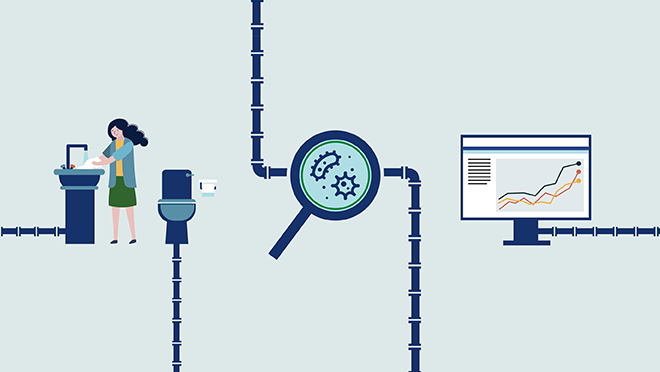
CDC's wastewater monitoring program, also known as the National Wastewater Surveillance System (NWSS), provides the public health infrastructure to monitor infectious diseases through wastewater across the country.
The program displays wastewater data for:
- Common respiratory viruses (influenza A, COVID-19, and RSV)
- Emerging viruses (measles, avian influenza A(H5), and monkeypox)
- Additional wastewater data are available for download or API connection on data.cdc.gov (search "wastewater").
Participating sites
CDC receives wastewater data from communities across the U.S. Wastewater monitoring for infectious diseases can be implemented in any community that is served by municipal wastewater collection systems.
Data sources
Data displayed by CDC's wastewater monitoring program include data collected and reported by state/territorial and local public health departments, CDC's national wastewater testing contract, and an academic partner group.
Contact your state/territory or local health department to learn more about wastewater monitoring efforts in your community.
State/territorial and local public health departments
Data from state/territorial and local health departments are reported to CDC and supported with funding through the Epidemiology and Laboratory Capacity for the Prevention and Control of Emerging Infectious Diseases (ELC) Cooperative Agreement. These data are listed with the "State_Territory" source in datasets.
Some state/territorial and local health departments also display wastewater data on their websites. Differences between the data on their websites and the CDC website represent differing levels of data reporting. Additionally, there may be differences in data visualization approaches that impact how data are displayed.
CDC's national wastewater testing contract
Data from some sites are supported through CDC's national wastewater testing contract (currently with Verily Life Sciences, LLC). These data are listed with the “CDC_Verily” source in datasets. Data from a previous contract are reported using the “Biobot_Analytics” source.
WastewaterSCAN
CDC receives data from an academic partner. These data were generated by WastewaterSCAN, a partnership between Stanford University, Emory University, and Verily. These data are listed with the "WastewaterSCAN" source in datasets.
- These data are being made available to inform public health decision making.
- Anyone seeking to use the database for other purposes or for research is required to contact the WastewaterSCAN / SCAN team (email: wwscan_stanford_emory@lists.stanford.edu) and any use of the data should be cited appropriately (https://data.wastewaterscan.org/about/#18).
- All results are understood to be based on inputs that are experimental in nature and are not intended to diagnose or treat any disease. The results are provided "as is" and without warranty of any kind. Stanford does not accept liability for any claim arising out of or in connection with the disclosure of these results. WastewaterSCAN indicates that by accessing or copying any part of the database, the user accepts the terms of Stanford's license (CC BY-NC 4.0).
This page was last updated on this date. Updates may include minor edits, image changes, or other modifications to page content.
The information on this page was last reviewed by subject matter experts to ensure accuracy.