 An official website of the United States government




Newsletter
Most Read 2025
Read the most popular Clinician’s Newsletter articles published in 2025.
Number 1: Hepatitis B and shared glucometers

In May 2024, the North Carolina Division of Public Health was notified that a hospitalized patient with diabetes had received a diagnosis of acute hepatitis B virus (HBV) infection after being transferred from a skilled nursing facility. The patient’s diabetes management included regular blood glucose monitoring. The patient had no documented history of hepatitis B or hepatitis B vaccination. Investigation revealed that glucometers at the skilled nursing facility were shared among several residents and observed to be disinfected per manufacturer instructions between uses. No other gaps in infection control practices were observed. Hepatitis B testing identified one skilled nursing facility resident with a previously diagnosed and unreported chronic HBV infection who had also received daily assisted blood glucose monitoring during a period that overlapped with the estimated incubation period of the newly infected resident. The newly infected resident repeatedly underwent monitoring <1 minute following the resident with chronic HBV infection, an interval that might not have allowed for adequate disinfection. Whole genome sequencing analysis demonstrated that both residents were infected with a genetically identical HBV strain.
|
Bottom line:
|
|
CDC: Considerations for Blood Glucose Monitoring and Insulin Administration
Universal Hepatitis B Vaccination in Adults Aged 19–59 Years: Updated Recommendations of the Advisory Committee on Immunization Practices — United States, 2022
Number 2: Arboviral Diseases
(HBV) was transmitted in a nursing home through a shared glucometer. Nursing homes, protect residents who have diabetes: offer routine HBV vaccination; use a dedicated glucometer for each resident. If shared glucometers are used, they should be those designed for use in professional settings and cleaned and disinfected after every use.”
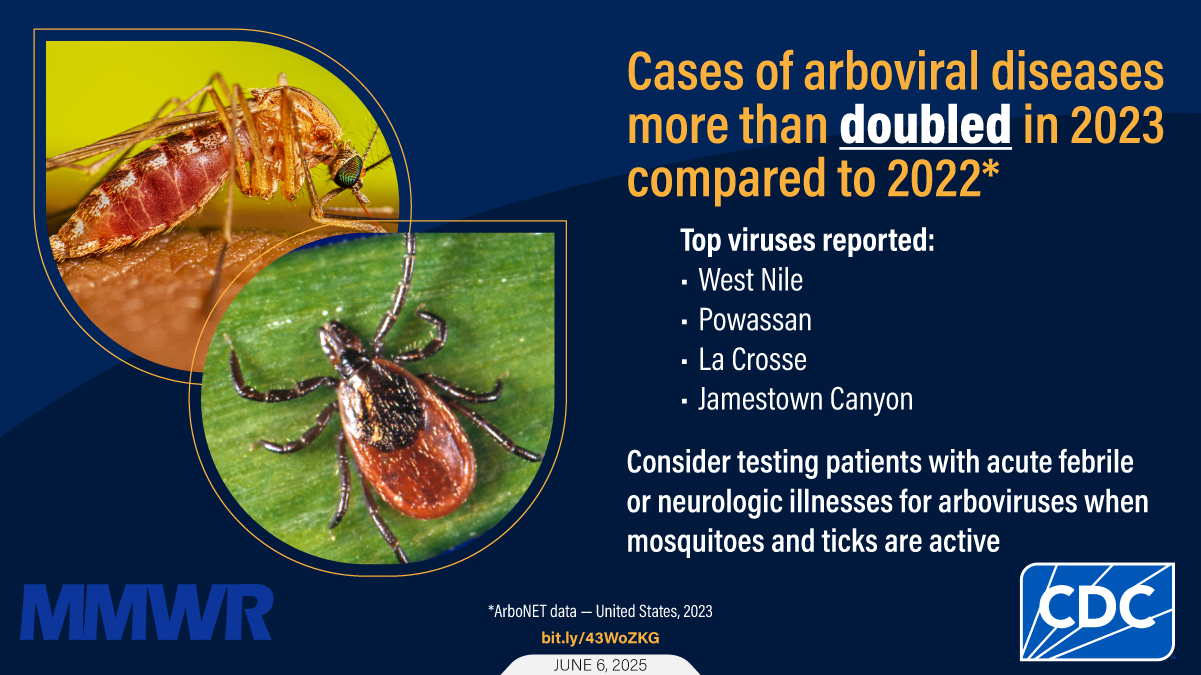
In 2023, arboviral disease cases were reported from all contiguous U.S. states; most occurred during April–December. West Nile virus (WNV) cases (n = 2,628) were most common, followed by Powassan virus disease cases (n = 49), which increased from the previous record high in 2022. Three WNV disease cases were reported among patients infected through organ transplantation from two donors. La Crosse virus was the most common cause of arboviral disease among children, with most cases classified as neuroinvasive.
|
Bottom Line:
|
|
MMWR: West Nile Virus and Other Nationally Notifiable Arboviral Diseases — United States, 2023
CDC: Guidelines for West Nile Virus Surveillance and Control
Preventing Mosquito Bites
Preventing Tick Bites
Blood Safety Basics
Number 3: Candidemia

Candidemia, a bloodstream infection caused by Candida spp., is a common cause of health care–associated bloodstream infections in the United States. Laboratory surveillance of candidemia at 10 U.S. sites during 2017–2021 found an incidence of 7.4 cases per 100,000 population. Incidence within demographic groups was generally stable or increased slightly over time. Older adults, males, and Black patients were disproportionately affected. In addition, 63.7% of cases occurred in patients who had a central venous catheter, and 36.2% occurred in patients with diabetes. The all-cause in-hospital mortality rate was 32.6%. Among 6,576 Candida isolates, 5.6% were fluconazole-resistant, and <1% were echinocandin-resistant. Antifungal resistance was stable for all antifungals tested across years.
|
Bottom Line:
|
|
MMWR: Population-Based Active Surveillance for Culture-Confirmed Candidemia — 10 Sites, United States, 2017–2021
Intravascular Catheter-related Infection (BSI) Prevention Guidelines
Number 4: Plague

Plague, caused by Yersinia pestis, is a rare but potentially life-threatening illness treatable with antibiotics if diagnosed early. Patients usually become infected through the bite of an infected rodent flea; however, Y. pestis can be transmitted to humans through exposure to ill pets, especially cats. An Oregon man sought care at an emergency department for signs and symptoms of plague on January 30, 2024, the earliest calendar date of plague recorded in the state’s history, possibly indicating a shift in the seasonality of plague incidence. The patient did not have direct contact with rodents, but did have contact with his infected cat, who had an abscess, after cutting his finger.
|
Bottom Line:
|
|
CDC: Clinical Testing and Diagnosis for Plague
Clinical Care of Plague
Number 5: Candida auris and hemodialysis

Candida auris, a frequently multidrug-resistant fungal pathogen, can spread within health care facilities. In five facilities providing dialysis in four states during 2020–2023, six patients infected or colonized with C. auris received dialysis for up to 4 months without transmission to other patients. Health care personnel at all five facilities had no knowledge of the patients’ C. auris status and had implemented standard dialysis infection prevention and control (IPC) only. Adherence to standard IPC practices appeared to enable safe provision of dialysis to patients with C. auris colonization or infection without transmission to other dialysis patients.
|
Bottom Line:
|
|
CDC: Guidelines, Recommendations and Resources
Infection Control Guidance: Candida auris
Did you know? Medscape & MMWR have FREE CME activities

Continuing medical education credits are available from Medscape on select MMWRs.
Subscribe to our newsletter
Get our monthly newsletter delivered to your email inbox.