 An official website of the United States government




Newsletter
November 2025
Tularemia treatment and prophylaxis recommendations

Tularemia, caused by Francisella tularensis bacteria, occurs naturally in the United States. A person can get tularemia from a bite from an infected arthropod (e.g., ticks and deer flies), contact with infected animals, ingestion of contaminated meat or water, contact with contaminated soil or hay, or inhalation of aerosolized particles. Because F. tularensis has a low infectious inoculum, it is classified as a potential bioterrorism agent that could infect thousands of people if intentionally released. CDC updated clinical guidelines to provide best practices for treatment and prophylaxis of human tularemia for both naturally occurring disease and after a bioterrorism attack.
|
Notable changes compared to previously published guidelines include:
|
|
CDC: Guidelines, Recommendations and Resources
Hepatitis B and shared glucometers
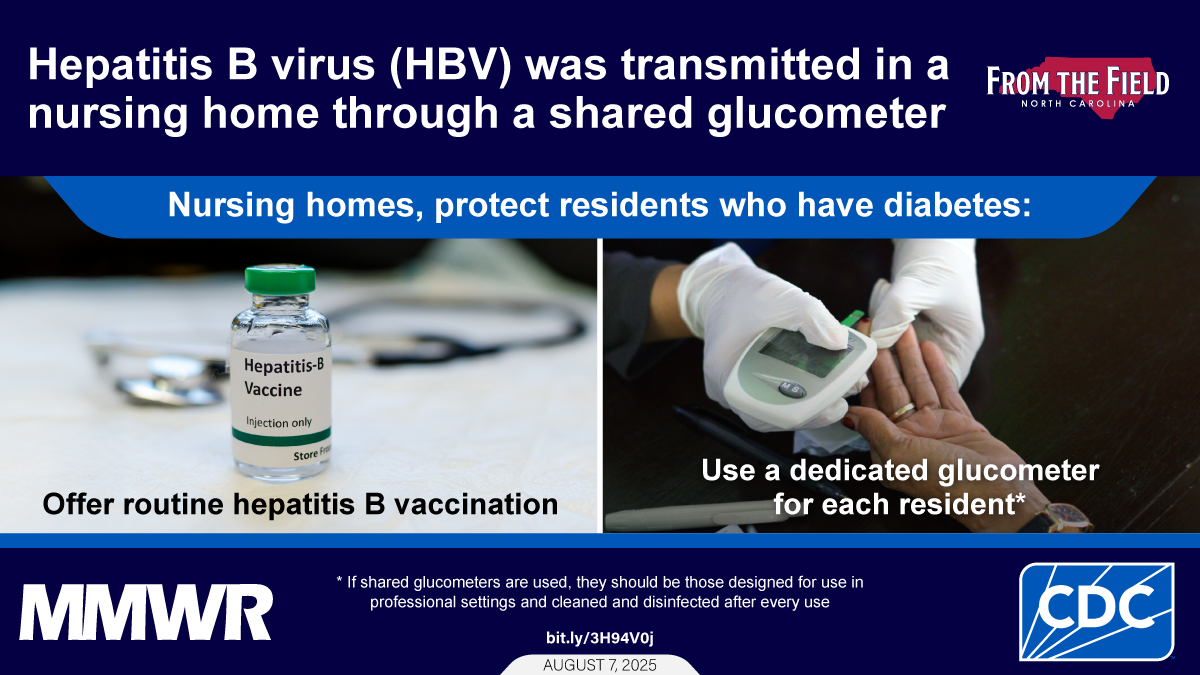
(HBV) was transmitted in a nursing home through a shared glucometer. Nursing homes, protect residents who have diabetes: offer routine HBV vaccination; use a dedicated glucometer for each resident. If shared glucometers are used, they should be those designed for use in professional settings and cleaned and disinfected after every use.”
In May 2024, the North Carolina Division of Public Health was notified that a hospitalized patient with diabetes had received a diagnosis of acute hepatitis B virus (HBV) infection after being transferred from a skilled nursing facility. The patient’s diabetes management included regular blood glucose monitoring. The patient had no documented history of hepatitis B or hepatitis B vaccination. Investigation revealed that glucometers at the skilled nursing facility were shared among several residents and observed to be disinfected per manufacturer instructions between uses. No other gaps in infection control practices were observed. Hepatitis B testing identified one skilled nursing facility resident with a previously diagnosed and unreported chronic HBV infection who had also received daily assisted blood glucose monitoring during a period that overlapped with the estimated incubation period of the newly infected resident. The newly infected resident repeatedly underwent monitoring <1 minute following the resident with chronic HBV infection, an interval that might not have allowed for adequate disinfection. Whole genome sequencing analysis demonstrated that both residents were infected with a genetically identical HBV strain.
|
Bottom Line:
|
|
CDC: Considerations for Blood Glucose Monitoring and Insulin Administration
Influenza vaccines

Influenza vaccination protects against influenza and its potential complications. This report updates the 2024–25 recommendations of the Advisory Committee on Immunization Practices (ACIP) concerning the use of seasonal influenza vaccines in the United States for the 2025–26 influenza season. Updates include approval of FluMist (nasal spray live attenuated influenza vaccine) for self-administration or caregiver administration and expansion of the approved age threshold for Flublok (recombinant influenza vaccine) from ≥18 years to ≥9 years.
|
Bottom Line:
|
|
Lenacapavir as HIV preexposure prophylaxis

HIV preexposure prophylaxis (PrEP) reduces HIV incidence; however, adherence to available PrEP regimens is suboptimal. In June 2025, FDA approved injectable lenacapavir (LEN) administered every 6 months as HIV PrEP, based on results from two randomized controlled trials (RCTs) that reported LEN efficacy at reducing HIV infection as 100% among females and 96% among a primarily male trial population over a follow-up of 52 weeks. Based on efficacy and safety demonstrated by the two RCTs, the CDC PrEP Guidelines Work Group strongly recommends administering LEN as an HIV PrEP option in persons weighing ≥77 lbs (≥35 kg) who would benefit from PrEP.
|
Bottom Line:
|
|
CDC: Clinical Guidance for PrEP
Neisseria meningitidis conjunctivitis
Neisseria meningitidis is an unusual cause of bacterial conjunctivitis. Forty-one cases of N. meningitidis conjunctivitis caused by an unencapsulated (nongroupable) strain of N. meningitidis identified by whole genome sequencing occurred in young, healthy military trainees living in a communal setting; all had received quadrivalent meningococcal vaccine. No source was identified. One patient developed periorbital cellulitis and received intravenous antibiotics; all other patients were treated successfully with topical antibiotics.
|
Bottom Line:
|
|
MMWR: Outbreak of Neisseria meningitidis Conjunctivitis in Military Trainees — Texas, February–May 2025
Did you know? Medscape & MMWR have FREE CME activities

Continuing medical education credits are available from Medscape on select MMWRs.

- Respiratory Syncytial Virus Immunization Coverage Among Infants Through Receipt of Nirsevimab Monoclonal Antibody or Maternal Vaccination — United States, October 2023–March 2024
An analysis of data from 36 state and local immunization information systems found that 29% of infants born during October 2023–March 2024 received protection against respiratory syncytial virus (RSV). Infant RSV protection through infant or maternal immunization ranged from an estimated 11% through 53% by state. - Use of Clesrovimab for Prevention of Severe Respiratory Syncytial Virus–Associated Lower Respiratory Tract Infections in Infants: Recommendations of the Advisory Committee on Immunization Practices — United States, 2025
On June 26, 2025, ACIP recommended clesrovimab, a newly licensed long-acting RSV monoclonal antibody, as an alternative to nirsevimab for infants younger than 8 months born during or entering their first RSV season who did not receive protection through maternal RSV vaccination.
Subscribe to our newsletter
Get our monthly newsletter delivered to your email inbox.