



What to know
Each year CDC estimates the burden of influenza in the United States. CDC uses models to estimate the number of flu illnesses, medical visits, hospitalizations, and deaths related to flu that occurred in a given season. CDC uses the estimates of the burden of flu in the population and the impact of flu vaccination to inform policy and communications related to flu.

Estimated Range of Annual Burden of Flu in the US from 2010 – 2025
The burden of flu disease in the United States can vary widely and is determined by a number of factors including the characteristics of circulating viruses, the timing of the season, how well flu vaccine is working to protect against illness, and how many people got vaccinated. While the burden of flu can vary, each year flu places a substantial burden on the health of people in the United States each year.
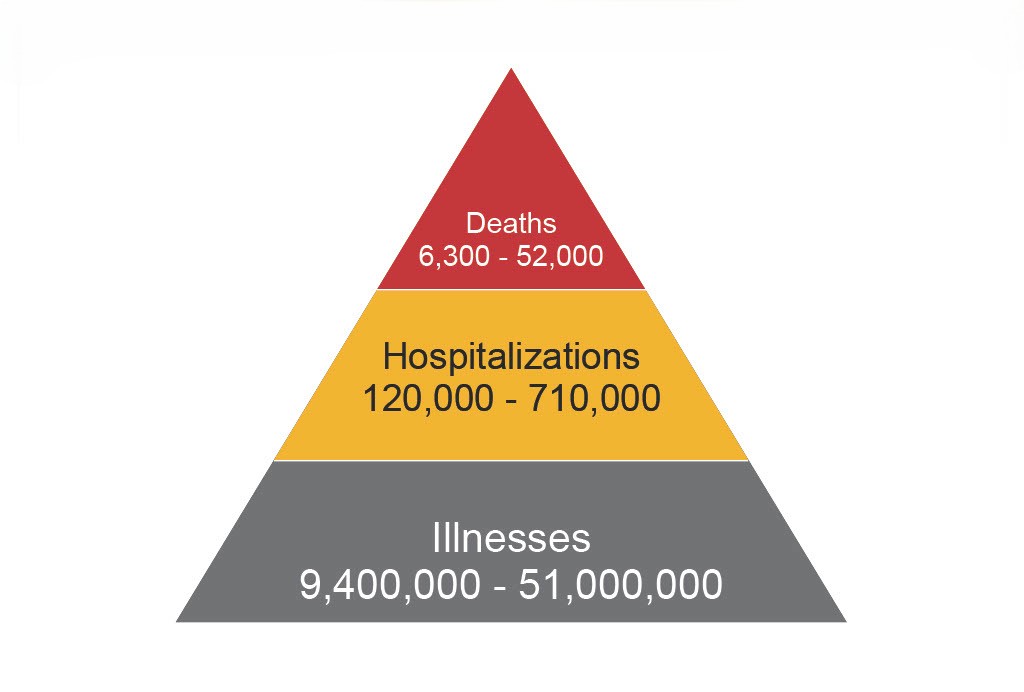
CDC estimates that flu has resulted in 9.4 million – 51 million illnesses, 120,000 – 710,000 hospitalizations and 6,300 – 52,000 deaths annually between 2010 and 2025.
Estimated U.S. Flu Burden, By Season
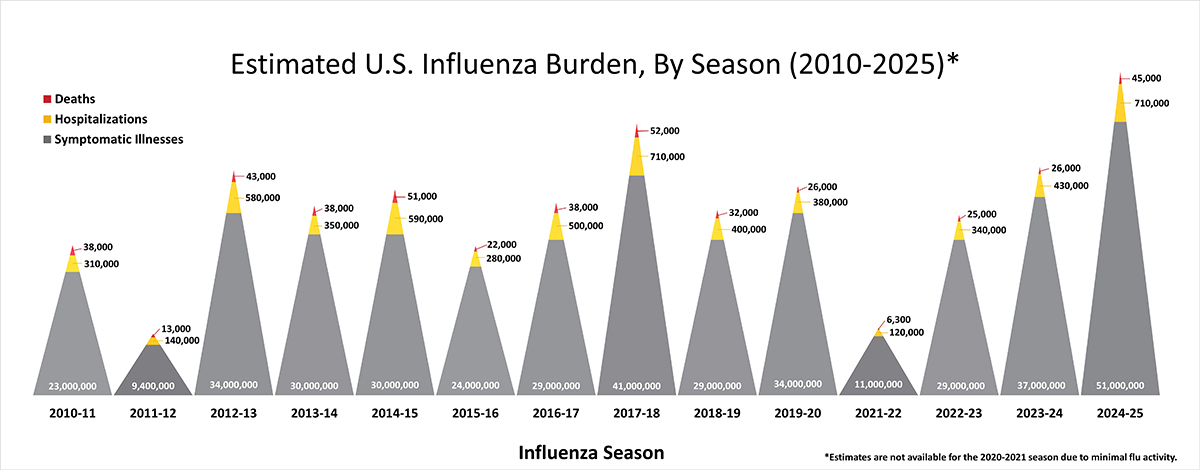
Estimates are not available for the 2020-2021 season due to minimal flu activity.
Supporting Research
Flu-related illness and hospitalization
United States
- Study: Annual estimates of the burden of seasonal flu in the United States: A tool for strengthening flu surveillance and preparedness. Flu Other Respir Viruses. 2018
- Study: Estimating flu disease burden from population-based surveillance data in the United States. PLoS One. 2015
- Study: The US Flu Hospitalization Surveillance Network. Emerg Infect Dis. 2015
- Study: Hospitalizations associated with flu and respiratory syncytial virus in the United States, 1993-2008. Clin Infect Dis. 2012
- Study: Flu-associated hospitalizations in the United States. JAMA. 2004
Global
- Study: Estimates of global seasonal flu-associated respiratory mortality: a modelling study. Lancet. 2017
- Study: Global role and burden of flu in pediatric respiratory hospitalizations, 1982-2012: A systematic analysis. PLoS Med. 2016
Visit Flu Burden Prevented by Vaccination for CDC estimates of flu-related illness and hospitalization averted by vaccination.
Flu-related deaths
- Q&A: Estimating Seasonal Flu-Associated Deaths in the United States: CDC Study Confirms Variability of Flu.
- Study: Estimates of deaths associated with seasonal flu—United States, 1976–2007. MMWR. 2010
- Study: Mortality associated with flu and respiratory syncytial virus in the United States. JAMA. 2003
Economic impact of flu
- Study: The annual impact of seasonal flu in the US: measuring disease burden and costs. Vaccine. 2007
About the 2020-2021 flu season
Each year, CDC usually generates estimates of the number of illnesses, medical visits, hospitalizations and deaths that happen during a flu season—these estimates are used to collectively describe the annual burden of flu. To produce these estimates, CDC uses a mathematical model that is based in part on the number of people that are hospitalized with flu in our hospitalization surveillance network, FluSurv-NET.
Flu activity during 2020-2021 was the lowest it has been since current reporting began in 1997. Flu illnesses, hospitalizations and deaths were very low, probably well below the estimates for the 2011-2012 season, which was the mildest flu season in the decade between 2010 and 2020. Several measures that can be evaluated to understand how low flu activity was during the 2020-2021 season are described below.
Comparing flu activity with past seasons
One measure to help understand how low flu activity was during 2020-2021 is the cumulative number (or percent of specimens testing positive) of clinical lab-confirmed flu infections from the start of the typical flu season (week 40) through week 34, which is typically around the middle of August, from the past two flu seasons.
Season (up to Week 34)
Specimens tested by clinical labs
Total Positive Specimens
2020-21
1,480,295
2,265 (0.15%)
2019-20
1,491,430
250,396 (16.8%)
Comparing cumulative flu hospitalization rates with past seasons
Another measure is the FluSurv-NET cumulative hospitalization rates from 2020-2021 and 2019-2020.
- The overall cumulative hospitalization rate for the 2020-2021 flu season was 0.8 per 100,000 people.
- For the 2019-2020 flu season, the overall cumulative end-of-season hospitalization rate was 66.2 per 100,000 people.
- Putting this into context, in 2020-2021 only 8 out of every 100,000 people were hospitalized with flu.
It's important to note that FluSurv-NET covers approximately 9% of the U.S. population and rates may not necessarily be representative of the entire country.
Comparing flu hospitalizations reported with past seasons
Finally, we can look at the total number of hospitalizations reported through FluSurv-NET.
- During 2020-2021, 230 lab-confirmed hospitalizations were reported through FluSurv-NET.
- During 2019-2020, 19,302 lab-confirmed hospitalization were reported through FluSurv-NET.
It's important to note that this is not a comprehensive count of all flu hospitalizations in the United States. This is just a small subset reported to CDC for surveillance purposes. FluSurv-NET covers approximately 9% of the U.S. population and rates may not necessarily be representative of the entire country.