



At a glance
Overview
CDC expects the upcoming U.S. fall and winter respiratory disease season will likely have a similar combined number of peak hospitalizations due to COVID-19, influenza, and RSV disease compared to last season. CDC's outlook is based on historical trends, expert opinion, and COVID-19 scenario modeling results.
This outlook serves as a baseline assessment for what could occur during the 2026-2027 season. It provides decision-makers with information to assist in public health preparedness for respiratory virus illnesses during the 2026-2027 fall and winter respiratory disease season (defined as October through May). This assessment includes when hospitals might experience the most demand for healthcare due to COVID-19, influenza, and respiratory syncytial virus (RSV) disease. We will update this outlook as warranted during the respiratory disease season.
To develop this outlook, we consulted CDC and external experts on COVID-19, influenza, RSV disease, and infectious disease dynamics to assess what may occur during the 2026-2027 season. Our assessments are based on the following: expert elicitation; historical data for COVID-19, influenza, and RSV disease; and COVID-19 scenario modeling conducted by the Center for Forecasting and Outbreak Analytics (CFA). Similar methods used in the past three respiratory disease seasons produced outlooks that provided useful ranges and captured the peak combined hospitalization rate due to COVID-19, influenza, and RSV disease. As with all long-range outlooks, there is inherent uncertainty, which we describe below. This assessment is intended to provide high-level information on how the 2026-2027 respiratory disease season could unfold; it is not a forecast.
We use COVID-19, influenza, and RSV disease–associated peak hospitalization rates to understand trends in disease-specific and combined burden throughout the respiratory disease season. While the highest peak hospitalization rate is a key metric assessed in this outlook and contributes substantially to hospital burden, cumulative disease burden will also impact hospital demand throughout the season. Multiple peaks in the combined hospitalization burden may occur, as have occurred in recent years.
Combined burden
CDC expects that the peak combined hospitalization rate due to COVID-19, influenza, and RSV disease will be similar (within 20% of the 2025-2026 peak) to that of last season, with low to moderate confidence, based on historical activity, expert opinion, and COVID-19 scenario modeling results. The peak combined hospitalization rate depends on the timing as well as the magnitude of each disease peak during the respiratory disease season. Past data show substantial variation in the timing of disease-specific seasonal peaks by region and across seasons. However, in the past 3 years, the magnitude of peak combined hospitalizations has been relatively consistent (Figure 1, RESP-NET). We consulted a range of CDC and external experts on COVID-19, influenza, RSV disease, and infectious disease dynamics to assess what could occur during the fall and winter respiratory disease season. In our questionnaire, experts assessed with low to moderate confidence that the peak combined hospitalization rate for the 2026-2027 season will most likely be similar (within 20%) to that of the 2025-2026 season (Figure 1).
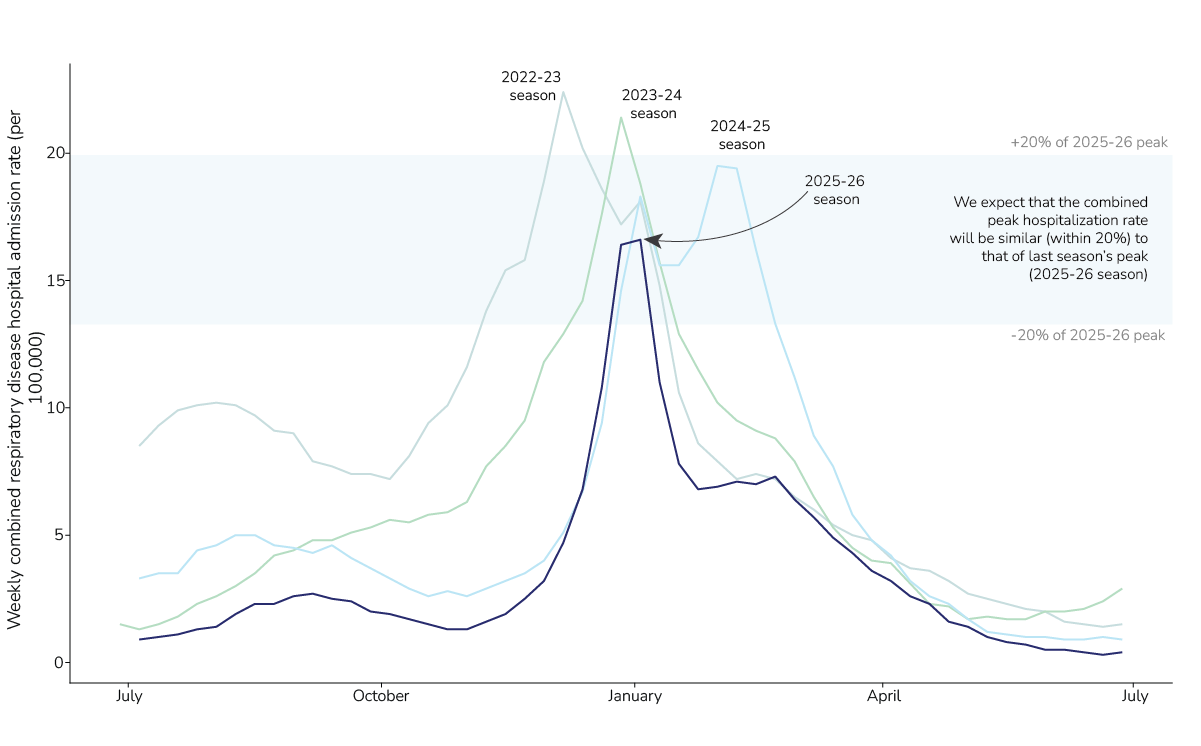
In considering what may occur during the 2026-2027 season, we note the following considerations for each disease:
- COVID-19: As of September 18, COVID-19 activity is elevated and increasing nationally, but hospitalizations remain low overall. Scenario modeling indicates that, assuming a variant with moderate immune escape propertiesA does not emerge, the peak weekly hospitalization rate due to COVID-19 during the 2026-2027 fall and winter season will be similar to the peak burden in previous years. See more details in the COVID-19 outlook below.
- Influenza: As of September 18, seasonal influenza activity is low and there is no evidence to indicate that a high severity season is more likely during the 2026-2027 respiratory disease season than observed historically. As of September 2026, influenza activity has been moderate, has peaked, and is declining in most Southern Hemisphere countries, where influenza activity typically occurs during April–September and sometimes lasts until October or November. See more details in the influenza outlook below.
- RSV: As of September 18, RSV disease activity is very low in most areas of the country. The peak hospitalization rate due to RSV disease during the 2025-2026 season was later than historic seasons. The reason that hospitalizations due to RSV disease peaked later than expected during the 2025-2026 season is uncertain. See more details in the RSV disease outlook below.
While this season's peak combined hospitalization rate is expected to be similar to that of last year, other outcomes remain possible. This uncertainty underscores the need to plan and prepare for the possibility of a higher peak, which could be driven by the following factors:
- Emergence of viruses with increased ability to evade existing population immunity, including:
- A new SARS-CoV-2 variant that is sufficiently different from recently circulating variants
- New mutations in a predominating influenza subtype that result in antigenic drift and reduced immunity from influenza vaccination or recent infection
- Increased viral severity: emergence of a new SARS-CoV-2 variant, or predominance of an influenza subtype, associated with increased clinical or seasonal severity
- Lower immunization uptake or effectiveness, including:
- Lower than expected uptake of the COVID-19 vaccine, influenza seasonal vaccine, or RSV disease immunizations
- Lower vaccine effectiveness against COVID-19–, influenza-, or RSV disease–associated hospitalizations than for the 2025-2026 immunizations
Predicting the precise magnitude and timing of peak activity for each disease, as well as how disease-specific timing might overlap, remain difficult. Experts agree that some level of overlap in peak hospitalization burden may occur. COVID-19 hospitalizations during the fall and winter typically have peaked in late December or early January nationally. Hospitalizations due to influenza have typically peaked between December and February nationally, but timing within this range is less predictable. The RSV disease national peak has typically occurred in late December or early January, although the national peak occurred later during the 2025-2026 season.
COVID-19 outlook
CDC expects that the peak weekly hospitalization rate due to COVID-19 for the 2026-2027 season will be similar to or lower than that of the 2025-2026 season, with moderate confidence, based on historical trends, expert opinion, and scenario modeling results. The emergence of a variant with moderate immune-escape properties this fall could contribute to a higher peak weekly COVID-19 hospitalization rate, according to scenario modeling results. Variants with high immune-escape properties have not emerged in recent years and thus are not considered here. Fall and winter COVID-19 hospitalization rates during the 2026-2027 season will depend on several factors, including:
- Summer 2026 activity: The timing and magnitude of COVID-19 activity during the summer at the national and regional levels may influence the timing and magnitude of COVID-19 activity during the fall and winter respiratory disease season.
- Emergence of new variants: If a SARS-CoV-2 variant emerges with moderate immune escape properties, higher transmission and hospitalization rates in the fall and winter may occur.
- Vaccination uptake and effectiveness: Lower vaccine uptake or reduced effectiveness may contribute to increased COVID-19 activity this fall and winter.
Since SARS-CoV-2 emerged in late 2019, hospitalizations due to COVID-19 have varied seasonally, with peaks occurring in both summer and winter months (Figure 2). Although peak hospitalization rates due to COVID-19 vary by state and region, the magnitude of national peak hospitalization rates due to COVID-19 during both summer and winter periods of increased activity has decreased over time.
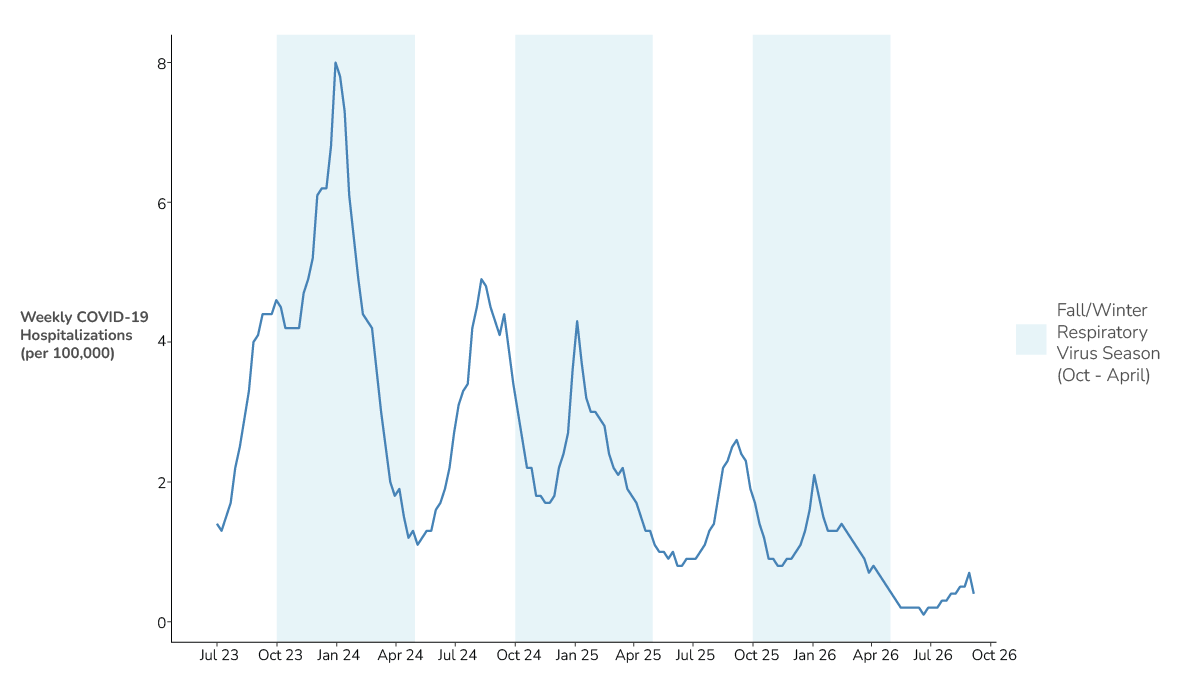
Scenario modeling can be used to assess what may occur during the fall and winter respiratory disease season. In our 2026 COVID-19 Summer Outlook, we assessed that in the absence of the emergence of a variant with moderate immune-escape properties, we expected only a modest increase in COVID-19 hospitalizations during summer 2026 in most HHS regions. As of September 21, no new variant with moderate immune escape properties has emerged. COVID-19 activity is elevated and increasing nationally, but hospitalizations remain low overall.
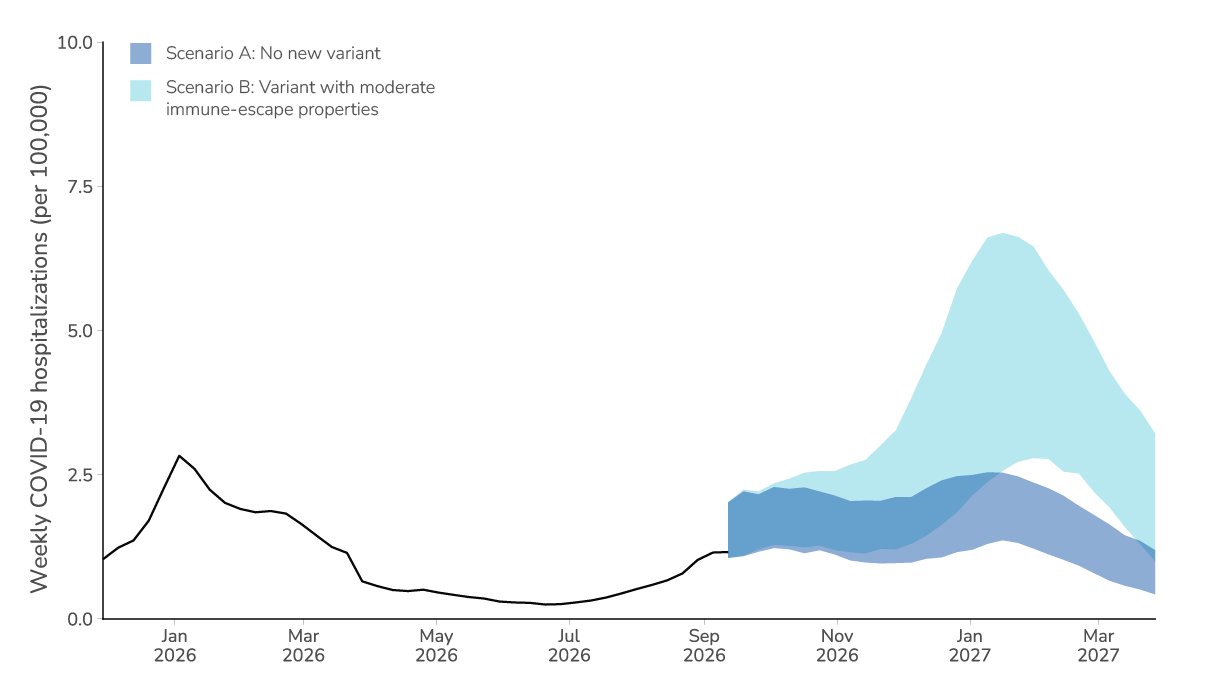
For the 2026-2027 fall and winter respiratory disease season, we developed two COVID-19 scenarios to evaluate how the coming season may unfold, based on the possible emergence of a variant with moderate immune-escape properties, similar to what was observed from variants that emerged in the United States in the past yearA (Figure 3). If such a variant does not emerge, modeling indicates that the peak weekly COVID-19 hospitalization rate during the respiratory disease season (October – May) would be between 1.4 and 2.5 hospitalizations per 100,000 (Scenario A) and would likely occur in early to mid-JanuaryB.
If a variant emerges during the fall and winter respiratory disease season that has moderate immune-escape properties (e.g., is different enough from recently circulating variants), modeling suggests a higher peak weekly COVID-19 hospitalization rate (2.8-6.7 hospitalizations per 100,000; Scenario B), likely occurring in late January 2027. Modeling results are consistent with the no-variant scenario in our 2026 COVID-19 Summer Outlook, which projected increases in COVID-19 hospitalizations through at least early September, and a peak hospitalization rate that is similar to that observed during the 2025-2026 season.
Regarding the relative likelihood of these two scenarios, currently no specific evidence exists to suggest a variant with moderate immune-escape properties will emerge this season. Two-thirds (65%) of experts who assessed whether such a variant will emerge this season indicated that this is unlikely to occur. Intermediate scenarios between A and B are both possible and may even be likely, for example due to the emergence of a variant that has lower immune-escape properties than the new variant considered in Scenario B. Experts assess that a peak hospitalization burden due to COVID-19 at the upper end of the range for Scenario B, while plausible, is relatively unlikely, compared to the lower end of the range for Scenario B.
Influenza outlook
CDC expects the severity of the 2026-2027 influenza season, based on the peak of influenza hospitalizations, will likely be classified as moderate across all ages, with low to moderate confidence, based on historical trends and expert opinion.
The 2025-2026 influenza season was classified as a moderate-severity season across all ages and as a high-severity season in children (ages 0-17 years). Currently, there is no evidence to indicate that a severe season is more likely during the 2026-2027 respiratory disease season than observed historically. However, past seasons have varied widely in the number of illnesses, hospitalizations, and deaths, and severity is difficult to predict before the season begins. Variations in severity from one season to the next depend in part on the subtypes circulating, population immunity to different subtypes, and vaccine effectiveness against circulating subtypes.
As of September 2026, influenza activity has been moderate, has peaked, and is declining in most Southern Hemisphere countries in South America and Southern Africa. Influenza activity is increasing in Australia (which provides most of the data for the Oceania region), though activity levels remain low. Influenza activity in the Southern Hemisphere does not always predict what will occur in the Northern Hemisphere. This is due in part to differences in the influenza viruses that may predominate in different parts of the world, as well as differences in population immunity between the Northern and Southern Hemispheres.
Vaccination is expected to play a key role in reducing influenza hospitalization burden this season. Influenza vaccines prevented an estimated 180,000 hospitalizations during the 2024-2025 season. Vaccination uptake and vaccine effectiveness may vary compared to past seasons.
RSV disease outlook
CDC expects the 2026-2027 peak weekly hospitalization rate across all age groups due to RSV disease will be similar (within 20%) to that of the 2025-2026 season, with moderate confidence, based on historical trends and expert opinion. RSV immunization products became available to protect both infants (monoclonal antibodies and maternal vaccination) and higher-risk adults (vaccination) in 2023. To prevent severe RSV disease in infants <8 months, either maternal RSV vaccination or immunization with a long-acting RSV monoclonal antibody is recommended. During the 2024-2025 season, RSV disease–associated hospitalization rates among infants aged <8 months in two surveillance networks were lower by 28% and 43% compared with RSV seasons before the COVID-19 pandemic. For adults, CDC recommends a single lifetime dose of RSV vaccine for all adults aged 75 years and older and adults aged 50-74 years with high-risk conditions. Adults who have received the vaccine since it became available in 2023 are still expected to have vaccine-derived immunity moving into the 2026-2027 season.
RSV disease historically has a consistent seasonality, with national-level hospitalizations generally peaking in late December or early January. The 2025-2026 season peaked later than usual, in the week ending February 21, 2026. The reasons hospitalizations due to RSV disease peaked later than usual during the 2025-2026 season are uncertain but may include:
- High levels of transmission in post-pandemic seasons, contributing to a higher level of population immunity to RSV during the 2025-2026 season.
- Changes in age group transmission dynamics due to the rollout of immunization products for infants.
- Other unknown behavioral or disease-specific factors that have not yet been identified.
The later peak during the 2025-2026 season may signal that there will also be a later peak in hospitalizations due to RSV disease during the upcoming season.
Key methods
This outlook is based on expert opinion and historical data for COVID-19, influenza, and RSV disease with the addition of scenario modeling for COVID-19. We have low to moderate combined confidence in our assessment, based on information availability and information gaps and assumptions.
This respiratory outlook incorporates expert opinion from 25 subject-matter experts specializing in COVID-19, influenza, and RSV disease epidemiology, infectious disease modeling, disease surveillance, and risk assessment methods. Experts answered a series of questions on the expected hospitalization burden posed by each disease, as well as on key drivers for a season with a higher peak hospitalization rate. Experts assigned confidence levels to their answers as a way of reflecting their uncertainty in their response. The results were used to inform this outlook. See our expert elicitation methods for further information on this process.
Scenario modeling explores longer-term hypothetical outcomes under different assumptions about the future. Our COVID-19 scenario modeling utilizes a transmission model with a compartmental modeling structure that takes into account population age structure, infection history, vaccination history, immunity waning status, and infecting strain. See our scenario modeling methods page for more technical details about the scenario model used in the outlook, and our Behind the Model page to learn more about how scenario models can be used to inform decision-making.
This page was last updated on this date. Updates may include minor edits, image changes, or other modifications to page content.
The information on this page was last reviewed by subject matter experts to ensure accuracy.
- Scenario B assumes that a variant is introduced with moderate immune-escape properties, similar to properties of XEC. The variant is introduced across projections with an introduction date that varies randomly between model runs, during September 16, 2026–December 15, 2026. This range is intended to capture uncertainty in when variant emergence might occur. Introductions of new variants in the model gradually increase over the 2 weeks prior to the sampled introduction date and decrease for the 2 weeks following the date.
- Hospitalizations reported through the National Healthcare Safety Network (NHSN) may underestimate the true hospital admissions burden. This could be due to decreases in testing for SARS-CoV-2 infection in hospitals or decreases in hospitals reporting to national surveillance systems. Modeling results are projected hospitalizations as reported to NHSN and are not necessarily projections of the true hospital admission burden.