



Highlights
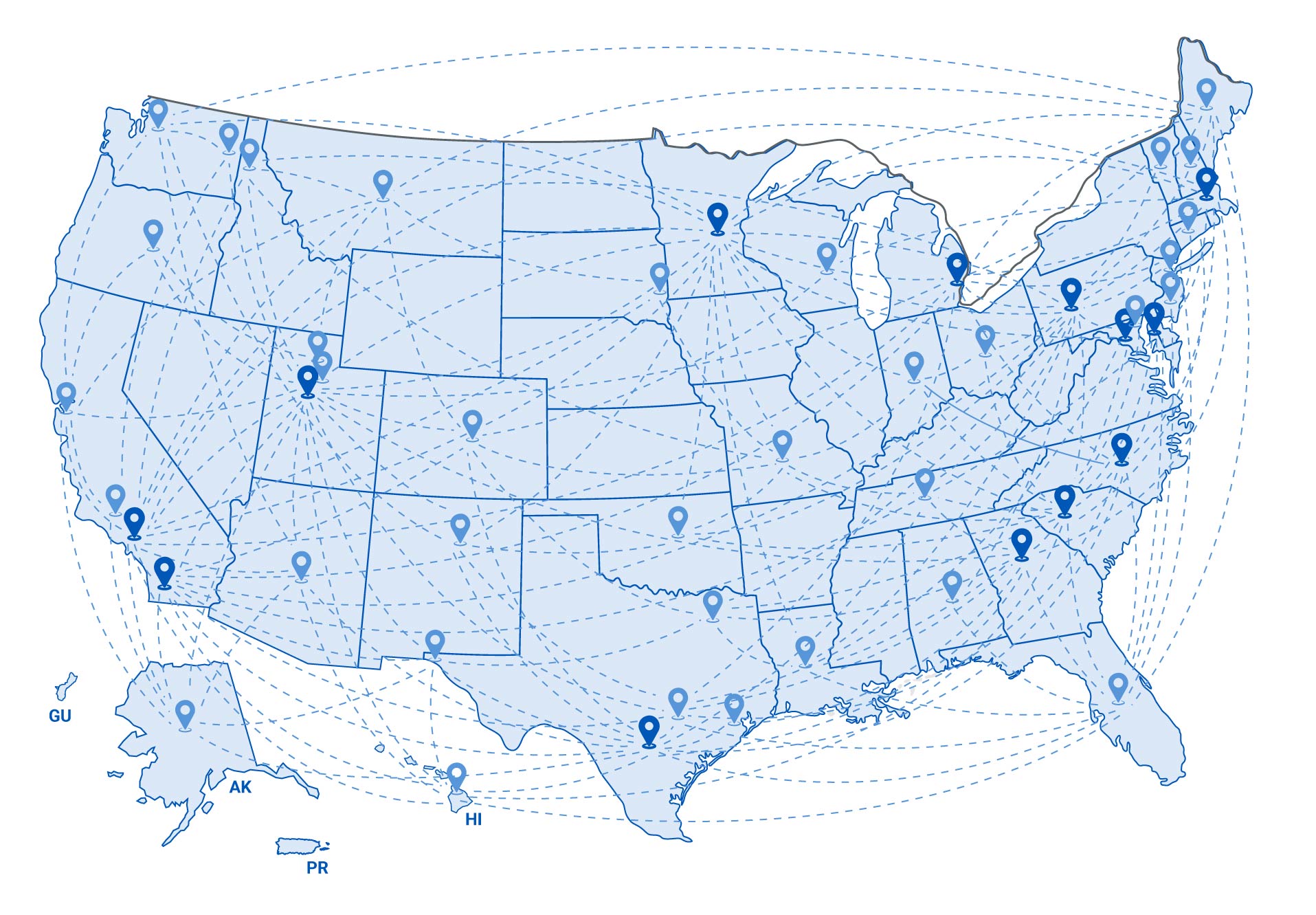
- Insight Net is a network of 180 partners across 30 states who develop tools to support state and local public health response.
- CFA funds Insight Net’s work, building capacity to identify and respond to infectious disease outbreaks before they have time to spread.
What does Insight Net do?
Outbreak response often starts at the local level. To ensure response readiness locally, in 2023, the Centers for Disease Control and Prevention's (CDC) Center for Forecasting and Outbreak Analytics (CFA) established Insight Net to build disease modeling capacity across the country. Insight Net partners rely on collaboration for innovation. They listen to what communities need, working side-by-side with state and local health departments. Then they develop technological solutions that simplify decision-making centered on local priorities, instead of prescribing solutions on a national scale. Together, the network and their partners implement forward-thinking outbreak solutions to drive better, more precise, action while preventing costly disruptions to the American way of life.
Who is included in the network?
The core of Insight Net is 13 partners, from across sectors, who are funded through the CFA's Centers for Outbreak Analytics and Disease Modeling cooperative agreement. This group of 13 collaborates with 180 additional state, local, tribal, private, public, and academic partners across 30 states, Puerto Rico, and Guam.
The network builds, tests, and employs tools that:
- Assess disease threats
- Forecast the trajectory of outbreaks where they begin
- Inform public health decision-making at the state and local level
Supporting disease modeling
Insight Net invests in transforming the country's disease forecasting, modeling, and simulation capacities by combining tools like machine learning and artificial intelligence with the best available technologies and science. To date, CDC has awarded more than $148 million to Insight Net partners through the cooperative agreement.
Insight Net partners are innovation hubs. In under two years, they have developed or adapted 155 tools for forecasting, modeling, and decision support to state and local health, and delivered 97 trainings to more than 1,000 participants. This work expands modeling literacy, scalability, and accessibility. Empowered by CFA, Insight Net is using infectious disease outbreak data to help drive more precise, life-saving decisions during public health emergencies.
Featured stories
Insight Net Stays Ahead of the Game for FIFA World Cup 2026™
Insight Net partners across the country coordinated a comprehensive, multi-site analytic effort to support public health preparedness during FIFA World Cup 2026™. Because strong health security requires a range of complementary tools and approaches, Insight Net partners worked together to assess the risk of disease importation, model how infectious diseases could spread in host cities, and strengthen early warning systems to help detect any unusual health events.
By combining simulations, disease modeling, and real-time surveillance, Insight Net helped public health agencies identify potential risks early and respond quickly during changing tournament conditions.
Learn more about Insight Net’s work during FIFA World Cup 2026™:
- Infectious Diseases World Cup Working Group: Infectious Disease Risk
- Atlantic Coast Center for Infectious Disease Dynamics and Analytics: Pathogen Risk Screening
- Epistorm: International Infectious Disease Importation Risk
- EpiENGAGE: TreeScan
Insight Net Partners Deliver Rapid, Local Support for Measles Outbreaks
When measles outbreaks emerged across the country in 2025, Insight Net centers partnered directly with state and local health departments to deliver timely, practical decision-support tools.
Work began in Texas, where epiENGAGE collaborated with Austin Public Health to build an interactive simulator that helped local schools understand the impact of vaccination during an outbreak. That simulator was then adapted and expanded by other Insight Net partners to meet the needs of their communities:
- Utah: Forecasting and Surveillance of Infectious Threats and Epidemics (ForeSITE) adapted the simulator to estimate the impact of quarantine on outbreak size.
- South Carolina: Disease Modeling and Analytics to Inform Outbreak Preparedness, Response, Intervention, Mitigation and Elimination (DMA-PRIME) customized the simulator to model potential outbreak trajectories in schools under different intervention scenarios.
Throughout the year, partners also developed additional resources to strengthen situational awareness and preparedness across the country:
- North Carolina and Minnesota: Atlantic Coast Center for Infectious Disease Dynamics and Analytics (ACCIDDA) and Midwest Analytics and Disease Modeling Center (MADMC) created interactive dashboards mapping measles, mumps, and rubella vaccination coverage to support public awareness.
- Michigan: Michigan Public Health Integrative Center for Outbreak Analytics and Modeling (MICOM) developed a dashboard with high-resolution vaccination data to support state and local decision-making.
- North America: Center for Outbreak Response Innovation (CORI) created response resources for health departments, including response templates, risk assessments, and a dashboard tracking measles cases and deaths.
Although each community faced unique outbreak challenges, Insight Net partners developed solutions tailored to local needs and shared lessons learned across the network, strengthening public health response efforts nationwide.
Funded partners
Carnegie Mellon University
Clemson University
Kaiser Permanente Southern California
Northeastern University
University of California, San Diego
University of Michigan
University of Minnesota
University of North Carolina, Chapel Hill
University of Texas, Austin
University of Utah
This page was last updated on this date. Updates may include minor edits, image changes, or other modifications to page content.
The information on this page was last reviewed by subject matter experts to ensure accuracy.