 An official website of the United States government


Acute Kidney Injury Among Patients with Drug Overdose–Involved Hospitalizations — United States, 2016–2025
Weekly / October 22, 2026 / 75(41);614–621
Sola Han, PharmD, PhD1; Fang Xu, PhD2; Hui Xie, PhD1; Gery Guy, PhD2; Meda E. Pavkov, MD, PhD1 (View author affiliations)
View suggested citationSummary
What is already known about this topic?
Acute kidney injury (AKI) occurs in approximately 20% of hospitalized adults and is associated with higher risk for long-term chronic kidney disease, kidney failure, and death. AKI can occur after a drug overdose, but national data on AKI in drug overdose–involved hospitalizations remain limited.
What is added by this report?
Analysis of 2016–2025 hospital discharge data found that AKI occurred in approximately one third of drug overdose–involved hospitalizations; of those, approximately two thirds involved a severe inpatient course. AKI incidence was higher with older age, but severe inpatient courses among AKI cases were lower with older age. Among patients with drug overdose–involved hospitalizations, AKI increased during 2016–2022 and decreased during 2022–2025.
What are the implications for public health practice?
Because the exposure is identifiable and potentially avoidable, some drug overdose–related AKI might be preventable. Clinician awareness and overdose prevention efforts can help reduce AKI and prevent long-term kidney complications.
Altmetric:
Abstract
Acute kidney injury (AKI) is a serious, often underrecognized complication among patients hospitalized for drug overdose. Although overdose mortality has recently declined in the United States, less is known about whether serious nonfatal complications, including AKI, have followed similar trends. Adjusted percentages of hospitalizations of patients with drug overdose and AKI were calculated using hospital discharge data during 2016–2025. The percentage with a severe inpatient course (i.e., acute dialysis, respiratory compromise, shock or hypotension, or in-hospital death) was also calculated. Among 1,297,847 drug overdose–involved hospitalizations, AKI was documented in 448,136 (34.5%). The percentage of patients with AKI was 28.2% among those aged ≤24 years, 37.4% among those aged ≥65 years, 29.4% among females, and 38.1% among males. AKI among patients with a drug overdose–involved hospitalization increased during 2016–2022 (annual percent change [APC] = 2.69%) and decreased during 2022–2025 (APC = −5.11%). Among patients with a drug overdose–involved hospitalization and AKI, 273,093 (60.9%) experienced a severe inpatient course, including 68.1% of persons aged ≤24 years, 56.1% of those aged ≥65 years, 61.9% of females, and 60.4% of males. The percentage of drug overdose–involved hospitalizations with a severe inpatient course increased during 2016–2023 (APC = 1.82%), before decreasing during 2023–2025 (APC = −2.89%). Disproportionately severe inpatient courses among younger patients, who might have more years of life at risk for developing chronic kidney disease or kidney failure after AKI, warrants continued attention to early kidney injury detection after drug overdose, postdischarge linkage to care, and overdose prevention through improved access to substance use treatment.
Introduction
Acute kidney injury (AKI) is a serious in-hospital complication occurring in approximately 20% of hospitalized adults and is associated with higher risk for chronic kidney disease (CKD), kidney failure, and death. In addition, AKI is associated with substantial health care costs, including an estimated $1,795 increase in cost per hospitalization compared with admissions without AKI, and $11,016 in additional costs per hospitalization when dialysis is required (1,2).
Traditional overdose surveillance has primarily focused on fatal overdoses and nonfatal overdose-related emergency department visits. Less is known about serious inpatient complications, including AKI, that might contribute to adverse longer-term health outcomes. Although AKI occurs across hospitalizations for a wide range of conditions, drug overdose–related AKI might warrant separate consideration because it typically follows an identifiable, potentially preventable exposure. Whereas many established risk factors for AKI, including older patient age and the presence of preexisting cardiovascular comorbidities, are not readily modifiable (1), the risk for drug overdose–related AKI might be mitigated through early recognition and reduction of substance exposure (3).
AKI can arise through various mechanisms after a drug overdose, including rhabdomyolysis, ischemic injury, and substance-specific nephrotoxicity, which vary by substance type (3). Although acute renal failure was reported in 33% of patients hospitalized for cocaine intoxication with rhabdomyolysis (4), national trends in coexisting AKI among drug overdose–involved hospitalizations, including demographic patterns and drug overdose AKI–associated inpatient severity, remain poorly characterized. Quantifying the prevalence of AKI among patients with a drug overdose–involved hospitalization and the percentage of these hospitalizations with a severe inpatient course could help identify groups at high risk for complications and guide the development and implementation of prevention and clinical management strategies aimed at reducing overdose-related AKI morbidity and health care costs. This report assessed trends in AKI among patients with drug overdose–involved hospitalizations during 2016–2025 and examined trends in severe inpatient courses among patients with drug overdose–involved hospitalizations and AKI.
Methods
Data Sources
The 2016–2025 hospital discharges recorded by the Premier Healthcare Database (PHD), a large hospital-based, all-payer, service-level database, were analyzed. PHD includes data from approximately 1,400 hospitals and health care systems, representing approximately 25% of annual U.S. inpatient admissions.
This analysis focused on selected substance-specific overdose hospitalizations involving opioids, cocaine, or psychostimulants, drug categories that are commonly involved in U.S. overdose deaths (5). A hospitalization for drug overdose* was defined as a patient admission with an International Classification of Diseases, Tenth Revision, Clinical Modification (ICD-10-CM) diagnosis code indicating opioid, cocaine, or psychostimulant poisoning in any diagnosis field and coded as present on admission. Among drug overdose–involved hospitalizations, those of patients with AKI† were identified by the presence of AKI in any diagnosis field. Among drug overdose–involved hospitalizations of patients with AKI, patients who received acute dialysis or experienced respiratory compromise, shock or hypotension, or who died while hospitalized were classified as having a severe inpatient course.§ Hospitalizations of patients with end-stage kidney disease or chronic dialysis dependence were excluded.
Statistical Analysis
Annual percentages of drug overdose–involved hospitalizations of patients with AKI were estimated. Among patients with an overdose-involved hospitalization and AKI, the percentages of hospitalizations in which patients experienced severe inpatient courses were also estimated. For both outcomes, 95% CIs were obtained from weighted multivariable logistic regression models adjusting for discharge year (categorical), age group, sex, race and ethnicity, CKD, heart failure, liver disease, diabetes, and type of drug involved in the overdose.¶ Estimates by age group and sex were derived from models with interactions between year and the respective subgroup, adjusting for the remaining covariates. Pooled 2016–2025 adjusted percentages were estimated overall and by age group and by sex using the same covariates but without year-by-subgroup interaction terms. Joinpoint regression (with a maximum of 1 joinpoint for 10 data points) was used to estimate annual percentage changes (APC). Inpatient projection weights provided by PHD were applied to generate national weighted estimates of hospitalizations, and variance estimation accounted for clustering at the hospital level. The unit of analysis was a hospitalization; therefore, an individual patient could contribute more than one hospitalization included, and patient characteristics such as age and sex were those documented for each hospitalization rather than for unique patients. Analyses were conducted using Azure Databricks (version 4.5.0 R, Microsoft Azure), and Joinpoint software (version 6.0.1; National Cancer Institute). This activity was reviewed by CDC, deemed not research, and conducted consistent with applicable federal law and CDC policy.**
Results
Percentage and Characteristics of Patients with AKI and Drug Overdose–Involved Hospitalizations
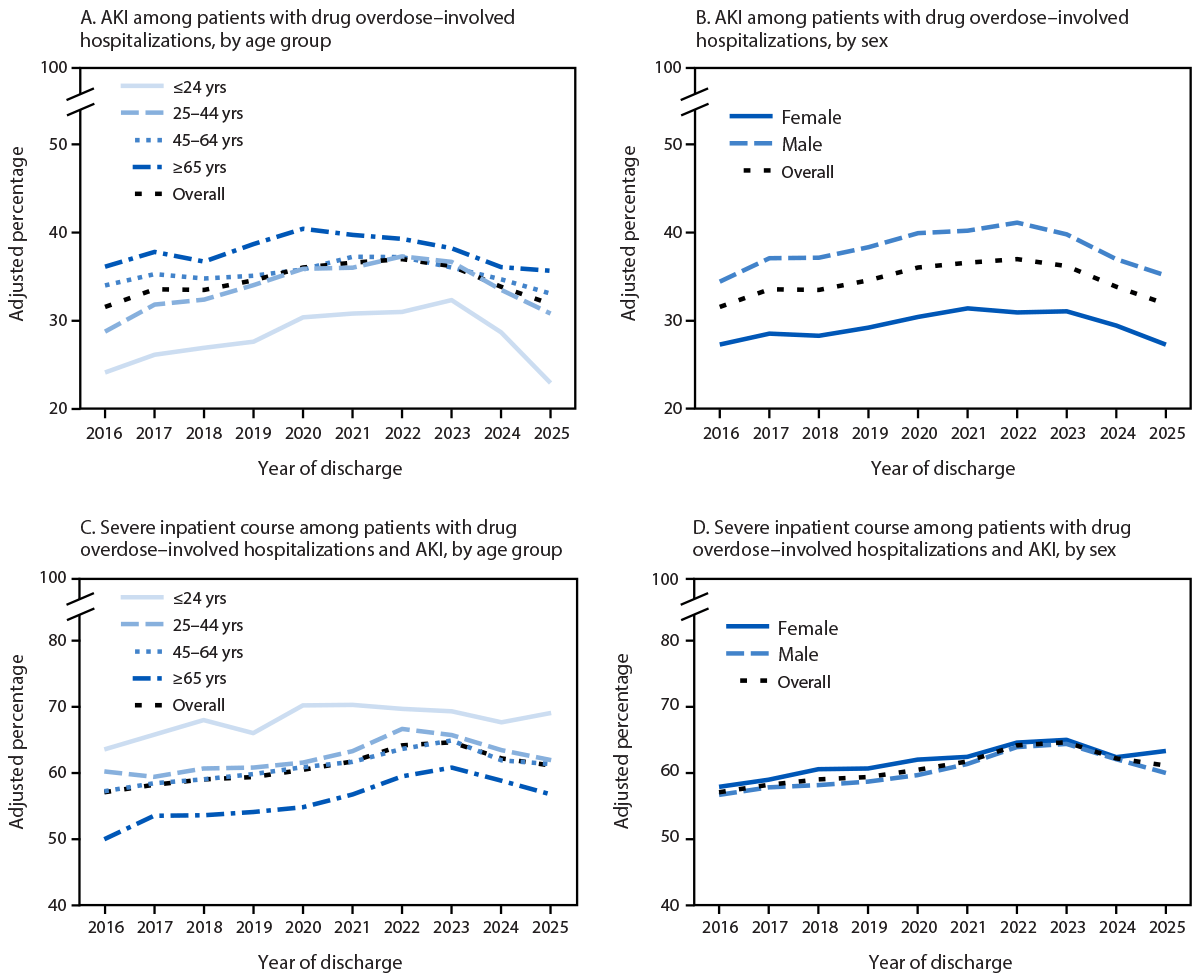
Overall, among 1,297,847 drug overdose–involved hospitalizations during 2016–2025, AKI was reported among 448,136 (34.5%) hospitalized patients. The percentage of drug overdose–involved hospitalizations with AKI was higher among older patients, ranging from 28.2% among patients aged ≤24 years to 37.4% among those aged ≥65 years (p-value <0.001) and was lower among females (29.4%) than among males (38.1%) (p-value <0.001) (Table 1). The percentage of patients with AKI increased during 2016–2022 (APC = 2.69%; 95% CI = 1.79%–3.65%), then decreased during 2022–2025 (APC = −5.11%) (Table 2).
Percentage and Characteristics of Severe Inpatient Course Among Patients with Drug Overdose–Involved AKI Hospitalizations
Among the 448,136 drug overdose–involved hospitalizations of patients with AKI during 2016–2025, 273,093 (60.9%) involved a severe inpatient course. This percentage was lower with older patient age, ranging from a high of 68.1% among patients aged ≤24 years to 56.1% among those aged ≥65 years (p-value <0.001) and was higher among females (61.9%) than among males (60.4%) (p-value <0.001) (Table 1). The percentage of a severe inpatient course increased during 2016–2023 (APC = 1.82%), then decreased during 2023–2025 (APC = −2.89%) (Table 2).
Temporal Trends by Demographic Subgroups
Temporal patterns across demographic subgroups generally followed the overall trend of an initial increase followed by a decline, with both APCs statistically significant in all subgroups (Figure), except that the decline in severe inpatient course was not statistically significant among patients aged ≤24 and 25–44 years or among females (Table 2). In age subgroup analyses, opposing age gradients were observed: whereas the percentage of drug overdose–involved hospitalizations with AKI was higher with older age, the percentage of those hospitalizations with AKI with a severe inpatient course was lower among older patients throughout the study period.
Discussion
This analysis characterized the percentage of drug overdose–involved hospitalizations with AKI and the severe inpatient course among patients with drug overdose–involved hospitalizations and AKI, highlighting kidney injury as an important component of overdose-related morbidity. The findings suggest that AKI occurrence in drug overdose–involved hospitalizations was higher among older patients and was more common among males, whereas severe inpatient course was more common among younger age groups and among females. Older age is a known risk factor for AKI (1), consistent with the finding that AKI occurred more frequently among older patients. In contrast, the percentage of patients with drug overdose–involved hospitalizations and AKI who experienced a severe inpatient course was highest among persons aged ≤24 years, which might partly reflect age-related differences in the types of illicit drugs involved across age groups. Among patients hospitalized with rhabdomyolysis, illicit drug use has been associated with younger age, more severe AKI, and the need for dialysis (6).
The percentage of males with drug overdose–involved hospitalizations who experienced AKI was consistently higher than that of females in this study population; this finding aligns with recent inpatient opioid overdose literature reporting lower adjusted odds of AKI among females (7). However, when AKI did occur, the percentage of severe inpatient course was slightly higher among females than among males. A previous study reported that female sex and the occurrence of shock or hypotension were risk factors for severe opioid-related adverse events among hospitalized patients (8); however, evidence of sex-specific patterns of hemodynamic instability in patients with drug overdose–related AKI remains limited.
Drug overdose–involved AKI should be considered both an acute inpatient complication and a marker of long-term risk for CKD. Because AKI is associated with subsequent CKD and kidney failure (1), the frequency of severe inpatient course among persons aged ≤24 years is particularly concerning, because younger patients might have more cumulative years at risk for the consequences of incomplete kidney recovery and CKD progression. Although the acute kidney injury work group clinical practice guideline (9) recommends kidney-function assessment within 3 months after AKI, national post-AKI follow-up among Medicare beneficiaries (13.6% in 2023), below the Healthy People 2030 target of 16.4% (Objective CKD-03). Linking drug overdose–involved hospitalizations of patients with AKI to postdischarge kidney function follow-up could help identify patients at risk for persistent kidney dysfunction and support early detection and management of CKD.
Limitations
The findings in this report are subject to at least four limitations. First, hospitals participating in PHD might differ from nonparticipating hospitals in urbanicity, hospital size, or overdose incidence, which could limit generalizability. Second, analyses were conducted at the hospitalization level and did not account for within-patient correlation, which could have underestimated SEs. Third, AKI was identified using diagnosis codes rather than laboratory-based criteria, which might have resulted in an underestimate of AKI occurrence. In addition, although certain underlying medical conditions potentially associated with AKI such as diabetes and heart disease were accounted for, not all relevant conditions were assessed. Information on intensive care unit admission and duration of hospitalization was not assessed; therefore, whether these factors might have contributed to the development of AKI or a severe hospital course could not be determined. Finally, selected diagnosis-code categories limited assessment of combinations, adulterants, dose, route, duration, exposure timing, and other drug classes with potential AKI relevance. In addition, expanded availability of naloxone, a medication that reverses opioid overdose since 2019, might have affected which opioid-involved overdose events resulted in hospitalization (10).
Implications for Public Health Practice
This study assessed national trends in AKI and AKI-related severe inpatient courses among drug overdose–involved hospitalizations across a broad range of real-world hospitalization settings. Public health efforts focusing on preventing drug overdose to reduce subsequent AKI risk, promoting early recognition of kidney injury, and improving continuity of kidney care after hospitalization might reduce the occurrence of drug overdose–involved AKI. Strategies might include expanding overdose prevention measures, such as naloxone distribution and substance use treatment access, encouraging timely medical evaluation for suspected drug overdose, and improving clinician awareness of AKI risk among patients with a drug overdose. Linking patients with AKI to postdischarge kidney follow-up care and substance use treatment services to prevent future drug overdoses and recurrent AKI could support long-term kidney health, particularly among younger patients who were more likely to have a severe inpatient course and might have more future years at risk for cumulative kidney consequences after AKI. In addition, because females experienced a higher percentage of severe inpatient outcomes despite a lower overall percentage of AKI, clinicians might consider monitoring female patients hospitalized for drug overdose for signs of severe complications, especially when AKI occurs.
Corresponding author: Sola Han, xpm3@cdc.gov.
1Division of Diabetes Translation, National Center for Chronic Disease Prevention and Health Promotion, CDC; 2Division of Overdose Prevention, National Center for Injury Prevention and Control, CDC.
All authors have completed and submitted the International Committee of Medical Journal Editors form for disclosure of potential conflicts of interest. No potential conflicts of interest were disclosed.
* Drug overdose–involved hospitalizations were defined using ICD-10-CM code T40.0–T40.4, T40.6 (opioid), T40.5 (cocaine), and T43.6 (psychostimulants). Subsequent encounters and sequelae were excluded based on the seventh character of ICD-10-CM diagnosis codes, as defined in the ICD-10-CM Official Guidelines for Coding and Reporting provided by the Centers for Medicare & Medicaid Services and the National Center for Health Statistics. This coding system is used to classify diagnoses and reasons for visits in all health care settings in the United States, and the seventh character indicates the phase of care (e.g., initial encounter, subsequent encounter, and sequela). All available intent codes (unintentional, intentional self-harm, assault, or undetermined) were included.
† AKI was defined using ICD-10-CM codes N17.0, N17.1, N17.2, N17.8, and N17.9.
§ Severe inpatient course included dialysis (International Classification of Diseases, Tenth Revision, Procedure Coding System [ICD-10-PCS]: 3E1M39Z, 5A1D00Z, 5A1D60Z, 5A1D70Z, 5A1D80Z, and 5A1D90Z; Current Procedural Terminology: 90935, 90937, 90945, and 90947), respiratory compromise (ICD-10-CM: J96.0, J96.2, and R09.2; ICD-10-PCS: 5A09457, 5A09557, 5A09458, 5A09558, 5A0945Z, 5A0955Z, 5A1945Z, and 5A1955Z), shock or hypotension (ICD-10-CM: I95.2, I95.9, R57.0, R57.1, R57.8, and R57.9), or in-hospital death (identified from discharge status).
¶ Type of drug involved in the overdose categories were mutually exclusive. Hospitalizations with one or more opioid codes and no cocaine or psychostimulant codes were classified as opioid; those with one or more cocaine codes and no opioid or psychostimulant codes were classified as cocaine; those with one or more psychostimulant codes and no opioid or cocaine codes were classified as psychostimulant. Hospitalizations with codes from two or more of these drug classes were classified as multiple drug classes.
** 45 C.F.R. part 46; 21 C.F.R. part 56; 42 U.S.C. Sect. 241(d), 5 U.S.C. Sect. 552a, 44 U.S.C. Sect. 3501 et seq.
References
- Hoste EAJ, Kellum JA, Selby NM, et al. Global epidemiology and outcomes of acute kidney injury. Nat Rev Nephrol 2018;14:607–25. https://doi.org/10.1038/s41581-018-0052-0 PMID:30135570
- Silver SA, Long J, Zheng Y, Chertow GM. Cost of acute kidney injury in hospitalized patients. J Hosp Med 2017;12:70–6. https://doi.org/10.12788/jhm.2683 PMID:28182800
- Yu C-H, Huang L-C, Su Y-J. Poisoning-induced acute kidney injury: a review. Medicina (Kaunas) 2024;60:1302. https://doi.org/10.3390/medicina60081302 PMID:39202583
- Roth D, Alarcón FJ, Fernandez JA, Preston RA, Bourgoignie JJ. Acute rhabdomyolysis associated with cocaine intoxication. N Engl J Med 1988;319:673–7. https://doi.org/10.1056/nejm198809153191103 PMID:3412385
- Garnett MF, Cisewski JA, Ahmad FB. Drugs most frequently involved in drug overdose deaths: United States, 2017–2023. Natl Vital Stat Rep 2026;1:1. https://doi.org/10.15620/cdc/174640 PMID:41805233
- Lau Hing Yim C, Wong EWW, Jellie LJ, Lim AKH. Illicit drug use and acute kidney injury in patients admitted to hospital with rhabdomyolysis. Intern Med J 2019;49:1285–92. https://doi.org/10.1111/imj.14266 PMID:30816623
- Quazi MA, Goyal A, Khan T, et al. Racial and sex disparities in inpatient outcomes of patients with opioid overdose: a nationwide analysis. Baylor Scott & White Health 2025;38(6):859–71. https://doi.org/10.1080/08998280.2025.2546764
- Herzig SJ, Stefan MS, Pekow PS, et al. Risk factors for severe opioid-related adverse events in a national cohort of medical hospitalizations. J Gen Intern Med 2020;35:538–45. https://doi.org/10.1007/s11606-019-05490-w PMID:31728892
- Kellum JA, Lameire N, Aspelin P, et al. Kidney disease: improving global outcomes (KDIGO) acute kidney injury work group. KDIGO clinical practice guideline for acute kidney injury. Kidney Int Suppl 2012;2:1–138. https://doi.org/10.1038/kisup.2012.1
- Rikard SM, Strahan AE, Schieber LZ, Guy GP Jr. Trends in naloxone dispensing from retail pharmacies in the US. JAMA 2024;332:165–7. https://doi.org/10.1001/jama.2024.8323 PMID:38869869

Abbreviations: AKI = acute kidney injury; CPT = Current Procedural Terminology; ICD-10-CM = International Classification of Diseases, Tenth Revision, Clinical Modification; ICD-10-PCS = International Classification of Diseases, Tenth Revision, Procedure Coding System; NA = not applicable; Ref = referent group.
* Drug overdose–involved hospitalizations were defined using ICD-10-CM code T40.0–T40.4, T40.6 (opioid), T40.5 (cocaine), and T43.6 (psychostimulants). Subsequent encounters and sequelae were excluded based on the seventh character of ICD-10-CM diagnosis codes, as defined in the ICD-10-CM Official Guidelines for Coding and Reporting provided by the Centers for Medicare & Medicaid Services and the National Center for Health Statistics. This coding system is used to classify diagnoses and reasons for visits in all health care settings in the United States, and the seventh character indicates the phase of care (e.g., initial encounter, subsequent encounter, and sequela). All available intent codes (unintentional, intentional self-harm, assault, or undetermined) were included.
† AKI was defined using ICD-10-CM codes N17.0, N17.1, N17.2, N17.8, and N17.9.
§ Severe inpatient course included dialysis (ICD-10-PCS: 3E1M39Z, 5A1D00Z, 5A1D60Z, 5A1D70Z, 5A1D80Z, and 5A1D90Z; CPT: 90935, 90937, 90945, and 90947), respiratory compromise (ICD-10-CM: J96.0, J96.2, and R09.2; ICD-10-PCS: 5A09457, 5A09557, 5A09458, 5A09558, 5A0945Z, 5A0955Z, 5A1945Z, and 5A1955Z), shock or hypotension (ICD-10-CM: I95.2, I95.9, R57.0, R57.1, R57.8, and R57.9), or in-hospital death (identified from discharge status). ICD-10-PCS is a seven-character alphanumeric medical coding system used to track and classify inpatient hospital procedures.
¶ For the AKI outcome, the denominator is drug overdose-involved hospitalizations. Overall and subgroup estimates were obtained from weighted multivariable logistic regression models adjusting for discharge year, age group, sex, race and ethnicity, presence of chronic kidney disease, heart failure, liver disease, diabetes, and type of drug involved in the overdose.
** For age group, p-values are from Wald t-tests comparing each age group with the Ref (age ≤24 years), with adjustment for multiple comparisons. For sex, p-values are from Wald t-tests comparing females with males.
†† For the severe inpatient course outcome, the denominator is patients with drug overdose–involved AKI hospitalizations. Overall and subgroup estimates were obtained from weighted multivariable logistic regression models adjusting for discharge year, age group, sex, race and ethnicity, presence of chronic kidney disease, heart failure, liver disease, diabetes, and type of drug involved in the overdose.
Abbreviations: AKI = acute kidney injury; APC = annual percent change; CPT = Current Procedural Terminology; ICD-10-CM = International Classification of Diseases, Tenth Revision, Clinical Modification; ICD-10-PCS = International Classification of Diseases, Tenth Revision, Procedure Coding System.
* Overall estimates were obtained from weighted multivariable logistic regression models adjusting for discharge year, age group, sex, race and ethnicity, presence of chronic kidney disease, heart failure, liver disease, diabetes, and type of drug involved in the overdose. Subgroup estimates were obtained from models with year-by-subgroup interaction, adjusted for remaining covariates.
† AKI was defined using ICD-10-CM codes N17.0, N17.1, N17.2, N17.8, and N17.9.
§ Severe inpatient course included dialysis (ICD-10-PCS: 3E1M39Z, 5A1D00Z, 5A1D60Z, 5A1D70Z, 5A1D80Z, and 5A1D90Z; CPT: 90935, 90937, 90945, and 90947), respiratory compromise (ICD-10-CM: J96.0, J96.2, and R09.2; ICD-10-PCS: 5A09457, 5A09557, 5A09458, 5A09558, 5A0945Z, 5A0955Z, 5A1945Z, and 5A1955Z), shock or hypotension (ICD-10-CM: I95.2, I95.9, R57.0, R57.1, R57.8, and R57.9), or in-hospital death (identified from discharge status). ICD-10-PCS is a seven-character alphanumeric medical coding system used to track and classify inpatient hospital procedures.
¶ Drug overdose–involved hospitalizations were defined using ICD-10-CM code T40.0–T40.4 and T40.6 (opioid), T40.5 (cocaine), and T43.6 (psychostimulants). Subsequent encounters and sequelae were excluded based on the seventh character of ICD-10-CM diagnosis codes, as defined in the ICD-10-CM Official Guidelines for Coding and Reporting provided by the Centers for Medicare & Medicaid Services and the National Center for Health Statistics. This coding system is used to classify diagnoses and reasons for visits in all healthcare settings in the United States, and the seventh character indicates the phase of care (e.g., initial encounter, subsequent encounter, and sequela). All available intent codes (unintentional, intentional self-harm, assault, or undetermined) were included.
** An APC was considered statistically significant if its 95% CI excluded zero.
 FIGURE. Adjusted percentages* of acute kidney injury† among patients with drug overdose–involved hospitalizations,§ by age group (A) and sex (B), and adjusted percentages of severe inpatient course¶ among patients with drug overdose–involved hospitalizations and acute kidney injury, by age group (C) and sex (D) — Premier Healthcare Database, United States, 2016–2025
Abbreviations: AKI = acute kidney injury; CPT = Current Procedural Terminology; ICD-10-CM = International Classification of Diseases, Tenth Revision, Clinical Modification; ICD-10-PCS = International Classification of Diseases, Tenth Revision, Procedure Coding System.
* Overall estimates were obtained from weighted multivariable logistic regression models adjusting for discharge year, age group, sex, race and ethnicity, presence of chronic kidney disease, heart failure, liver disease, diabetes, and type of drug involved in the overdose. Subgroup estimates were obtained from models with year-by-subgroup interaction, adjusted for remaining covariates.
† AKI was defined using ICD-10-CM codes N17.0, N17.1, N17.2, N17.8, and N17.9.
§ Drug overdose–involved hospitalizations were defined using ICD-10-CM code T40.0–T40.4 and T40.6 (opioid), T40.5 (cocaine), and T43.6 (psychostimulants). Subsequent encounters and sequelae were excluded based on the seventh character of ICD-10-CM diagnosis codes, as defined in the ICD-10-CM Official Guidelines for Coding and Reporting provided by the Centers for Medicare & Medicaid Services and the National Center for Health Statistics. This coding system is used to classify diagnoses and reasons for visits in all health care settings in the United States, and the seventh character indicates the phase of care (e.g., initial encounter, subsequent encounter, and sequela). All available intent codes (unintentional, intentional self-harm, assault, or undetermined) were included.
¶ Severe inpatient course included dialysis (ICD-10-PCS: 3E1M39Z, 5A1D00Z, 5A1D60Z, 5A1D70Z, 5A1D80Z, and 5A1D90Z; CPT: 90935, 90937, 90945, and 90947), respiratory compromise (ICD-10-CM: J96.0, J96.2, and R09.2; ICD-10-PCS: 5A09457, 5A09557, 5A09458, 5A09558, 5A0945Z, 5A0955Z, 5A1945Z, and 5A1955Z), shock or hypotension (ICD-10-CM: I95.2, I95.9, R57.0, R57.1, R57.8, and R57.9), or in-hospital death (identified from discharge status). ICD-10-PCS is a seven-character alphanumeric medical coding system used to track and classify inpatient hospital procedures.
Suggested citation for this article: Han S, Xu F, Xie H, Guy G, Pavkov ME. Acute Kidney Injury Among Patients with Drug Overdose–Involved Hospitalizations — United States, 2016–2025. MMWR Morb Mortal Wkly Rep 2026;75:614–621. DOI: http://dx.doi.org/10.15585/mmwr.mm7541a1.
MMWR and Morbidity and Mortality Weekly Report are service marks of the U.S. Department of Health and Human Services.
Use of trade names and commercial sources is for identification only and does not imply endorsement by the U.S. Department of
Health and Human Services.
References to non-CDC sites on the Internet are
provided as a service to MMWR readers and do not constitute or imply
endorsement of these organizations or their programs by CDC or the U.S.
Department of Health and Human Services. CDC is not responsible for the content
of pages found at these sites. URL addresses listed in MMWR were current as of
the date of publication.
All HTML versions of MMWR articles are generated from final proofs through an automated process. This conversion might result in character translation or format errors in the HTML version. Users are referred to the electronic PDF version (https://www.cdc.gov/mmwr) and/or the original MMWR paper copy for printable versions of official text, figures, and tables.
Questions or messages regarding errors in formatting should be addressed to mmwrq@cdc.gov.