 An official website of the United States government



Laboratory-Confirmed COVID-19 Among Adults Hospitalized with COVID-19–Like Illness with Infection-Induced or mRNA Vaccine-Induced SARS-CoV-2 Immunity — Nine States, January–September 2021
Weekly / November 5, 2021 / 70(44);1539–1544
On October 29, 2021, this report was posted online as an MMWR Early Release.
Catherine H. Bozio, PhD1; Shaun J. Grannis, MD2,3; Allison L. Naleway, PhD4; Toan C. Ong, PhD5; Kristen A. Butterfield, MPH6; Malini B. DeSilva, MD7; Karthik Natarajan, PhD8,9; Duck-Hye Yang, PhD6; Suchitra Rao, MBBS5; Nicola P. Klein, MD, PhD10; Stephanie A. Irving, MHS4; Brian E. Dixon, PhD2,11; Kristin Dascomb, MD, PhD12; I-Chia Liao, MPH13; Sue Reynolds, PhD1; Charlene McEvoy, MD7; Jungmi Han8; Sarah E. Reese, PhD6; Ned Lewis, MPH10; William F. Fadel, PhD2,11; Nancy Grisel, MPP12; Kempapura Murthy, MBBS13; Jill Ferdinands, PhD1; Anupam B. Kharbanda, MD14; Patrick K. Mitchell, ScD6; Kristin Goddard, MPH10; Peter J. Embi, MD3,15; Julie Arndorfer, MPH12; Chandni Raiyani, MPH13; Palak Patel, MBBS1; Elizabeth A. Rowley, DrPH6; Bruce Fireman, MA10; Nimish R. Valvi, DrPH, MBBS2; Eric P. Griggs, MPH1; Matthew E. Levy, PhD6; Ousseny Zerbo, PhD10; Rachael M. Porter, MPH1; Rebecca J. Birch, MPH6; Lenee Blanton, MPH1; Sarah W. Ball, ScD6; Andrea Steffens, MPH1; Natalie Olson, MPH1; Jeremiah Williams, MPH1; Monica Dickerson, MPH1; Meredith McMorrow, MD1; Stephanie J. Schrag, DPhil1; Jennifer R. Verani, MD1; Alicia M. Fry, MD1; Eduardo Azziz-Baumgartner, MD1; Michelle Barron, MD5; Manjusha Gaglani, MBBS13; Mark G. Thompson, PhD1; Edward Stenehjem, MD12 (View author affiliations)
View suggested citationSummary
What is already known about this topic?
Previous infection with SARS-CoV-2 or COVID-19 vaccination can provide immunity and protection against subsequent SARS-CoV-2 infection and illness.
What is added by this report?
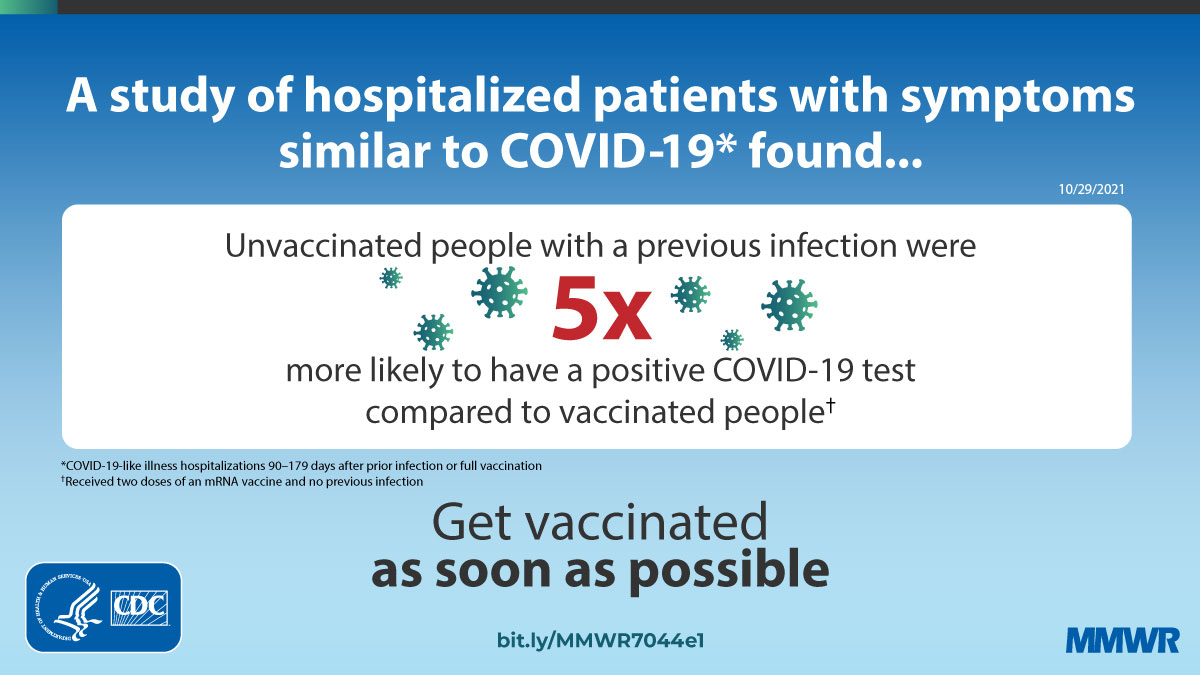
Among COVID-19–like illness hospitalizations among adults aged ≥18 years whose previous infection or vaccination occurred 90–179 days earlier, the adjusted odds of laboratory-confirmed COVID-19 among unvaccinated adults with previous SARS-CoV-2 infection were 5.49-fold higher than the odds among fully vaccinated recipients of an mRNA COVID-19 vaccine who had no previous documented infection (95% confidence interval = 2.75–10.99).
What are the implications for public health practice?
All eligible persons should be vaccinated against COVID-19 as soon as possible, including unvaccinated persons previously infected with SARS-CoV-2.
Altmetric:
Discussion
In this multistate analysis of hospitalizations for COVID-19–like illness among adults aged ≥18 years during January–September 2021 whose previous infection or vaccination occurred 90–179 days earlier, the adjusted odds of laboratory-confirmed COVID-19 were higher among unvaccinated and previously infected patients than among those who were fully vaccinated with 2 doses of an mRNA COVID-19 vaccine without previous documentation of a SARS-CoV-2 infection. Secondary analyses that did not adjust for time since infection or vaccination or adjusted time since infection or vaccination differently as well as before and during Delta variant predominance produced similar results. These findings are consistent with evidence that neutralizing antibody titers after receipt of 2 doses of mRNA COVID-19 vaccine are high (5,6); however, these findings differ from those of a retrospective records-based cohort study in Israel,†† which did not find higher protection for vaccinated adults compared with those with previous infection during a period of Delta variant circulation. This variation is possibly related to differences in the outcome of interest and restrictions on the timing of vaccination. The Israeli cohort study assessed any positive SARS-CoV-2 test result, whereas this study examined laboratory-confirmed COVID-19 among hospitalized patients. The Israeli cohort study also only examined vaccinations that had occurred 6 months earlier, so the benefit of more recent vaccination was not examined. This report focused on the early protection from infection-induced and vaccine-induced immunity, though it is possible that estimates could be affected by time. Understanding infection-induced and vaccine-induced immunity over time is important, particularly for future studies to consider.
In this study, the benefit of vaccination compared with infection without vaccination appeared to be higher for recipients of Moderna than Pfizer-BioNTech vaccine, which is consistent with a recent study that found higher vaccine effectiveness against COVID-19 hospitalizations for Moderna vaccine recipients than for Pfizer-BioNTech vaccine recipients (7). In this study, the protective effect of vaccination also trended higher for adults aged ≥65 years than for those aged 18–64 years. However, considering the limited data by both product type and age, additional research is needed on the relative protection of vaccination versus infection without vaccination across demographic groups and vaccine products, as well as vaccination in previously infected persons.
The findings in this report are subject to at least seven limitations. First, although this analysis was designed to compare two groups with different sources of immunity, patients might have been misclassified. If SARS-CoV-2 testing occurred outside of network partners’ medical facilities or if vaccinated persons are less likely to seek testing, some positive SARS-CoV-2 test results might have been missed and thus some patients classified as vaccinated and previously uninfected might also have been infected. In addition, despite the high specificity of COVID-19 vaccination status from these data sources, misclassification is possible. Second, the aOR could not be further stratified by time since infection or vaccination because of sparse data and limited ability to control for residual confounding that could be magnified within shorter intervals. The aOR that did not adjust for time might also be subject to residual confounding, particularly related to waning of both types of immunity. Third, selection bias might be possible if vaccination status influences likelihood of testing and if previous infection influences the likelihood of vaccination. Previous work from the VISION network did not identify systematic bias in testing by vaccination status, based on data through May 2021 (1). Fourth, residual confounding might exist because the study did not measure or adjust for behavioral differences between the comparison groups that could modify the risk of the outcome. Fifth, these results might not be generalizable to nonhospitalized patients who have different access to medical care or different health care–seeking behaviors, particularly outside of the nine states covered. Sixth, the statistical model incorporated the use of a weighted propensity score method which is subject to biases in estimates or standard errors if the propensity score model is misspecified. Numerous techniques were used to reduce potential suboptimal specification of the model, including but not limited to including a large set of covariates for machine learning estimation of propensity scores, including covariates in both regression and propensity models, ensuring large sample sizes and checking stability of weights, and conducting secondary analyses to assess robustness of results. Finally, the study assessed COVID-19 mRNA vaccines only; findings should not be generalized to the Janssen vaccine.
In this U.S.-based epidemiologic analysis of patients hospitalized with COVID-19–like illness whose previous infection or vaccination occurred 90–179 days earlier, vaccine-induced immunity was more protective than infection-induced immunity against laboratory-confirmed COVID-19, including during a period of Delta variant predominance. All eligible persons should be vaccinated against COVID-19 as soon as possible, including unvaccinated persons previously infected with SARS-CoV-2.
Acknowledgments
Jefferson Jones, Claire Midgley, Ruth Link-Gelles, Sharon Saydah, Jerome Tokars, Adi Gundlapalli, Natalie Thornburg, Abigail Shefer, John Kools, Erin Tromble, Melissa Carter, Cory Kokko, Stephanie Weaver, Kuzhali Muthumalaiappan, Bao-Ping Zhu, Roumiana Boneva, CDC.
Corresponding author: Catherine H. Bozio, ise7@cdc.gov.
1CDC COVID-19 Response Team; 2Center for Biomedical Informatics, Regenstrief Institute, Indianapolis, Indiana; 3Indiana University School of Medicine, Indianapolis, Indiana; 4Center for Health Research, Kaiser Permanente Northwest, Portland, Oregon; 5Department of Medicine, University of Colorado, Anschutz Medical Campus, Aurora, Colorado; 6Westat, Rockville, Maryland; 7HealthPartners Institute, Minneapolis, Minnesota; 8Department of Biomedical Informatics, Columbia University, New York, New York; 9New York Presbyterian Hospital, New York City, New York; 10Kaiser Permanente Vaccine Study Center, Kaiser Permanente Northern California, Oakland, California; 11Fairbanks School of Public Health, Indiana University, Indianapolis, Indiana; 12Division of Infectious Diseases and Clinical Epidemiology, Intermountain Healthcare, Salt Lake City, Utah; 13Baylor Scott & White Health, Texas A&M University College of Medicine, Temple, Texas; 14Children’s Minnesota, Minneapolis, Minnesota; 15Regenstrief Institute, Indianapolis, Indiana.
All authors have completed and submitted the International Committee of Medical Journal Editors form for disclosure of potential conflicts of interest. Stephanie A. Irving reports support from Westat to Kaiser Permanente Northwest Center for Health Research. Nicola P. Klein reports support from Pfizer to Kaiser Permanente, Northern California for COVID-19 vaccine clinical trials, and institutional support from Merck, GlaxoSmithKline, and Sanofi Pasteur outside the current study. Charlene McEvoy reports support from AstraZeneca to HealthPartners Institute for COVID-19 vaccine trials. Allison L. Naleway reports Pfizer Research funding to Kaiser Permanente Northwest for unrelated study of meningococcal B vaccine safety during pregnancy. Suchitra Rao reports grants from GlaxoSmithKline and Biofire Diagnostics. No other potential conflicts of interest were disclosed.
* Funded by CDC, the VISION Network includes Columbia University Irving Medical Center (New York), HealthPartners (Minnesota and Wisconsin), Intermountain Healthcare (Utah), Kaiser Permanente Northern California (California), Kaiser Permanente Northwest (Oregon and Washington), Regenstrief Institute (Indiana), and University of Colorado (Colorado).
† Medical events with a discharge code consistent with COVID-19–like illness were included. COVID-19–like illness diagnoses included acute respiratory illness (e.g., COVID-19, respiratory failure, or pneumonia) or related signs or symptoms (cough, fever, dyspnea, vomiting, or diarrhea) using diagnosis codes from the International Classification of Diseases, Ninth Revision and International Classification of Diseases, Tenth Revision.
§ Index test date was defined as the date of respiratory specimen collection associated with the most recent positive or negative SARS-CoV-2 test result before the hospitalization or the hospitalization date if testing only occurred after admission.
¶ https://www.cdc.gov/coronavirus/2019-ncov/php/invest-criteria.html
** 45 C.F.R. part 46; 21 C.F.R. part 56.
†† https://www.medrxiv.org/content/10.1101/2021.08.24.21262415v1
References
- Thompson MG, Stenehjem E, Grannis S, et al. Effectiveness of Covid-19 vaccines in ambulatory and inpatient care settings. N Engl J Med 2021;385:1355–71. https://doi.org/10.1056/NEJMoa2110362 PMID:34496194
- Grannis SJ, Rowley EA, Ong TC, et al.; VISION Network. Interim estimates of COVID-19 vaccine effectiveness against COVID-19–associated emergency department or urgent care clinical encounters and hospitalizations among adults during SARS-CoV-2 B.1.617.2 (Delta) variant predominance—nine states, June–August 2021. MMWR Morb Mortal Wkly Rep 2021;70:1291–3. https://doi.org/10.15585/mmwr.mm7037e2 PMID:34529642
- Månsson R, Joffe MM, Sun W, Hennessy S. On the estimation and use of propensity scores in case-control and case-cohort studies. Am J Epidemiol 2007;166:332–9. https://doi.org/10.1093/aje/kwm069 PMID:17504780
- Marshall SW. Power for tests of interaction: effect of raising the Type I error rate. Epidemiol Perspect Innov 2007;4:4. https://doi.org/10.1186/1742-5573-4-4 PMID:17578572
- Edara VV, Hudson WH, Xie X, Ahmed R, Suthar MS. Neutralizing antibodies against SARS-CoV-2 variants after infection and vaccination. JAMA 2021;325:1896–8. https://doi.org/10.1001/jama.2021.4388 PMID:33739374
- Edara VV, Pinsky BA, Suthar MS, et al. Infection and vaccine-induced neutralizing-antibody responses to the SARS-CoV-2 B.1.617 variants. N Engl J Med 2021;385:664–6. https://doi.org/10.1056/NEJMc2107799 PMID:34233096
- Self WH, Tenforde MW, Rhoads JP, et al.; IVY Network. Comparative effectiveness of Moderna, Pfizer-BioNTech, and Janssen (Johnson & Johnson) vaccines in preventing COVID-19 hospitalizations among adults without immunocompromising conditions—United States, March–August 2021. MMWR Morb Mortal Wkly Rep 2021;70:1337–43. https://doi.org/10.15585/mmwr.mm7038e1 PMID:34555004

Abbreviation: NA = not applicable.
* Medical events with a discharge code consistent with COVID-19–like illness were included. COVID-19–like illness diagnoses included acute respiratory illness (e.g., COVID-19, respiratory failure, or pneumonia) or related signs or symptoms (cough, fever, dyspnea, vomiting, or diarrhea) using diagnosis codes from the International Classification of Diseases, Ninth Revision and International Classification of Diseases, Tenth Revision. Clinician-ordered molecular assays (e.g., real-time reverse transcription–polymerase chain reaction) for SARS-CoV-2 occurring ≤14 days before to <72 hours after hospital admission were included.
† Index test date was defined as the date of respiratory specimen collection associated with the most recent positive or negative SARS-CoV-2 test result before the hospitalization or the hospitalization date if testing only occurred after the admission.
§ Full vaccination was defined as receipt of the second dose of Pfizer-BioNTech or Moderna mRNA vaccine ≥14 days before the index test date.
¶ Partners contributing hospitalizations were in California, Colorado, Indiana, Minnesota and Wisconsin, Oregon and Washington, Utah, and New York.
** In comparing characteristics between unvaccinated adults with a previous infection and fully vaccinated adults without a previous documented infection, a standardized mean or proportion difference >0.2 was considered noteworthy. After balancing characteristics that differed between the two comparison groups, the standardized mean or proportion differences were ≤0.06.
†† Other race includes Asian, Hawaiian or Other Pacific islander, American Indian or Alaskan Native, Other not listed, and multiple races.
Abbreviations: CI = confidence interval; ref = referent group.
* Odds ratios were adjusted for age, geographic region, calendar time (days since January 1, 2021), and local virus circulation (percentage of SARS-CoV-2 positive results from testing within the counties surrounding the facility on the date of the hospitalization) and balanced using inverse weights on characteristics that differed between the two groups (calculated separately for each odds ratio model) using facility characteristics, sociodemographic characteristics, and underlying medical conditions. Cardiovascular disease was also adjusted in the main model and in the model for Pfizer-BioNTech. Any likely immunosuppression was also included in the model for Moderna. Neuromuscular and respiratory conditions were also adjusted in the model for adults aged ≥65 years. Number of days since previous infection or completion of vaccination, instead of calendar time, was adjusted in the model within the stated secondary analysis.
† Full vaccination was defined as receipt of the second dose of Pfizer-BioNTech or Moderna mRNA vaccine ≥14 days before the index test date.
§ P-value from assessment of effect modification by mRNA product was 0.02.
¶ P-value for interaction term for exposure group by age group was 0.05.
** SARS-CoV-2 B.1.617.2 (Delta) variant predominance began on the date the Delta variant accounted for >50% of sequenced isolates in each medical facility’s state. https://doi.org/10.15585/mmwr.mm7037e2
Suggested citation for this article: Bozio CH, Grannis SJ, Naleway AL, et al. Laboratory-Confirmed COVID-19 Among Adults Hospitalized with COVID-19–Like Illness with Infection-Induced or mRNA Vaccine-Induced SARS-CoV-2 Immunity — Nine States, January–September 2021. MMWR Morb Mortal Wkly Rep 2021;70:1539–1544. DOI: http://dx.doi.org/10.15585/mmwr.mm7044e1.
MMWR and Morbidity and Mortality Weekly Report are service marks of the U.S. Department of Health and Human Services.
Use of trade names and commercial sources is for identification only and does not imply endorsement by the U.S. Department of
Health and Human Services.
References to non-CDC sites on the Internet are
provided as a service to MMWR readers and do not constitute or imply
endorsement of these organizations or their programs by CDC or the U.S.
Department of Health and Human Services. CDC is not responsible for the content
of pages found at these sites. URL addresses listed in MMWR were current as of
the date of publication.
All HTML versions of MMWR articles are generated from final proofs through an automated process. This conversion might result in character translation or format errors in the HTML version. Users are referred to the electronic PDF version (https://www.cdc.gov/mmwr) and/or the original MMWR paper copy for printable versions of official text, figures, and tables.
Questions or messages regarding errors in formatting should be addressed to mmwrq@cdc.gov.