



At a glance
As of May 29, 2026
CDC assessed the overall risk to the United States posed by the Andes virus outbreak associated with cruise ship travel for two populations.
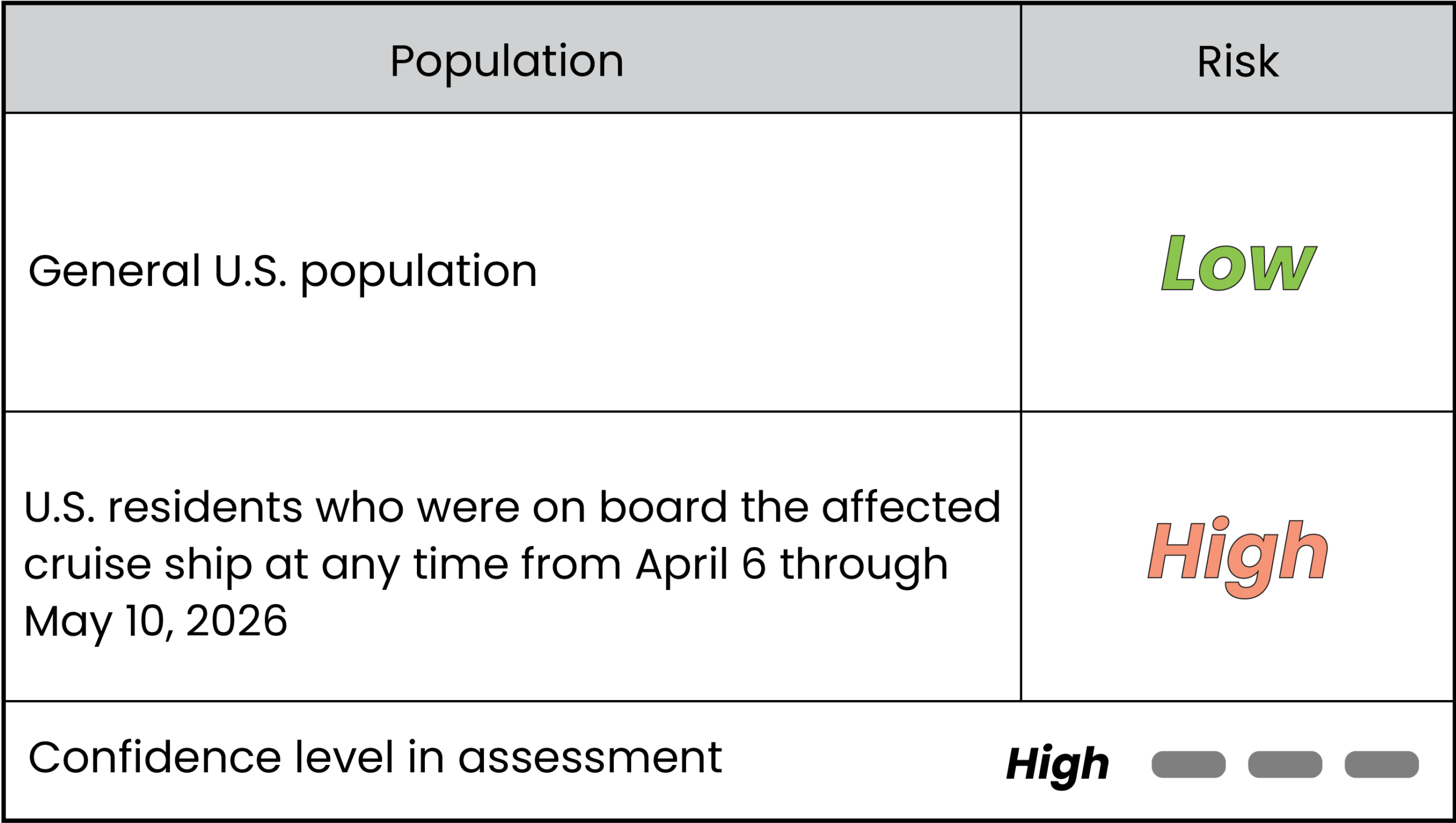
The purpose of this assessment is to provide time-sensitive health information about the risk to the United States from the Andes virus outbreak. Risk describes the potential public health implications of an outbreak for populations assessed. CDC assessed risk by considering both likelihood and impact of infection in each population (see Methods section). Both the likelihood and impact of infection are assessed at a population level. Likelihood of infection refers to the probability or extent of infection across the population of interest. The likelihood assessment considers factors such as the potential for transmission within or to the population, the number of people exposed or infected, population immunity against infection, and effectiveness or capacity of public health measures to limit spread. Impact of infection considers factors such as the severity of disease, level of population immunity against severe disease, availability of resources to limit impact, and necessary public health response resources.
We have high confidence in this assessment. The assessment relied on CDC subject-matter experts evaluating a range of evidence related to risk, including epidemiologic data from the outbreak and historical data on Andes virus epidemiology and clinical severity. We continue to monitor the situation and will update this risk assessment if new information warrants changes.
Risk assessment for the general U.S. population
Risk
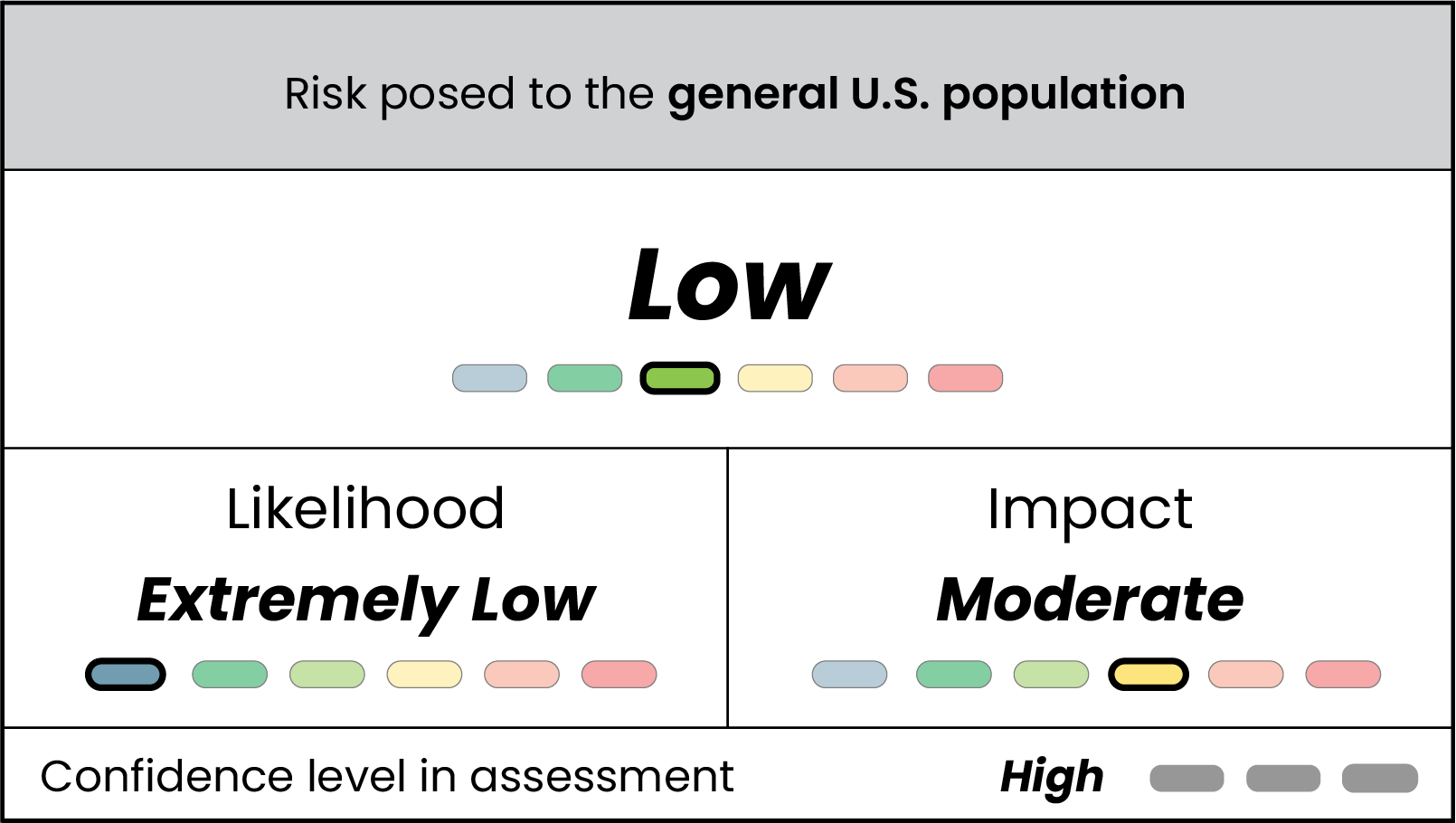
We assess the risk to the general U.S. population as low, with high confidence. Risk is assessed by considering the likelihood and impact of infection across the population (see Methods section).
Likelihood of infection for the general U.S. population
The likelihood of Andes virus infections occurring in the general U.S. population is extremely low. Factors that informed our assessment of likelihood include:
- There are very few cases overall associated with this outbreak, and the outbreak is unlikely to be widespread in the general U.S. population.
- As of May 19, 2026, there are no confirmed cases of Andes virus associated with this cluster in the United States.
- As of May 27, there have been 11 confirmed cases and an additional 2 probable cases reported in this outbreak overall.
- 26 U.S. residents were on board the ship at the time of the outbreak. All U.S. residents who have returned to the United States following departure from the ship are undergoing symptom monitoring by public health authorities, either at home or at a designated facility, with modified activities following CDC guidance.
- Some exposures were due to a traveler from the affected cruise ship who disembarked and boarded commercial flights while symptomatic and was later confirmed to have Andes virus infection. The individuals who were potentially exposed on these planes have been identified and are undergoing symptom monitoring by public health authorities
- Person-to-person transmission of Andes virus has been documented in previous outbreaks and is historically limited to close personal contacts of symptomatic cases, particularly in confined spaces.
- Members of the general U.S. population are extremely unlikely to be exposed to the virus.
- The incubation period of Andes virus is 4-42 days (median 18 days), so it remains possible that people who have already been exposed are incubating the virus and may become sick and infectious later.
- People who may have been exposed on an airplane or had other contact with a symptomatic traveler with Andes virus infection may have a higher likelihood of infection than the rest of the general U.S. population. There is currently no evidence to suggest that there is an increased likelihood of infection for other travelers (either domestic or international) due to this outbreak.
- People who remain in contact with those who were exposed on the affected cruise ship, particularly their household contacts, have a higher likelihood of infection than the rest of the general U.S. population if those exposed passengers develop symptomatic infection.
- The general U.S. population does not have existing immunity against Andes virus infection.
- The United States has a high capacity for implementing case identification, isolation, contact tracing, and infection prevention and control measures that are expected to stop a domestic Andes virus outbreak before it grows. If other cases are identified in the United States, limited spread is possible, but we expect control measures could be implemented rapidly.
Impact of infection for the general U.S. population
The impact of Andes virus infections occurring in the general U.S. population would be moderate. Factors that informed the assessment of impact include the following:
- Andes virus infections can lead to Hantavirus pulmonary syndrome, which is associated with a 30-40% case fatality rate in past outbreaks.
- The general U.S. population does not have immunity against severe illness or outcomes.
- There are no specific treatments or vaccines currently available for people infected with Andes virus. Rapid access to critical care services, including ECMO (extracorporeal membrane oxygenation), is critical to improving the odds of survival.
- U.S. resources are being used for public health response, and this outbreak has captured significant media attention and public interest.
- The situation is unlikely to cause disruption to normal activities for the general U.S. population.
Risk Assessment for U.S. residents who were on board the affected cruise ship at any time from April 6 through May 10, 2026
Risk
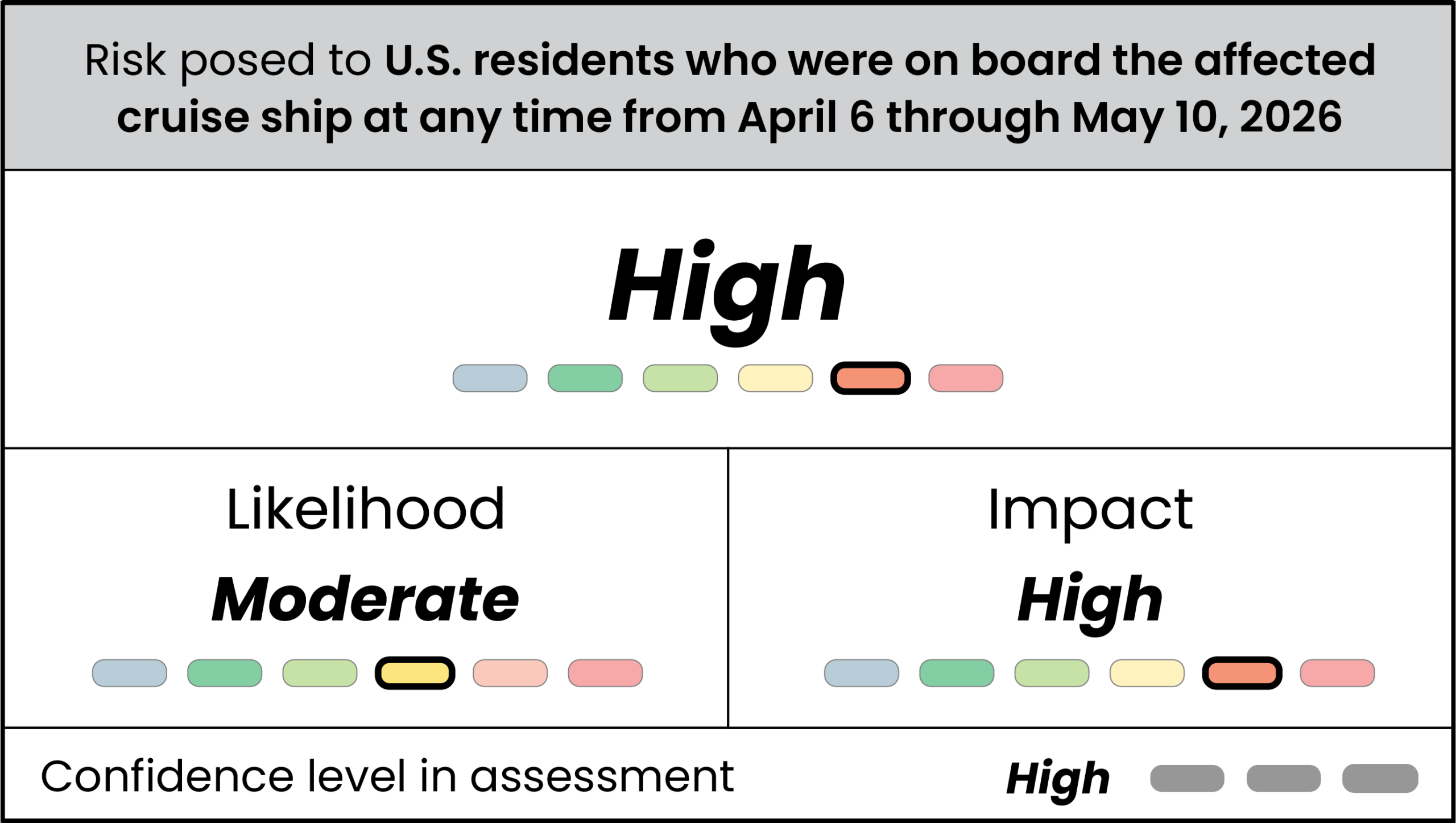
We assess the risk to U.S. residents who were on board the affected cruise ship at any time from April 6, 2026 (the date the first case-patient started having symptoms) through May 10, 2026 (the date these passengers disembarked the ship) as high, with high confidence.
Risk is assessed by considering the likelihood and impact of infection across the population of U.S. residents who were on board the affected cruise ship (see Methods section).
Likelihood of infection for U.S. residents who were on board the affected cruise ship at any time from April 6 through May 10, 2026
The likelihood of Andes virus infections occurring among people with a history of travel on the affected cruise ship during the time that the virus was spreading is moderate. Factors that informed our assessment of likelihood include:
- While person-to-person transmission rates have been low in previous outbreaks of Andes virus (approximately 5% in households), person-to-person transmission is most likely in situations where people are sharing close quarters, as they were on this cruise ship. Because of the setting, the likelihood of infection for those who were on board at the time of the outbreak is higher than that of the general U.S. population.
- As of May 27, 2026, there have been 11 confirmed cases and an additional 2 probable cases, all of which were in travelers who were on board the affected cruise ship during the cruise at some point between April 6, and May 10, 2026.
- The incubation period for Andes virus ranges from 4-42 days, so potentially exposed travelers are still within this period and could become ill and infectious in the coming weeks. The 42-day symptom monitoring period will end on June 21.
- Potentially exposed travelers are in contact with public health agencies and are being monitored for symptom onset. If any more potentially exposed travelers do become ill, control measures are expected to be implemented rapidly.
Impact of infection for U.S. residents who were on board the affected cruise ship at any time from April 6 through May 10, 2026
The impact of Andes virus infections occurring among potentially exposed U.S. residents would be high. Factors that informed the assessment of impact include the following:
- Andes virus infections can lead to Hantavirus pulmonary syndrome, which is associated with a 30-40% case fatality rate.
- This population does not have immunity against severe illness or outcomes. There is widespread access to care in the United States and symptomatic individuals who were exposed to Andes virus are expected to receive supportive care to reduce the likelihood of severe illness, hospitalization, or death.
- There are no specific treatments or vaccines currently available for people infected with Andes virus. Rapid access to critical care services, including ECMO, is important for improving the odds of survival. The U.S. government and state and local health departments are coordinating to ensure that each individual with exposure during travel is monitoring symptoms and has access to the necessary medical services should they develop symptoms.
- Individuals in this population are likely to experience substantial disruption to their day-to-day lives. The CDC has recommended monitoring by public health authorities, either at home or in a designated facility, with modified activities for 42 days following their date of disembarkation from the ship.
Key uncertainties
We have high confidence in this assessment.
- It is uncertain how many of the U.S. passengers who returned from the cruise ship may develop symptoms during their monitoring period.
- There is uncertainty in the level of exposure for travelers who were on the affected cruise ship during the outbreak. Person-to-person transmission of Andes virus is most likely among very close contacts or within confined spaces, which may apply to a large portion of the passengers who were on board the cruise ship.
- There is uncertainty in the frequency of person-to-person transmission for Andes virus due to a limited number of previous outbreak investigations. However, the evidence that is available suggests that it is low.
Factors that could change this assessment
We continue to monitor factors that could change our risk assessment, including:
- Detection of cases among individuals who did not travel on the affected cruise ship during the time of the outbreak, April 6 through May 10, 2026.
- So far, all cases associated with this outbreak have been among individuals who were exposed on the ship. Evidence of transmission in other settings, such as airplanes, would not necessarily be unexpected and could lead us to update this assessment. Air contact travel assessments and contact monitoring are in progress.
- Evidence of asymptomatic or pre-symptomatic transmission in this outbreak. In past outbreaks of Andes virus, person-to-person transmission has only occurred when individuals have had symptoms.
Background and Methods
On May 2, an outbreak of what has been confirmed to be Andes virus was declared in association with a multinational cruise that had left Argentina on April 1, 2026. Passengers who are U.S. residents were evacuated on May 10, 2026, in the Canary Islands. So far, there have been thirteen confirmed or probable cases, including three deaths. CDC was informed through IHR reporting that there were 26 U.S. residents aboard the cruise when it originally left Argentina. Seven U.S. residents left the cruise ship in late April and are self-monitoring at home in coordination with state and local public health departments, and eighteen U.S. residents were returned directly from the ship on May 10 and are undergoing monitoring and care by the U.S. government in a designated facility.
Andes virus is a type of hantavirus spread by rodents in South America and, less commonly, by other infected people. The rodents that carry Andes virus have not been found in the United States. Andes virus, like other hantaviruses, can cause a severe respiratory disease in people, called hantavirus pulmonary syndrome (HPS). Andes virus is the only type of hantavirus that is known to spread person-to-person. This spread is usually limited to people who have close contact with a symptomatic infected person. This includes direct physical contact, prolonged time spent in close or enclosed spaces, and exposure to the sick person's body fluids.
CDC subject-matter experts specializing in risk assessment methods, infectious disease modeling, and Andes virus epidemiology collaborated to develop this rapid assessment. Experts convened in May 2026 to discuss the need for an assessment examining the risks posed by the Andes virus outbreak to the United States, key evidence related to the current outbreak, and specific populations to include in the assessment. To conduct this assessment, experts considered evidence including epidemiologic data for the current Andes virus outbreak, information about exposed U.S. travelers, and historical data on Andes virus outbreaks.
Overall risk was estimated by combining the likelihood of infection and the impact of the disease. For example, low likelihood of infection combined with high impact of disease would result in moderate risk. The likelihood of infection is assessed for two populations: the general U.S. population and individuals with history of travel on the affected cruise ship during the time that the virus was spreading or their contacts. The likelihood of infection depends on the likelihood of exposure, infectiousness of the disease, and susceptibility of the population. The impact of infection considers several factors affecting the consequences of infection in the population, including the severity of disease, level of population immunity, availability of treatments, and public health resources needed to respond to an outbreak. A degree of confidence was assigned to each level of the assessment, taking into account the quality, extent, and corroboration of available evidence.
For more details on our methods, please see our rapid risk assessment methods webpage.