Public Health Professionals
The following Web pages offer information about public health issues regarding asthma.
Strategies and Guidance
Addressing Asthma in Homes [PDF – 2 MB]
This document provides a compilation of information and resources for implementing asthma programs in homes.
Home Characteristics and Asthma Triggers – Checklist for Home Visitors [PDF – 930 KB] | Spanish [PDF – 1,018 KB]
This checklist, developed by CDC, EPA, and HUD, guides home visitors in identifying environmental asthma triggers most commonly found in homes. It includes sections on the building, home interior, and room interior and provides low-cost action steps for remediation. Print-only Version (PDF) Checklist
Home Characteristics and Asthma Triggers – Training for Home Visitors
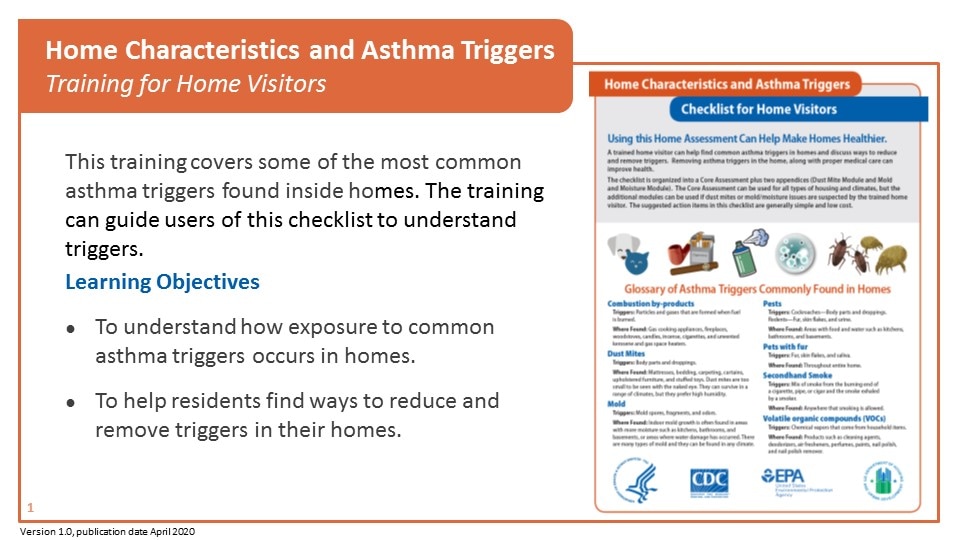
This training covers some of the most common asthma triggers found inside homes. This training supplements information in the Home Characteristics and Asthma Triggers: Assessment Checklist for Home Visitors. The Centers for Disease Control and Prevention (CDC), the Environmental Protection Agency (EPA), and the U.S. Department of Housing and Urban Development (HUD) developed the checklist. By completing this training, you will be able to: understand how exposure to common asthma triggers occurs in homes, and help residents find ways to identify, reduce, and remove triggers in their homes. This training complements the existing Checklist: https://www.cdc.gov/asthma/pdfs/home_assess_checklist_P.pdf“.
Powerpoint audio file [PPTX – 93 MB] | Powerpoint (no audio) [PPTX – 15.6 MB]
Addressing Asthma in Schools [PDF – 6MB]
This document provides a compilation of information and resources for implementing asthma programs in schools.
EXHALE Technical Package [PDF – 760 KB]
The EXHALE technical package represents a group of strategies, which, based on the best available evidence, can improve asthma control and reduce health care costs. It is intended as a resource to inform decision-making in communities, organizations, and states.
Home-based Multi-trigger, Multi-component Environmental Interventions
Interventions that target a wide variety of asthma triggers through home visits are beneficial in improving asthma outcomes. CDC scientists and the Task Force on Community Preventive Services systematically reviewed the evidence of effectiveness of home-based multi-trigger multi-component environmental interventions in improving asthma-related morbidity. Findings from this review indicate that home-based multi-trigger, multi-component, interventions with an environmental focus are effective in improving overall quality of life and productivity in children with asthma.
Controlling Asthma in American Cities Project
CDC issued findings on tailored strategies that help individuals and communities control asthma. The findings of the Controlling Asthma in American Cities Project (CAACP) can guide not only asthma-control programs, but also other comprehensive, community-based efforts. The publication, “It Takes a Community: Controlling Asthma in American Cities”External was published as a special edition of the February 2011 issue of the Journal of Urban Health.
CAACP provided funding to seven inner-city sites to support the translation of scientific advances in the treatment of asthma into innovative, comprehensive approaches to improve asthma control among urban children up to 18 years of age in underserved communities with a high asthma burden.
Program Evaluation
On this page you will find resources for planning and implementing program evaluation including the CDC National Asthma Control Program’s Learning & Growing through Evaluation: State Asthma Program Evaluation Guide (May 2010), CDC Evaluation Working Group—Framework for Program Evaluation, and Introduction to Program Evaluation for Public Health Programs: A Self-Study Guide (August 2005).
Guide for State Health Agencies in the Development of Asthma Programs [PDF – 2.2 MB] [published December 2003]
A 35-page guide to assist asthma program staff in state health departments to develop and implement asthma control programs.
Review and Selection of Core Asthma Quality Measures [PDF – 327 KB]
This document describes a core set of evidence-based measures that drive improved asthma outcomes. Authors: Beavers S, Thaker K, Herman E (CDC National Asthma Control Program).

CDC Resources
Allergy Testing for Persons with Asthma [PDF – 96 KB]
This fact sheet discusses how allergies affect individuals with asthma and allergy testing.
Asthma and Inhalant Allergens [PPT – 4 MB]
This slide presentation describes the process through which inhalant allergens can affect individuals with asthma; describes the types of inhalant allergens that can affect individuals with asthma; reviews NAEPP recommendations for the evaluation of inhalant allergens for persons with asthma, and reviews NAEPP recommendations for the environmental control of inhalant allergens for individuals with asthma found to be sensitive to inhalant allergens.
Podcast Series: Asthma Community Network – Conversations for Advancing Action
This podcast series explores best practices for reducing the impact of asthma, especially in underserved communities. Hear from people who have successfully developed asthma management programs that have improved health outcomes in their communities. Learn about their effective health delivery systems; strategies for addressing environmental triggers; key partnerships; and the tools and resources they use to achieve outstanding results.
Know How to Use Your Asthma Inhaler
CDC’s National Asthma Control Program developed this set of videos to help public health professionals explain proper inhaler techniques to people with asthma and to their families and caregivers. These step-by-step instructions are presented in English and in Spanish. Use the videos at your office and provide the website address so that more people are able to control their asthma.
Asthma: A Presentation of Asthma Management and Prevention
(Slide Presentation and Speaker Notes)
This slide presentation depicts the pathophysiology of asthma; prevalence, mortality, and morbidity measures at the national level; risk factors; medical management; and the public health response needed to successfully fight asthma.
National Environmental Public Health Tracking Network
Asthma prevalence data among adults and children in every state can also be viewed through the Tracking Network. Your search results can be displayed in dynamic, customizable map, chart, and table views. You can also print and email your results and export the data into CSV files for further analysis.
CDC Office of Genomics and Precision Public Health
The mission of the Office of Genomics and Precision Public Health is to integrate advances in genomics and precision health into public health research, policy, and programs.
Quality Measures Summary [PDF – 613 KB]
Quality measures are tools that help measure or quantify healthcare processes, outcomes, patient perceptions, organizational structure, and systems and are associated with the ability to provide high-quality health care.
American Sign Language Video – ‘Information About Asthma’
Right-click to download .wmv fileCdc-media(WMV – 15:26)
This American Sign Language (ASL) film, produced by the CDC and the Deaf Wellness Center at the University of Rochester Medical Center, discusses how to manage asthma to help prevent attacks or decrease the overall health effects of this disease. Listen to/Watch this Video (ASX – 15:26)
Government Departments, Agencies, and Resources
Agency for Healthcare Research and Quality: Characteristics of Existing Asthma Self-Management Education
This technical brief identifies the components that comprise asthma self-management education (AS-ME) packages used in the United States, and examines, compares, and organizes their key characteristics and available research to enable a better understanding of current practice and future needs.
Agency for Healthcare Research and Quality: Impact of Community Health Worker Certification on Workforce and Service Delivery for Asthma and Other Selected Chronic Diseases
This report explores and describes the state of the evidence on community health worker certification and its relationship with community health worker outcomes (such as recruitment, retention, and employment stability) and outcomes for people with asthma and other selected chronic illnesses.
Progress Reviews for Healthy People 2020
Healthy People 2020 Progress Reviews are intended to provide the Assistant Secretary for Health, senior Health and Human Services (HHS) officials, Healthy People 2020 stakeholders, and the public with information and data on the current status of objectives within each of the Healthy People 2020 Topic Areas.
National Heart, Lung, and Blood Institute (NHLBI)
National Asthma Education and Prevention Program (NAEPP)
The National Asthma Education and Prevention Program works with other groups, including major medical associations, voluntary health organizations, and community programs, to educate patients, health professionals, and the public. This site contains information about the program, educational resources, and the Expert Panel Report 3 (EPR3): Guidelines for the Diagnosis and Management of Asthma.
National Institute of Allergy & Infectious Diseases (NIAID)
This site provides support for scientists conducting research aimed at developing better ways to diagnose, treat, and prevent asthma.
National Institute of Environmental Health Sciences (NIEHS)
This institute coordinates and supports research on environmental health sciences and provides resources.
National Library of Medicine (NLM)
The National Library of Medicine, the largest online medical library, provides health information, library services, research programs, and general information related to topics such as asthma.
U.S. Environmental Protection Agency (EPA)—Asthma Page
EPA informs people about the environment and develops and enforces regulations about the environment. Its mission is to protect human health and the environment. Visit this Web site to learn about EPA’s Asthma Education Campaigns to promote asthma awareness in your community and the EPA National Environmental Leadership Awards.
Other U.S. Organizations and Resources
American Academy of Pediatrics
This site offers information to help you learn more about childhood asthma and allergies.
Alliance of Community Health Plans (ACHP)
This organization works with medical directors, quality improvement staff, and other health plan officials to improve the health care system and the lives of people in the communities they serve. The site provides background information about the intervention “Asthma Intervention for Inter-City Children.”
Allies Against Asthma (Allies)
Allies Against Asthma, a program of the Robert Woods Johnson Foundation, was a national initiative to improve asthma control for children and adolescents. This site provides tools and resources that may be useful to other asthma coalitions and programs addressing asthma
Association of State and Territorial Health Officials (ASTHO)
This organization formulates and influences public health policy to ensure excellence in state-based public health practice.
Asthma Care for Adults
Interactive curriculum to help improve adult asthma care from the Asthma and Allergy Foundation of America (AAFA).
Asthma Community Network
EPA supports this network in partnership with Allies Against Asthma, a program of the Robert Wood Johnson Foundation. It provides community-based asthma programs with a platform for real-time learning that can drive ongoing improvement of asthma care.
- Resource Bank
Find valuable asthma-related materials and resources to assist your program or coalition. - Webinar Series
Learn knowledge and information from leading experts and asthma-management program leaders from across the country.
Center for Health Care Strategies, Inc. (CHCS)
This site provides information about advancing Medicaid and public health adoption of evidence-based prevention strategies.
Institute of Medicine (IOM)
Clearing the Air: Asthma and Indoor Air Exposure—Executive Summary is a book that contains information about the role that indoor air pollution plays in asthma causation, prevalence, triggering, and severity.
National Board for Respiratory Care
The National Asthma Educator Certification Board promotes optimal asthma management and quality of life among individuals with asthma, their families and communities by advancing excellence in asthma education through the Certified Asthma Educator process.
