Key points
- St. Louis encephalitis is caused by a virus primarily spread to people through the bites of infected mosquitoes.
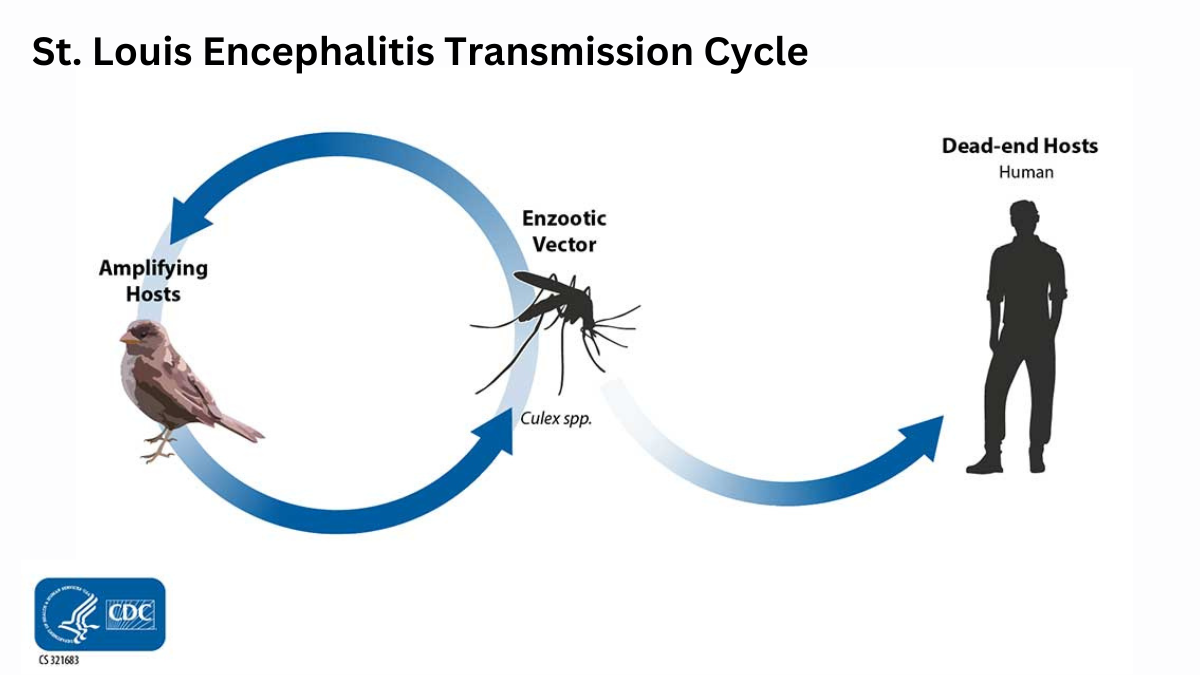
- St. Louis encephalitis virus is maintained in the environment between mosquitoes and birds.
- People do not spread the infection other than rarely through blood transfusions.
Primary cause
St. Louis encephalitis is caused by a virus that is found in North and South America.
About the virus
St. Louis encephalitis virus is a member of the family Flaviviridae, genus Flavivirus. Other medically important flaviviruses found in the United States include West Nile virus and Powassan virus.
The virus has a single-stranded, positive-sense RNA genome. The virus particles are spherical and have a diameter of 40 nm.

How it spreads
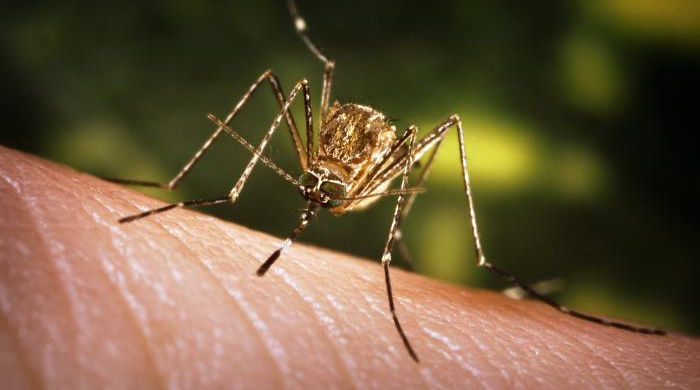
St. Louis encephalitis virus spreads to people through the bites of infected mosquitoes.
People are considered “dead-end” hosts, meaning they do not spread the virus to uninfected mosquitoes that bite them.
The virus does not spread from person to person, except rarely by blood transfusion. People who were recently diagnosed with St. Louis encephalitis virus infection should not donate blood and bone marrow for 120 days following infection.

Transmission cycle
Birds that live in urban-suburban areas, such as the house sparrow, pigeon, blue jay, and robin, are common St. Louis encephalitis virus hosts. The principal vectors are Culex species mosquitoes, including Cx. pipiens and Cx. quinquefasciatus in Eastern states, Cx. nigripalpus in Florida, and Cx. tarsalis and members of the Cx. pipiens complex in Western states. Although people are dead-end hosts, person-to-person transmission via blood transfusion has been documented in rare cases.