



Key points
- NIOSH is the federal agency responsible for testing and approving respirators used in U.S. workplace settings.
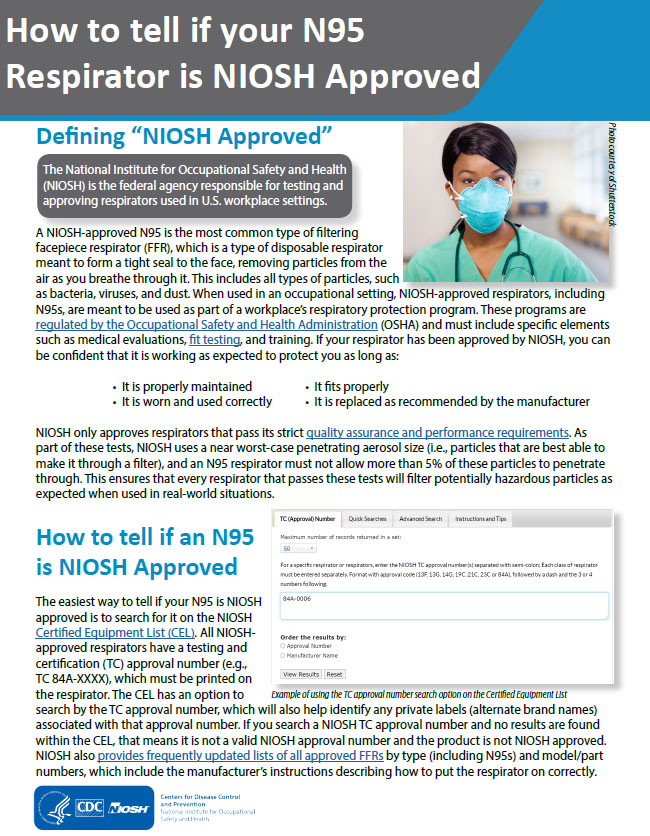
- The easiest way to tell if a product is a NIOSH approved respirator is to search for it on the NIOSH Certified Equipment List (CEL).
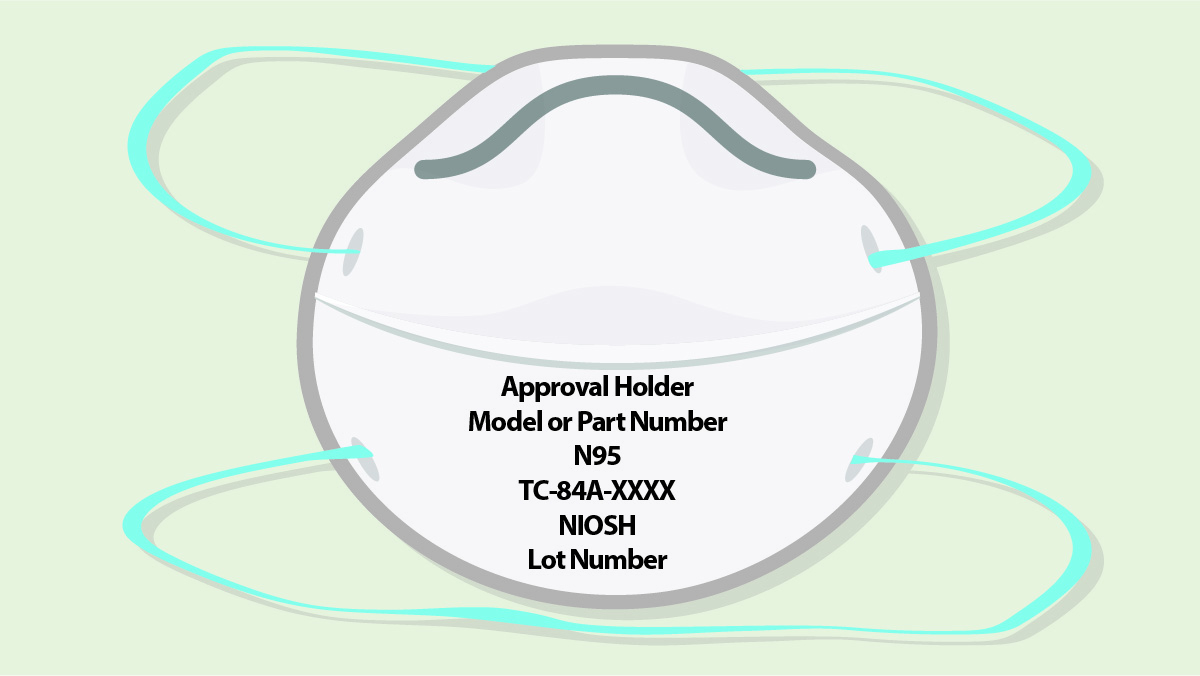
- All NIOSH Approved respirators have a testing and certification (TC) approval number (e.g. TC 84A-XXXX), which must be printed on the respirator.
- NIOSH only approves respirators that pass strict quality assurance and performance requirements.
Facts
All NIOSH approved respirators come with a NIOSH approval label on or within the respirator packaging. This label includes a testing and certification (TC) approval number (e.g., TC 84A-XXXX).
The easiest way to confirm that a product is a NIOSH approved respirator is to search for it on the NIOSH Certified Equipment List (CEL). You can search the CEL by the TC approval number.
Required labeling for NIOSH Approved FFRs
Filtering facepiece respirators (FFRs) that have NIOSH approval will have specific labeling printed on the facepiece. Some respirators on the market may be labeled as “N95” (the most common type of FFR). However, if a respirator does not contain all of the components of the required label, it is not a NIOSH approved respirator and cannot be relied on to provide the same level of respiratory protection. (See Counterfeit and Misrepresented Respirators for more information.)

FFR approval markings
• Name of approval holder/manufacturer business name
• Part number (which may be the model number, but looking for the part number, even on FFRs, is the most accurate way to identify a particular respirator.)
• NIOSH filter series and filter efficiency level, which will most often be N95® (For other FFR types, it could be N99®, N100®, R95®, R99, R100, P95®, P99, or P100®.)
• NIOSH testing and certification approval number, e.g., TC-84A-XXXX
• NIOSH in capital block letters
• Lot number may be on the N95 abbreviated label or the product packaging
NIOSH approval criteria
NIOSH only approves respirators that pass its strict quality assurance and performance requirements. As part of these tests, NIOSH uses a near worst-case penetrating aerosol size (i.e., particles that are best able to make it through a filter). This ensures that every respirator that passes these tests will filter potentially hazardous particles as expected when used in real-world situations. For example, an N95 respirator must not allow more than 5% of these particles to penetrate through.
This page was last updated on this date. Updates may include minor edits, image changes, or other modifications to page content.
The information on this page was last reviewed by subject matter experts to ensure accuracy.
- eCFR :: 42 CFR Part 84 -- Approval of Respiratory Protective Devices
- N99, N100, R95, P95, and P100 are registered certification trademarks of the U.S. Department of Health and Human Services (HHS) in the United States.
- N95 and NIOSH Approved are registered certification trademarks of the U.S. Department of Health and Human Services (HHS) in the United States and several other countries.