



At a glance
- The NIOSH Certified Equipment List (CEL) is a tool to help respirator users, safety managers, industrial hygienists, and others determine if they are using a NIOSH approved respirator.
- This page provides links to the most popular CEL respirator searches.

Categories
Links to popular CEL searches
- All filtering facepiece respirators (FFRs)
- N95® FFRs - Filters at least 95% of airborne particles. Not resistant to oil.
- Surgical N95 FFRs - In compliance with CDC MOU 225-18-006
- Particulate filtering PAPRs with HE, PAPR100-N and PAPR100-P
- Elastomeric half mask respirators - may include an exhalation valve (or filtered exhalation valve) and offer N95 protection, including in combination with other gas and vapor protection.
Links to other FFR filter classes
FFRs are air-purifying respirators that protect by filtering particles out of the air the user is breathing. There are seven classes of FFR filters, though not all have active approvals at this time.
- N99® - Filters at least 99% of airborne particles. Not resistant to oil.
- N100® - Filters at least 99.97% of airborne particles. Not resistant to oil.
- R95® - Filters at least 95% of airborne particles. Somewhat resistant to oil.
- P95® - Filters at least 95% of airborne particles. Strongly resistant to oil.
- P100® - Filters at least 99.97% of airborne particles. Strongly resistant to oil.
Ninety-five percent is the minimal level of filtration that NIOSH will approve. For more information about types of FFRs and protection levels, see the link below.
Best practices
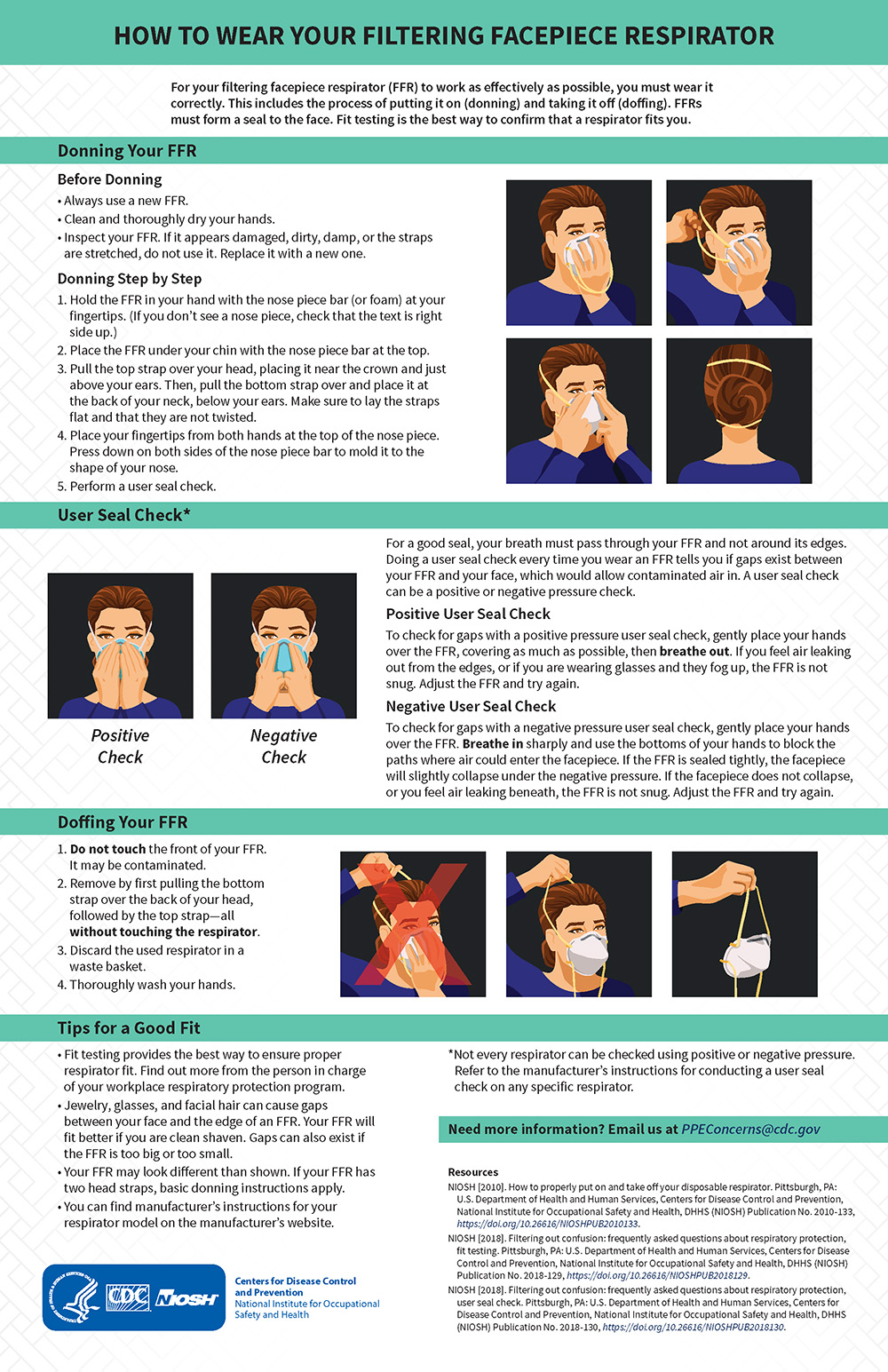
For your FFR to work as effectively as possible, you must wear it correctly. This includes the process of putting it on (donning) and taking it off (doffing).
For donning instructions specific to the make and model of FFR you are using, see the donning instructions in or on the packaging of your respirator. If you do not have access to these instructions, please see the respirator approval holder (manufacturer) or private label entity website or contact the approval holder directly.
For generalized donning instructions, refer to the NIOSH Infographic below.
This page was last updated on this date. Updates may include minor edits, image changes, or other modifications to page content.
The information on this page was last reviewed by subject matter experts to ensure accuracy.
- eCFR :: 42 CFR Part 84 -- Approval of Respiratory Protective Devices
- N95 and NIOSH Approved are registered certification trademarks of the U.S. Department of Health and Human Services (HHS) in the United States and several other countries.
- N99, N100, R95, P95, and P100 are registered certification trademarks of the U.S. Department of Health and Human Services (HHS) in the United States.