 An official website of the United States government



Deaths by Select Demographic and Geographic Characteristics
Provisional Death Counts for COVID-19
‹View Table of Contents
NOTICE: THIS WEBSITE WAS ARCHIVED ON SEPTEMBER 27, 2023.
Datasets linked on this page are available on data.cdc.gov. Please note that these datasets will no longer be updated after September 27, 2023. Provisional data is available on CDC WONDER (wonder.cdc.gov). Data are updated weekly, and users can query data by a variety of demographic, geographic, and temporal options. Please direct questions and inquiries to cdcinfo@cdc.gov with the subject line “NVSS Mortality Surveillance Data”.
List of Topics
- Sex and age
- Race and Hispanic origin
- Place of death
- Comorbidities and other conditions
- Excess deaths
- Additional data (county, leading causes of death, etc.)
For the Index of Provisional COVID-19 Mortality Surveillance and Ad-hoc Data Files, click here.
The provisional counts for COVID-19 deaths are based on a current flow of mortality data in the National Vital Statistics System. National provisional counts include deaths occurring within the 50 states and the District of Columbia that have been received and coded as of the date specified. It is important to note that it can take several weeks for death records to be submitted to National Center for Health Statistics (NCHS), processed, coded, and tabulated. Therefore, the data shown on this page may be incomplete, and will likely not include all deaths that occurred during a given time period, especially for the more recent time periods. Death counts for earlier weeks are continually revised and may increase or decrease as new and updated death certificate data are received from the states by NCHS. COVID-19 death counts shown here may differ from other published sources, as data currently are lagged by an average of 1–2 weeks.
Sex and Age
Table 1 has counts of deaths involving COVID-19 and other select causes of death by time-period in which the death occurred, sex and age group. For data on deaths involving COVID-19 by month, year, jurisdiction, sex, and age, . This data file contains two sets of age groups: (1) age-groups consistent with those used across CDC COVID-19 surveillance pages, and (2) age groups that are routinely included in NCHS mortality reports. When analyzing the file, the user should make sure to select only the desired age groups. Summing across all age categories provided will result in double counting deaths from certain age groups. For data on deaths involving COVID-19 by week, sex, and age (by NCHS age groups), . Data on deaths involving COVID-19 among ages 0–18 are available here: .
NOTE: Empty data cells represent counts between 1-9 that have been suppressed in accordance with NCHS confidentiality standards. Number of deaths reported in this table are the total number of deaths received and coded as of the date of analysis and may not represent all deaths that occurred in that period. Counts of deaths occurring before or after the reporting period are not included in the table. Data during recent periods are incomplete because of the lag in time between when the death occurred and when the death certificate is completed, submitted to NCHS and processed for reporting purposes. This delay can range from 1 week to 8 weeks or more, depending on the jurisdiction and cause of death. United States death counts include the 50 states, plus the District of Columbia and New York City. New York state estimates exclude New York City.
[1] Deaths with confirmed or presumed COVID-19, coded to ICD–10 code U07.1.
[2] Counts of deaths involving pneumonia (J12.0-J18.9) include pneumonia deaths that also involve COVID-19 and exclude pneumonia deaths involving influenza.
[3] Counts of deaths involving influenza (J09-J11) include deaths with pneumonia or COVID-19 also listed as a cause of death.
[4] Deaths with confirmed or presumed COVID-19, pneumonia, or influenza, coded to ICD–10 codes U07.1 or J09–18.9.Race and Hispanic origin
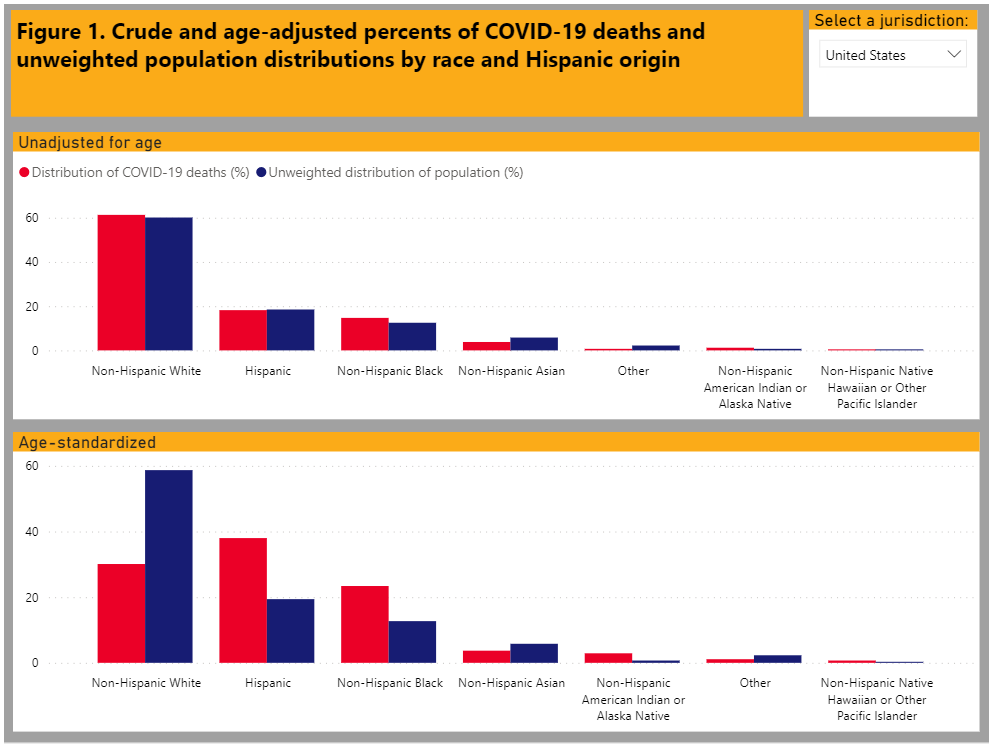
Data by race and Hispanic origin are available at the national, state, and county level. Data by race and Hispanic origin is also available by age at the national and state level. Click here to visit the NCHS Health Disparities page.
Place of death
Table 2 presents death counts involving COVID-19 and other select causes of death by time-period in which the death occurred, and the place of death. For data on deaths involving COVID-19 by time-period, jurisdiction, place of death, and age group, .
NOTE: Empty data cells represent counts between 1-9 that have been suppressed in accordance with NCHS confidentiality standards. Number of deaths reported in this table are the total number of deaths received and coded as of the date of analysis and may not represent all deaths that occurred in that period. Counts of deaths occurring before or after the reporting period are not included in the table. Data during recent periods are incomplete because of the lag in time between when the death occurred and when the death certificate is completed, submitted to NCHS and processed for reporting purposes. This delay can range from 1 week to 8 weeks or more, depending on the jurisdiction and cause of death. United States death counts include the 50 states, plus the District of Columbia and New York City. New York state estimates exclude New York City.
[1] Deaths with confirmed or presumed COVID-19, coded to ICD–10 code U07.1.
[2] Counts of deaths involving pneumonia (J12.0-J18.9) include pneumonia deaths that also involve COVID-19 and exclude pneumonia deaths involving influenza.
[3] Counts of deaths involving influenza (J09-J11) include deaths with pneumonia or COVID-19 also listed as a cause of death.
[4] Deaths with confirmed or presumed COVID-19, pneumonia, or influenza, coded to ICD–10 codes U07.1 or J09-18.9.Comorbidities and other conditions
Table 3 shows the types of health conditions and contributing causes mentioned in conjunction with deaths involving COVID-19. The number of deaths that mention one or more of the conditions indicated is shown for all deaths involving COVID-19 and by age groups. For over 5% of these deaths, COVID-19 was the only cause mentioned on the death certificate. For deaths with conditions or causes in addition to COVID-19, on average, there were 4.0 additional conditions or causes per death. For data on deaths involving COVID-19 by time-period, jurisdiction, and other health conditions, .
NOTE: Empty data cells represent counts between 1-9 that have been suppressed in accordance with NCHS confidentiality standards. Conditions contributing to the death were identified using the International Classification of Diseases, Tenth Revision (ICD–10). Deaths involving more than one condition (e.g., deaths involving both diabetes and respiratory arrest) were counted in both totals. To avoid counting the same death multiple times, the numbers for different conditions should not be summated. Some deaths involve more than one of the same condition category (e.g. deaths involving unintentional and intentional injury often include two or more injury ICD-10 codes), the number of mentions presented on the table above represents the number of instances where the condition was cited on the death certificate. Number of deaths and number of mentions reported in this table are tabulated from deaths received and coded as of the date of analysis and do not represent all deaths that occurred in that period. Data for this table are derived from a cut of the National Vital Statistics System (NVSS) database taken at a particular time, separate from other surveillance tables on this page which are tabulated on the date of update. As a result, the total number of COVID-19 deaths in this table may not match other surveillance tables on this page. Data during recent periods are incomplete because of the lag in time between when the death occurred and when the death certificate is completed, submitted to NCHS and processed for reporting purposes. This delay can range from 1 week to 8 weeks or more, depending on the jurisdiction and cause of death. United States death counts include the 50 states, plus the District of Columbia and New York City. New York state estimates exclude New York City. Estimates for 2020 and 2021 are based on final data.
[1] Deaths with confirmed or presumed COVID-19, coded to ICD–10 code U07.1.Excess deaths
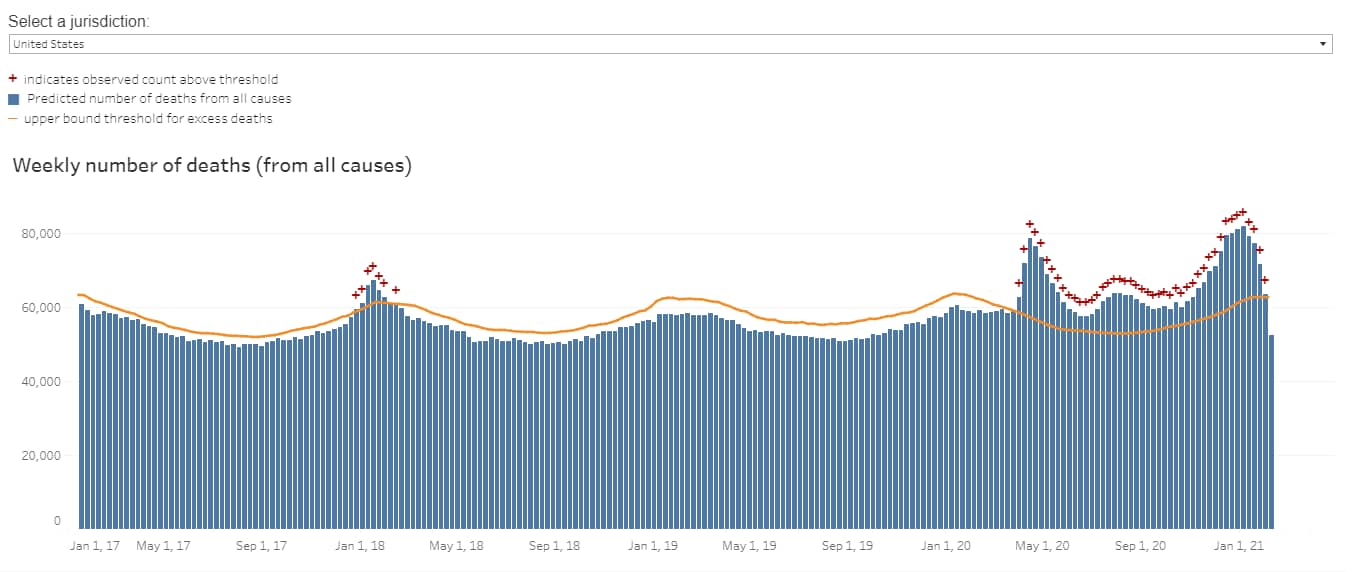
See the NCHS Excess Deaths Data Visualization.
This data visualization presents data on weekly counts of all-cause mortality by jurisdiction of occurrence. Counts of deaths in the most recent weeks are compared with historical trends to determine whether the number of deaths in recent weeks is significantly higher than expected.
Weekly final data for 2014–2019
Weekly counts of leading causes of death based on final underlying cause mortality data for years 2014–2019, by state.
Monthly final data for 2014–2019
Monthly counts of leading causes of death, including injury-related causes, based on final underlying cause mortality data for years 2014–2019, for the U.S.
Weekly provisional data for 2020–2023
Weekly counts of leading causes of death based on provisional underlying cause mortality data for 2020–2022, by state.
Monthly provisional data for 2020–2023
Monthly counts of leading causes of death, including injury-related causes, based on provisional underlying cause mortality data for 2020–2022, for the U.S.
County-level data
Urban/Rural Status
Provisional death counts deliver the most complete and accurate picture of lives lost to COVID-19. They are based on death certificates, which are the most reliable source of data and contain information not available anywhere else, including comorbid conditions, race and ethnicity, and place of death.
How it Works
The National Center for Health Statistics (NCHS) uses incoming data from death certificates to produce provisional COVID-19 death counts. These include deaths occurring within the 50 states and the District of Columbia.
NCHS also provides summaries that examine deaths in specific categories and in greater geographic detail, such as deaths by county and by race and Hispanic origin.
COVID-19 deaths are identified using a new ICD–10 code. When COVID-19 is reported as a cause of death – or when it is listed as a “probable” or “presumed” cause — the death is coded as U07.1. This can include cases with or without laboratory confirmation.
Why These Numbers are Different
Provisional death counts may not match counts from other sources, such as media reports or numbers from county health departments. Counts by NCHS often track 1–2 weeks behind other data.
- Death certificates take time to be completed. There are many steps to filling out and submitting a death certificate. Waiting for test results can create additional delays.
- States report at different rates. Currently, 63% of all U.S. deaths are reported within 10 days of the date of death, but there is significant variation between states.
- Other reporting systems use different definitions or methods for counting deaths.
Things to know about the data
Provisional counts are not final and are subject to change. Counts from previous weeks are continually revised as more records are received and processed.
Provisional data are not yet complete. Counts will not include all deaths that occurred during a given time period, especially for more recent periods. However, we can estimate how complete our numbers are by looking at the average number of deaths reported in previous years.
Death counts should not be compared across states. Some states report deaths on a daily basis, while other states report deaths weekly or monthly. State vital record reporting may also be affected or delayed by COVID-19 related response activities.
For more detailed technical information, visit the Provisional Death Counts for COVID-19 Technical Notes page.
Contents
- COVID-19 Mortality Overview
- Deaths by Week and State
- ›Deaths by Select Demographic and Geographic Characteristics
- Health Disparities
- Excess Deaths Associated with COVID-19
- Index of Available Data Files
- Technical Notes