



At a glance
As of October 24, 2025
The Ministry of Public Health in the DRC declared an outbreak of Ebola virus disease (Ebola) on September 4, 2025. As of October 21, 2025, there have been 64 cases (confirmed or probable) and 45 deaths in the Kasai Province of the DRC. This assessment is an update to the outbreak scenario assessment originally published September 26, 2025 and updated on October 10, 2025.
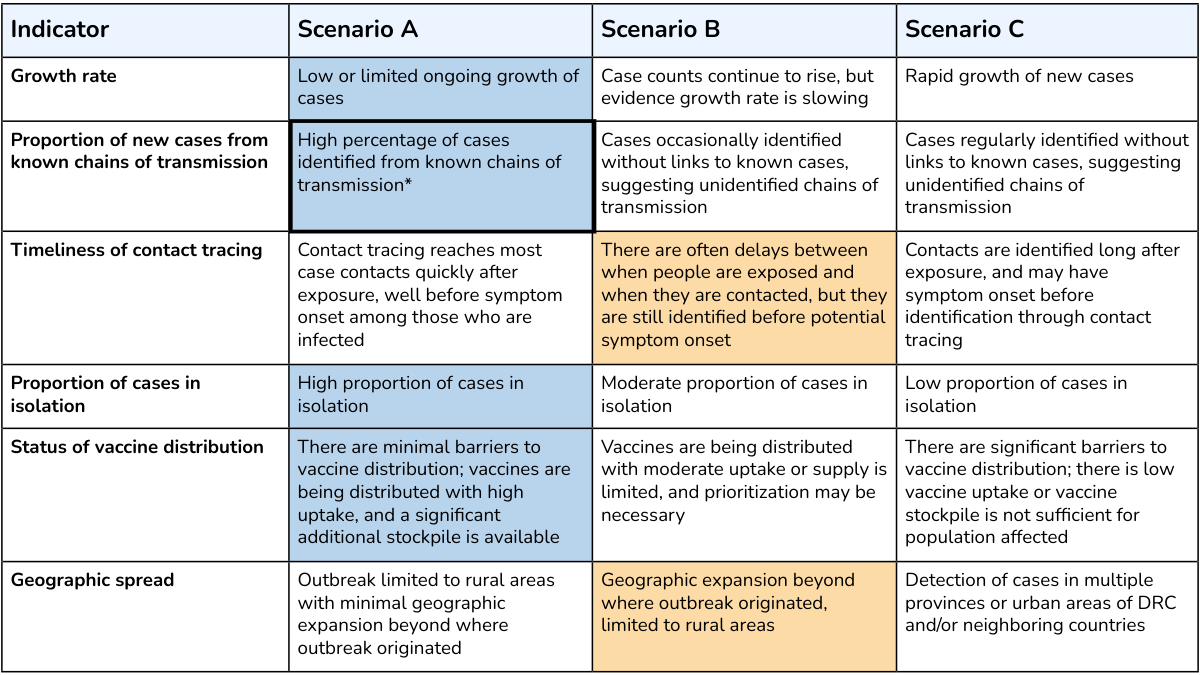
As of October 24, we assess the current outbreak is most closely following Scenario A, based on indicators below (Figure 1) and CDC expert judgment. This assessment has not changed since our previous update on October 10.
- No new cases have been reported since September 26, 2025. As of October 20, no confirmed cases remained in clinical care. If no new cases are detected, the outbreak will be declared over in early December 2025 by the DRC Ministry of Public Health following a 42-day observation period.
- Retrospective case investigations have identified transmission links between the majority of cases, and we have updated our assessment of this indicator (see table below).
- Vaccines are available and reaching people at higher risk of infection. As of October 19, more than 35,000 individuals have been vaccinated against Ebola in Bulape, including healthcare and frontline workers, contacts of cases, potential contacts of cases, and others living in the affected heath areas.
- The outbreak has remained limited to rural areas in Kasai Province, with all confirmed cases located in Bulape Health Zone.
- Since 2019, CDC has supported the implementation of Ebola survivor programs in DRC. By report, health authorities in Kasai Province are also enrolling survivors from this outbreak in a survivor program.
We have moderate confidence in this assessmentA, although there are uncertainties that could change our assessment, outlined below. We will continue to review available evidence every two weeks, or if the situation changes significantly, and update this assessment as warranted.
Key uncertainties
This scenario assessment is intended to provide a high-level overview of how the outbreak could progress during the next three months. We recognize that there are several areas of uncertainty that could change our assessment of the outbreak and future scenarios including:
- Potential for undetected chains of transmission. While there have been no new confirmed cases since September 26th, it remains possible that there could be undetected cases or chains of transmission.
- Potential for spread from survivor(s). Ebola can be transmitted through contact with semen from a person who recovered from Ebola disease, and this kind of spread may be recognized more slowly than spread from contacts of active cases who are monitored more closely.
Key definitions
We outline three plausible scenarios for how the outbreak in the DRC could progress over the next three months:
- Scenario A: An outbreak of Ebola (<100 total cases) with no ongoing transmission in three months. In this scenario, the DRC could experience limited spread among healthcare and household contacts, similar to the 2014 Ebola virus disease outbreak in northwestern DRC, which totaled 69 reported cases.
- Scenario B: A medium-sized outbreak of Ebola (100–500 total cases). There may be ongoing transmission in three months, with indications that the outbreak is declining. In this scenario, the DRC could experience expanded transmission among healthcare workers and household contacts of cases, similar to the 2007 outbreak of Ebola virus disease in the same region of the DRC, which totaled 264 reported cases. In this scenario, there may be some spread to neighboring countries.
- In this scenario, DRC may require expanded interventions to control the outbreak. These could include resources to support rapid detection of Ebola, isolation of cases, contact tracing, treatments, and vaccinations as the number of cases in the outbreak increase.
- The risk of importation to the United States may increase if the outbreak in the DRC grows or if it spreads to neighboring countries, due to increases in returning healthcare workers or travelers from the region. Historically, the majority of Ebola cases in the United States during outbreaks in other countries have been among returning healthcare workers and travelers.
- Scenario C: A large outbreak of Ebola (more than 500 cases) with evidence of exponential growth in three months. In this scenario, the DRC would likely experience sustained community transmission, as was observed in the 2018 outbreak of Ebola virus disease in the DRC (3,470 total reported cases) and the 2014 outbreak of Ebola virus disease in Guinea, Liberia, and Sierra Leone (28,610 total reported cases). Spread to neighboring countries is most likely in this scenario.
- In this scenario, the DRC, and possibly neighboring countries, will require substantial additional resources for rapid detection and control of ongoing spread, including additional medical staff and facilities.
- Of the three potential scenarios, importation to the United States is most likely to occur in this scenario. If a large outbreak occurs in the DRC, the public health impact for the U.S. general population may be significantly higher. Additionally, there may be increased need for U.S. assistance and increased concern in the United States as the outbreak in DRC grows.
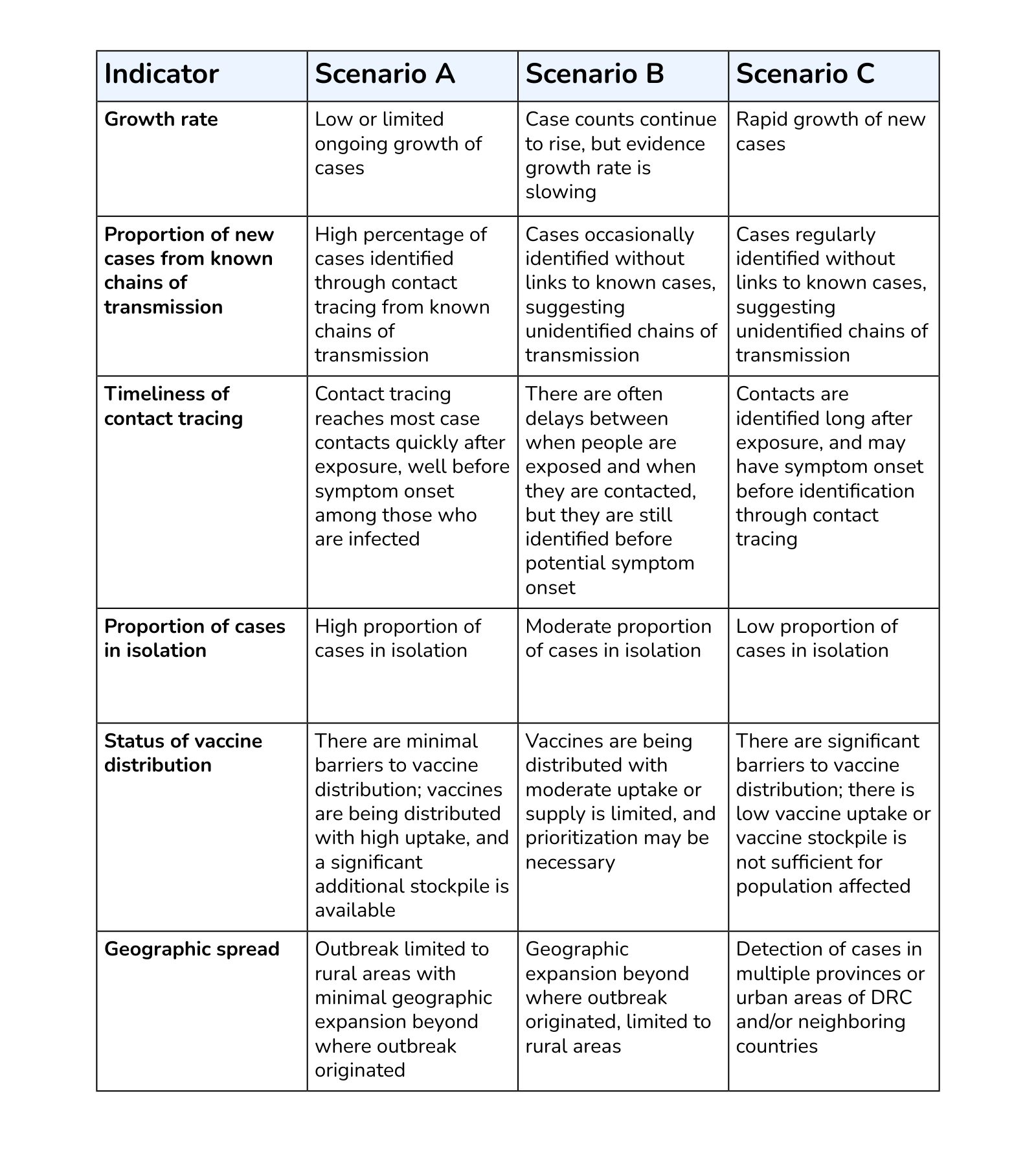
We examine the latest outbreak data and evidence to determine which scenario is most likely to occur during the next three months. Below, we identify a set of indicators and associated levels that we use to assess which scenario best captures the current outbreak (Table 1). Not all indicators need to be met for the assessment of a given scenario, and we rely on expert judgment to determine which scenario is most likely to occur.
Previous outbreak scenario assessments
Assessment
The Ministry of Public Health in the DRC declared an outbreak of Ebola virus disease (Ebola or EVD) on September 4, 2025. As of October 7, 2025, there are 64 cases (confirmed or probable) and 43 deaths in the Kasai province of the DRC. This assessment is an update to the outbreak scenario assessment published September 26, 2025.
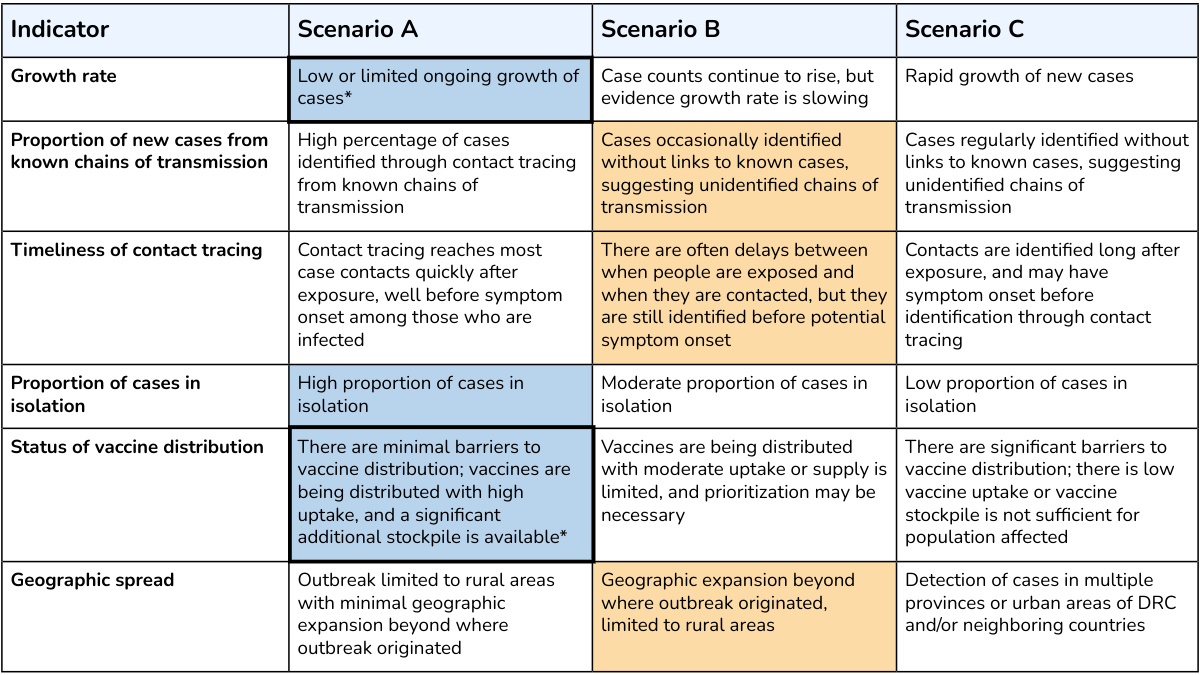
As of October 10, we assess the current outbreak is most closely following Scenario A, an outbreak of fewer than 100 cases, based on indicators below (Figure 1) and CDC expert judgment. Although three indicators align with Scenario B, we assess that the outbreak is more closely aligned with Scenario A because of limited outbreak growth and more widespread, effective implementation of control measures.
- New cases may still emerge even if transmission is declining, as in-country investigations are still in progress. It can take up to 21 days for a person to show symptoms after exposure to the virus.
- Health authorities in DRC continue to implement and strengthen case isolation and contact tracing and have intensified active surveillance in health areas with the highest case numbers, with the goal that no cases or contacts are missed, in order to minimize the risk of resurgence.
- Vaccines are available and reaching people at risk of exposure. As of October 5, more than 20,000 individuals have been vaccinated, including healthcare and frontline workers, contacts of cases, potential contacts of cases, and others living in the affected health areas.
- The outbreak is currently limited to rural areas in Kasai province, with all confirmed cases located in Bulape Health Zone. However, Bulape Health Zone covers a wide geographic area, increasing logistical challenges of health authorities to conduct comprehensive surveillance.
- CDC has supported the implementation of Ebola survivor programs in DRC. By report, health authorities in Kasai Province are also enrolling survivors from this outbreak in a survivor program.
We have moderate confidence in this assessmentA, although there are uncertainties that could change our assessment, outlined below. We will continue to review available evidence every two weeks, or if the situation changes significantly, and update this assessment as warranted.
Key Uncertainties
This scenario assessment is intended to provide a high-level overview of how the outbreak could progress during the next three months. We recognize that there are several areas of uncertainty that could change our assessment of the outbreak and future scenarios including:
- The timeliness and effectiveness of active case detection efforts and contact tracing. While the most recently confirmed case was reported on September 26 and contact tracing efforts are ongoing, cases have been identified with unknown chains of transmission and there could be additional unlinked cases.
- The impact of the location of the outbreak in the rural setting of Kasai province, DRC. The Kasai province is a remote area with limited transportation networks. This may lower the risk of the outbreak spreading to other areas but also makes it challenging for responders and resources to reach the area due to impassable roads and natural barriers, particularly as the rainy season begins. Although DRC has experienced Ebola outbreaks in recent years, this is the first outbreak in Kasai province since 2008.
- Potential for spread from survivors. Ebola can be transmitted through sexual contact with a person who recovered from Ebola disease (even years after initial infection), and this kind of spread may be recognized more slowly than spread from contacts of active cases, which are monitored more closely.
Background
The Ministry of Public Health in the DRC declared an outbreak of Ebola virus disease (Ebola) on September 4, 2025. As of September 22, 2025, there had been 57 cases (confirmed or probable) and 35 deaths in the Kasai province of the DRC.
Ebola virus (species Orthoebolavirus zairense) has historically caused large outbreaks leading to severe illness and death. The 2014-2016 outbreak in West Africa was the largest Ebola outbreak to date, with more than 28,600 cases reported. Ebola virus also caused a 2018–2020 outbreak in the DRC, which led to 3,481 cases. There is a safe and effective vaccine that has been approvedB to prevent Ebola virus disease, as well as approved monoclonal antibody treatments.
To inform preparedness and decision-making, we outline three plausible scenarios for the outbreak in the DRC over the next three months, including implications for the United States. CDC's Center for Forecasting and Outbreak Analytics (CFA), in collaboration with the CDC DRC Ebola Outbreak Response team, developed these scenarios by integrating insights from previous Ebola outbreaks and expert opinion.
In a recent rapid risk assessment, CDC assessed the current risk posed by the outbreak of Ebola virus disease in the DRC to the U.S. general population as low, with moderate confidence.
Current Assessment
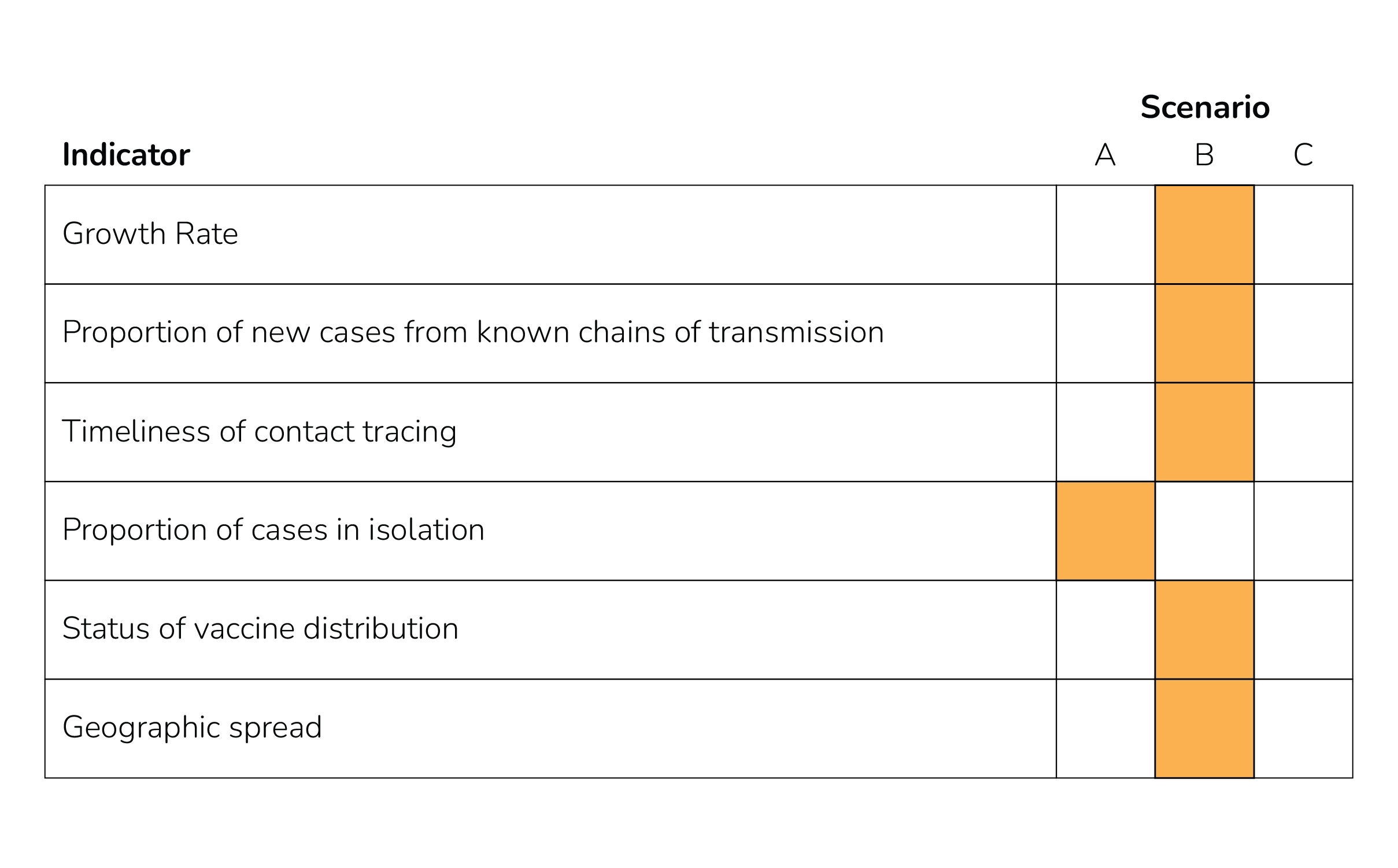
As of September 26, we assess the current outbreak is most closely following Scenario B, based on indicators below (Figure 1) and CDC expert judgment:
- Currently, the rate of new cases is growing, although we may expect case growth even if transmission is declining, as in-country investigations are still in progress.
- Health authorities in DRC are working to effectively implement case isolation and contact tracing, but data on the comprehensiveness and timeliness of these actions are limited.
- Vaccines are available and being distributed. There are challenges in delivery of additional vaccines due to remote outbreak location.
- The outbreak is currently limited to rural areas in Kasai province, with all confirmed cases located in Bulape Health Zone. However, there is evidence of spread within Bulape Health Zone, which covers a wide geographic area.
We have low confidence in this assessmentA, and there are uncertainties that could change our assessment, outlined below. We will review available evidence every two weeks, or if the situation changes significantly, and update this assessment as warranted.
Key uncertainties of original scenario
This scenario assessment is intended to provide a high-level overview of how the outbreak could progress during the next three months. We recognize that there are several areas of uncertainty that could change our assessment of the outbreak and future scenarios including:
- The current size and geographic scope of the outbreak, and completeness and timeliness of existing surveillance data. We note uncertainty on whether new cases are due to a backlog in testing or reflect new infections.
- The timeliness and effectiveness of active case detection efforts and contact tracing in the ongoing outbreak.
- The timeliness of vaccination efforts. While a large order of vaccines has been approved and shipped to DRC, the number of doses currently in the Bulape health zone remains low. The timing of vaccine administration will depend on how quickly these are delivered to the outbreak area, and the level of resources available for vaccine storage and administration.
- The impact of the location of the outbreak in the rural setting of Kasai province, DRC. The Kasai province is a remote area with limited transportation networks. This may lower the risk of the outbreak spreading to other areas but also makes it challenging for responders to reach the area due to impassable roads and natural barriers.
- Although DRC has experienced Ebola outbreaks in recent years, this is the first outbreak in Kasai province since 2008.
- Confidence of assessment is based on the extent and quality of information and how well different lines of evidence corroborate one another. See definitions in our methods for rapid risk assessments here.
- The ERVEBO vaccine is approved by the U.S. Food and Drug Administration. It is not approved in the DRC but is administered under an expanded access protocol.