Physical Activity

For Everyone

What to know

Regular physical activity during adolescence supports lifelong health and helps prevent chronic health conditions, like obesity, diabetes, and heart disease. Yet many adolescents do not get the amount of physical activity recommended in the Physical Activity Guidelines for Americans to reduce the risk of chronic conditions across the lifespan.
High school students and coach getting ready for game.

At A Glance

2-year changes and 10-year trends in how high school students are doing across five physical activity behaviors.

Table titled 'At a Glance' showing 2-year changes (2023–2025) and 10-year (2015–2025) trends for five physical activity behaviors among high school students. Were physically active for at least 60 minutes daily: no change over 2 years, worsened over 10 years. Strengthened muscles at least 3 days a week: no change over 2 years, worsened over 10 years. Met both the aerobic and muscle-strengthening guidelines: no change over 2 years, worsened over 10 years. Attended physical education daily: worsened over both periods. Played on a sports team: improved over 2 years, no change over 10 years.

Summary

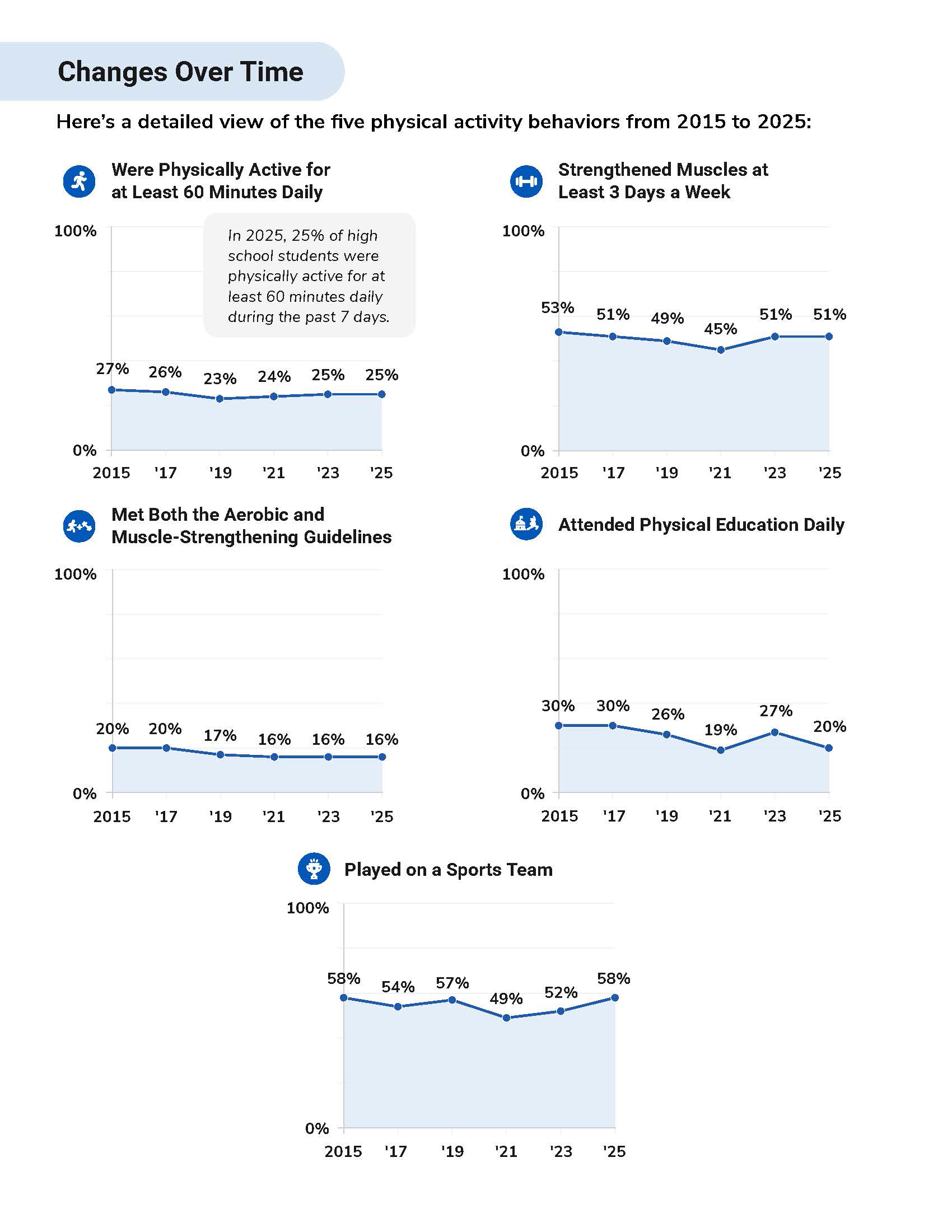
Physical activity changes over time.

Five line charts titled 'Changes Over Time' showing percentages of high school students reporting physical activity behaviors from 2015 to 2025. Were Physically Active for at Least 60 Minutes Daily: 27%, 26%, 23%, 24%, 25%, 25%. Strengthened Muscles at Least 3 Days a Week: 53%, 51%, 49%, 45%, 51%, 51%. Met Both the Aerobic and Muscle-Strengthening Guidelines: 20%, 20%, 17%, 16%, 16%, 16%. Attended Physical Education Daily: 30%, 30%, 26%, 19%, 27%, 20%. Played on a Sports Team: 58%, 54%, 57%, 49%, 52%, 58%. A callout notes that in 2025, 25% of high school students were physically active for at least 60 minutes daily during the past 7 days.

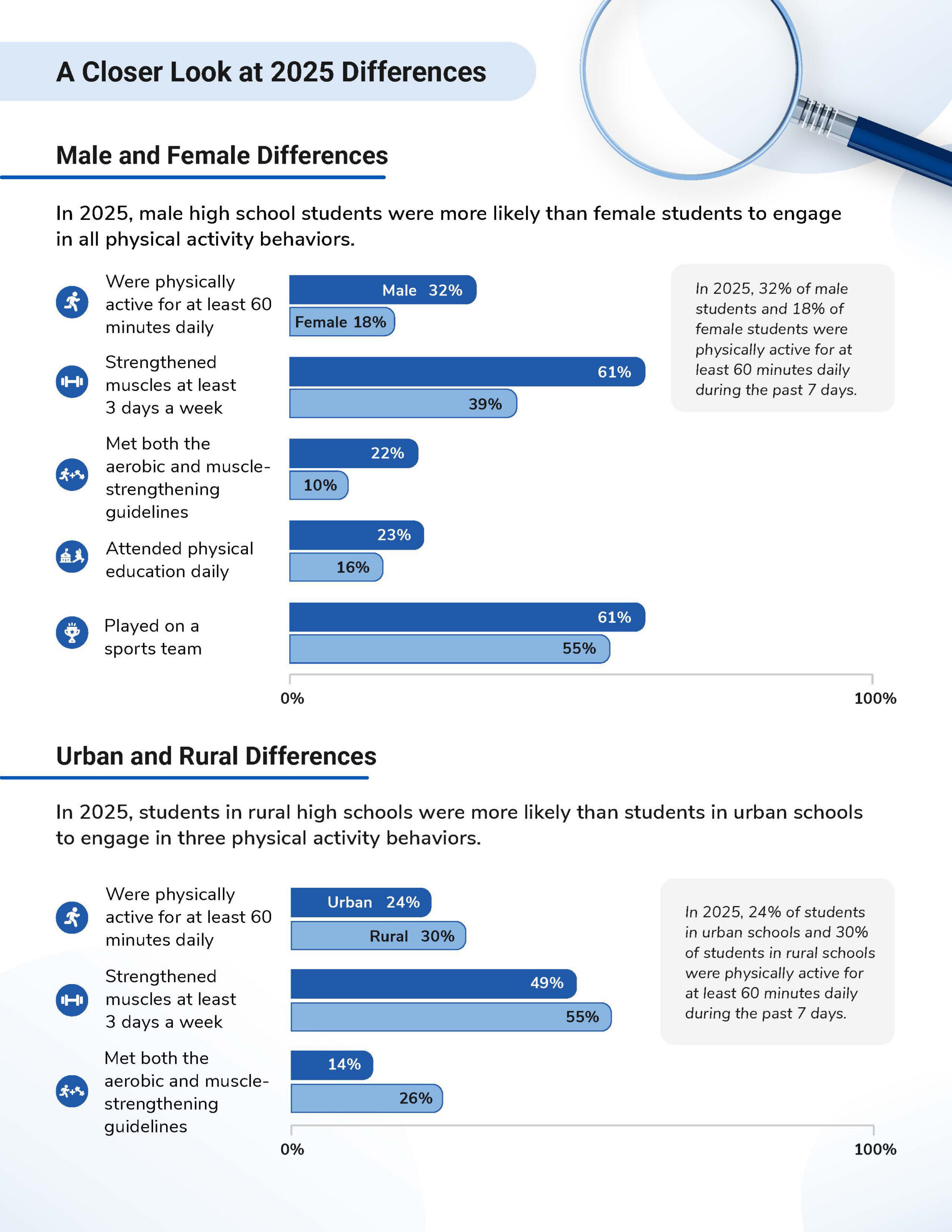
A closer look at 2025 differences in the physical activity behaviors of high school students.

Bar charts titled 'A Closer Look at 2025 Differences.' Male and Female Differences: text notes males were more likely than females to engage in all physical activity behaviors. Physically active at least 60 minutes daily — Male 32%, Female 18%. Strengthened muscles at least 3 days a week — Male 61%, Female 39%. Met both guidelines — Male 22%, Female 10%. Attended physical education daily — Male 23%, Female 16%. Played on a sports team — Male 61%, Female 55%. Urban and Rural Differences: text notes rural students were more likely than urban students to engage in three behaviors. Physically active at least 60 minutes daily — Urban 24%, Rural 30%. Strengthened muscles at least 3 days a week — Urban 49%, Rural 55%. Met both guidelines — Urban 14%, Rural 26%.

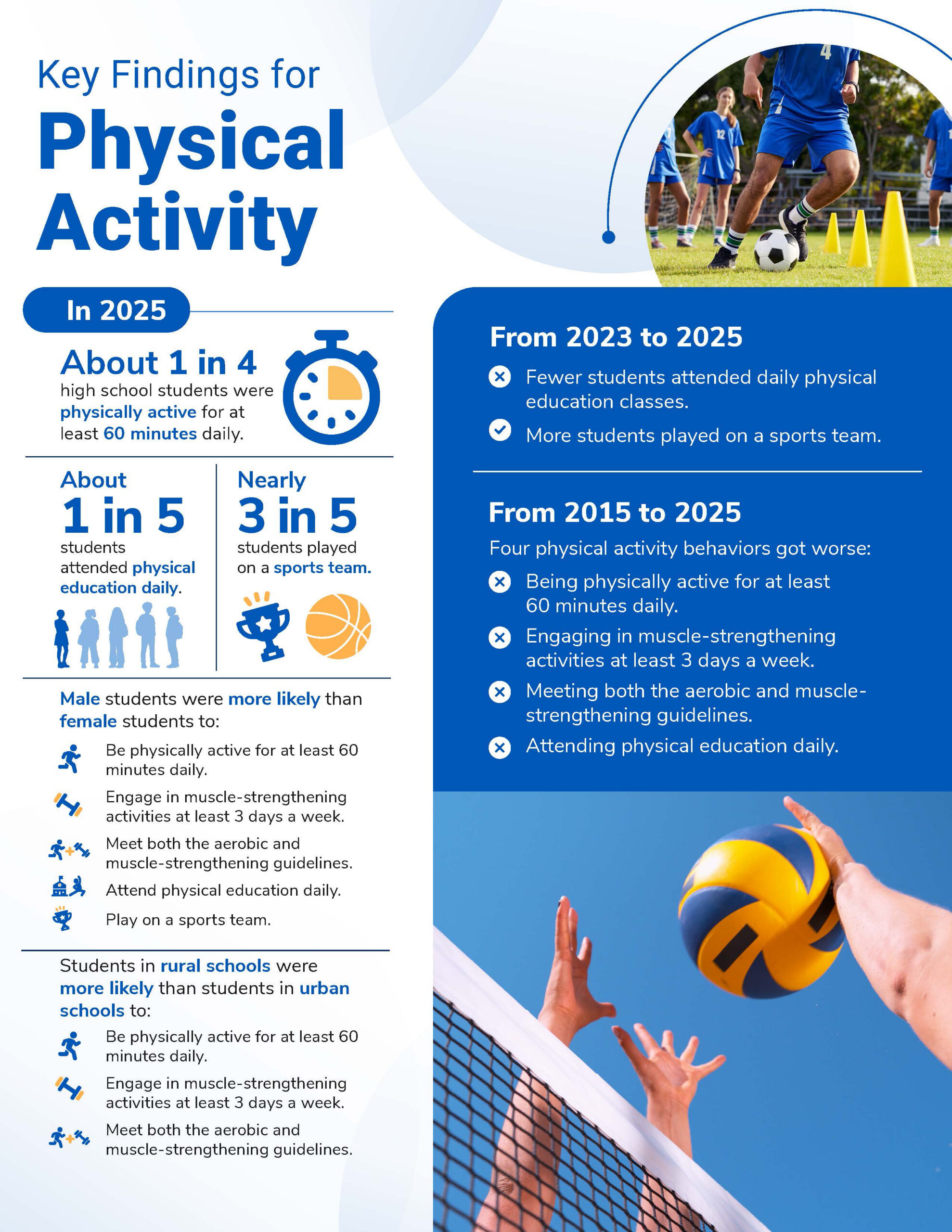
Key findings for physical activity behaviors.

Infographic titled 'Key Findings for Physical Activity.' In 2025, about 1 in 4 high school students were physically active for at least 60 minutes daily. About 1 in 5 students attended physical education daily. Nearly 3 in 5 students played on a sports team. Male students were more likely than female students to be physically active for at least 60 minutes daily, engage in muscle-strengthening activities at least 3 days a week, meet both the aerobic and muscle-strengthening guidelines, attend physical education daily, and play on a sports team. Students in rural schools were more likely than students in urban schools to be physically active for at least 60 minutes daily, engage in muscle-strengthening activities, and meet both guidelines. From 2023 to 2025, fewer students attended daily physical education classes while more students played on a sports team. From 2015 to 2025, four behaviors got worse: being physically active for at least 60 minutes daily, engaging in muscle-strengthening activities, meeting both guidelines, and attending physical education daily. Includes photos of a youth soccer player and hands reaching for a volleyball at a net.

Physical activity provides physical, mental, and social benefits. It helps students strengthen their bodies, support their mental health, build social connections, and be ready to learn. Schools are uniquely positioned to help students meet daily physical activity recommendations by providing opportunities for physical activity before, during, and after school.

CDC's Comprehensive School Physical Activity Program (CSPAP) framework provides a roadmap for this work. Schools can use this framework to consider:

  • Providing standards-based physical education that builds students' knowledge, motor skills, physical fitness, and behaviors for lifelong physical activity.
  • Offering opportunities for physical activity during school in classrooms and through recess.
  • Making opportunities available for physical activity before and after school, such as support for walking or biking to school, activity clubs, intramural and interscholastic sports, and extended-day programs.
  • Encouraging staff to create a culture that values physical activity by modeling active behaviors, supporting physical activity throughout the day, and participating in employee wellness programs.
  • Working with families and community members to expand and promote physical activity opportunities during and beyond the school day by volunteering at events, supporting "walking school buses" (adults walking groups of young people to and from school), joining wellness committees, or helping with field days and fitness activities.

Parents and families can also consider incorporating physical activity into family routines, for example, by taking regular walks and engaging in active games at parks or community centers. They can also encourage participation in recreational or school-based sports teams. These efforts can build strong and trusting partnerships between home, school, and community and make it easier for students to be active every day.
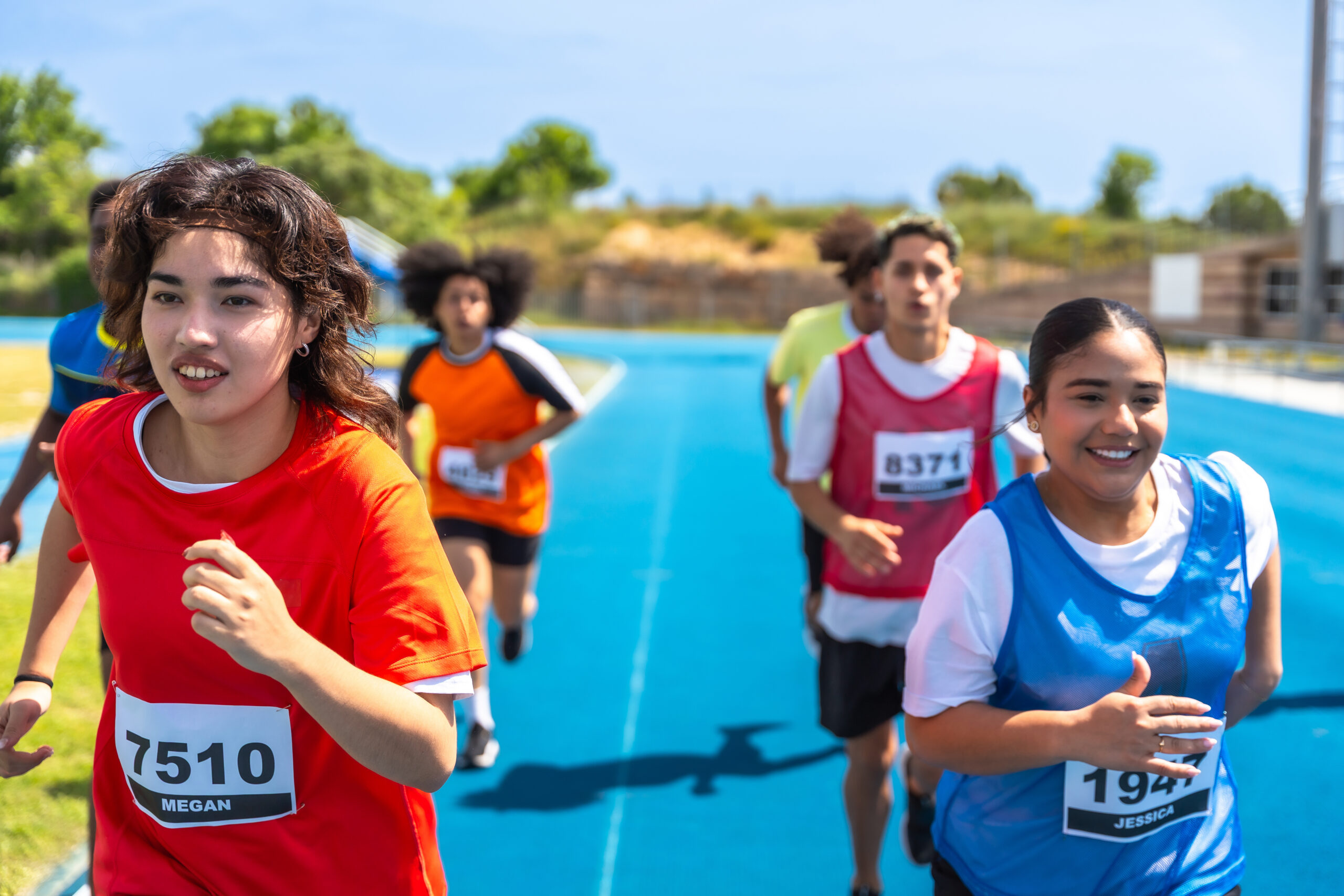
High school students running in a track event.

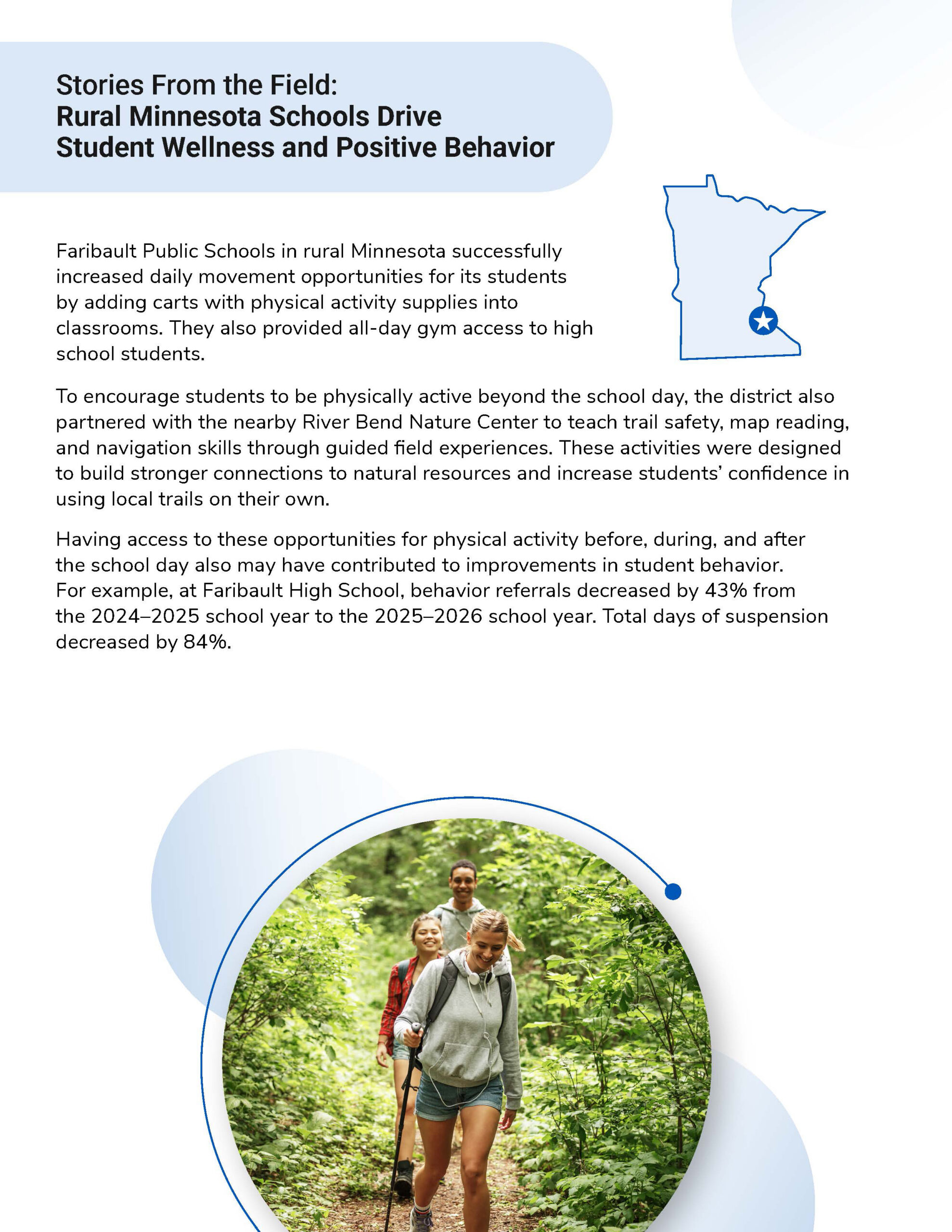
Rural Minnesota schools drive student wellness and positive behavior.

Story image titled 'Stories From the Field: Rural Minnesota Schools Drive Student Wellness and Positive Behavior.' Text explains that Faribault Public Schools in rural Minnesota increased daily movement opportunities by adding carts with physical activity supplies into classrooms and providing all-day gym access to high school students. The district also partnered with the nearby River Bend Nature Center to teach trail safety, map reading, and navigation skills through guided field experiences, building stronger connections to nature and confidence in using local trails. These opportunities may have contributed to improvements in student behavior: at Faribault High School, behavior referrals decreased by 43% and total days of suspension decreased by 84% from the 2024–2025 to 2025–2026 school year. Includes a map of Minnesota with Faribault marked and a photo of three people hiking on a wooded trail.

Content Source
Adolescent and School Health; National Center for Chronic Disease Prevention and Health Promotion
About This Page
Published:
Updated: August 14, 2026

This page was last updated on this date. Updates may include minor edits, image changes, or other modifications to page content.

Reviewed: September 18, 2026

The information on this page was last reviewed by subject matter experts to ensure accuracy.