Mental Health and Suicide Risks

For Everyone

What to know

Mental health is an important part of adolescents' overall health and well-being. Poor mental health can affect learning, behavior, relationships, and school engagement. Strong connections with adults and peers at home, school, and in the community can help adolescents feel supported and reduce risks like substance use and violence.
A high school student making a heart sign with her hands.

At A Glance

2-year changes and 10-year trends in how high school students are doing across six indicators of mental health and suicide risk.

Table titled 'At a Glance' showing 2-year changes (2023–2025) and 10-year (2015–2025) trends for six indicators of mental health and suicide risk among high school students. Persistent feelings of sadness or hopelessness: improved over 2 years, worsened over 10 years. Poor mental health: improved over 2 years, data not available for 10-year trend. Seriously considered attempting suicide: improved over 2 years, no change over 10 years. Made a suicide plan: improved over 2 years, no change over 10 years. Attempted suicide: improved over 2 years, no change over 10 years. Injured in a suicide attempt that had to be treated by a doctor or nurse: no change over 2 years, improved over 10 years.

Summary

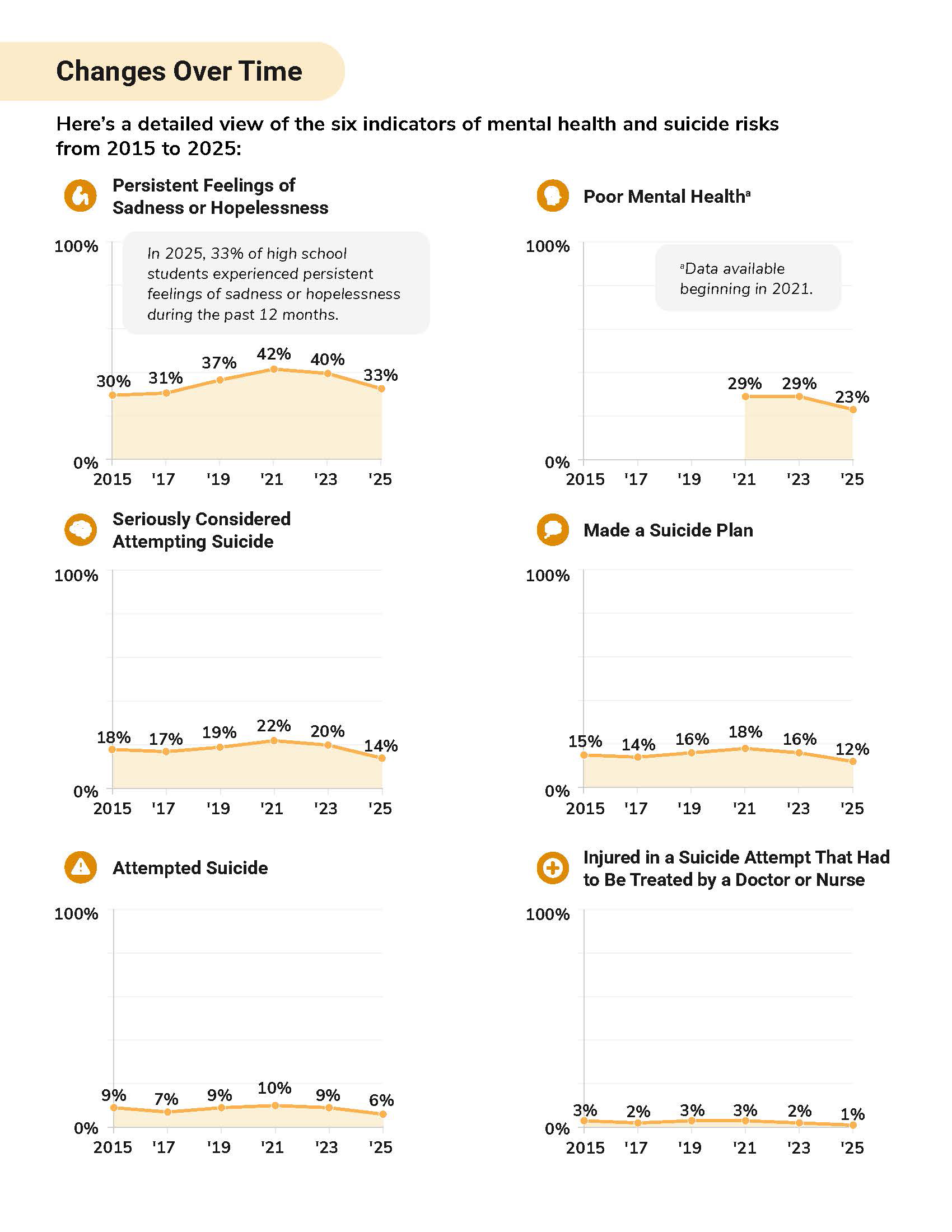
Mental health and suicide risks changes over time.

Six line charts titled 'Changes Over Time' showing percentages of high school students reporting mental health and suicide risk indicators from 2015 to 2025. Persistent Feelings of Sadness or Hopelessness: 30%, 31%, 37%, 42%, 40%, 33%. Poor Mental Health (data available beginning 2021): 29%, 29%, 23%. Seriously Considered Attempting Suicide: 18%, 17%, 19%, 22%, 20%, 14%. Made a Suicide Plan: 15%, 14%, 16%, 18%, 16%, 12%. Attempted Suicide: 9%, 7%, 9%, 10%, 9%, 6%. Injured in a Suicide Attempt That Had to Be Treated by a Doctor or Nurse: 3%, 2%, 3%, 3%, 2%, 1%. A callout notes that in 2025, 33% of high school students experienced persistent feelings of sadness or hopelessness during the past 12 months.

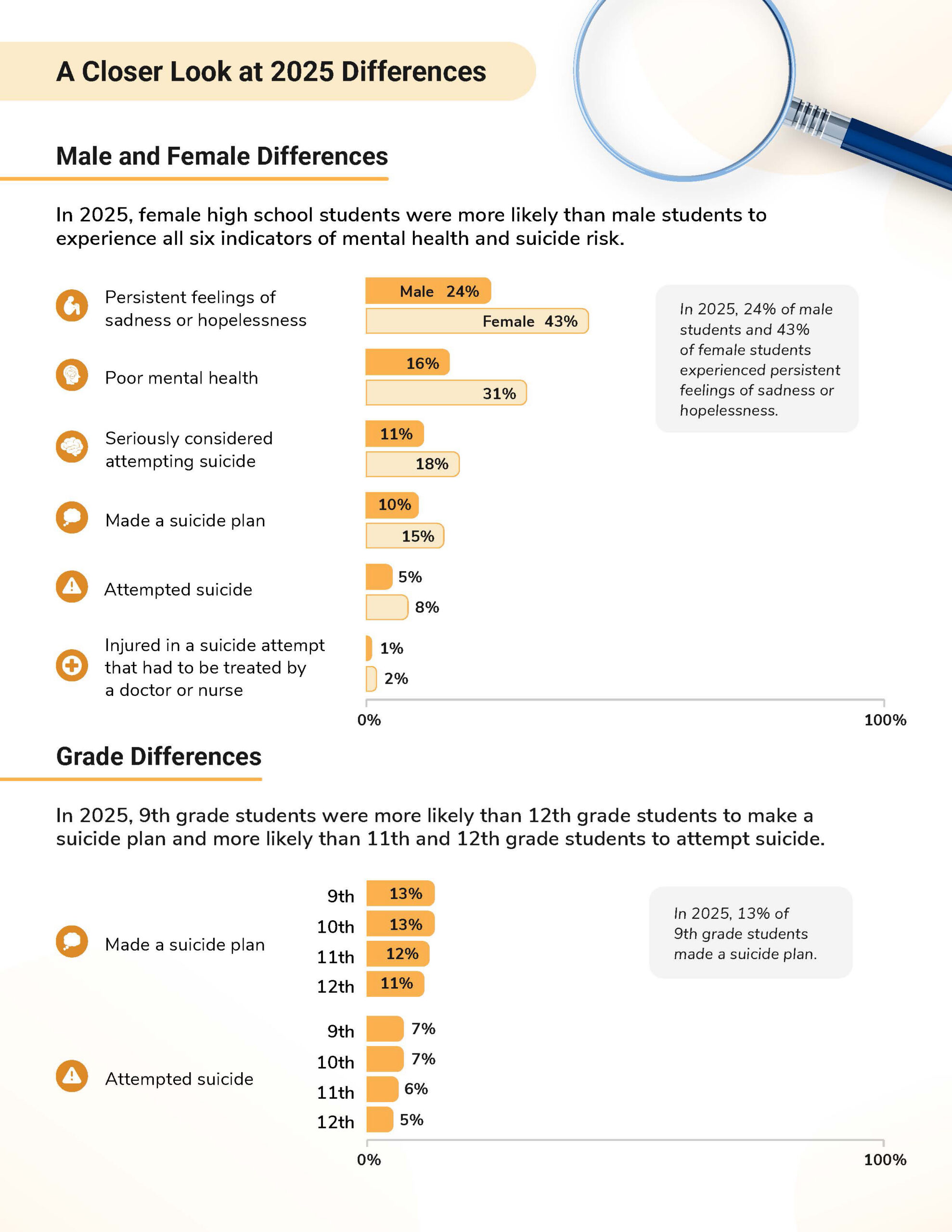
A closer look  at 2025 differences in the mental health and suicide risks of high school students.
A closer look at 2025 differences in the mental health and suicide risks of high school students.

Bar charts titled 'A Closer Look at 2025 Differences.' Male and Female Differences: text notes female students were more likely than male students to experience all six indicators. Persistent feelings of sadness or hopelessness — Male 24%, Female 43%. Poor mental health — Male 16%, Female 31%. Seriously considered attempting suicide — Male 11%, Female 18%. Made a suicide plan — Male 10%, Female 15%. Attempted suicide — Male 5%, Female 8%. Injured in a suicide attempt treated by a doctor or nurse — Male 1%, Female 2%. Grade Differences: text notes 9th graders were more likely than 12th graders to make a suicide plan, and more likely than 11th and 12th graders to attempt suicide. Made a suicide plan by grade — 9th 13%, 10th 13%, 11th 12%, 12th 11%. Attempted suicide by grade — 9th 7%, 10th 7%, 11th 6%, 12th 5%.

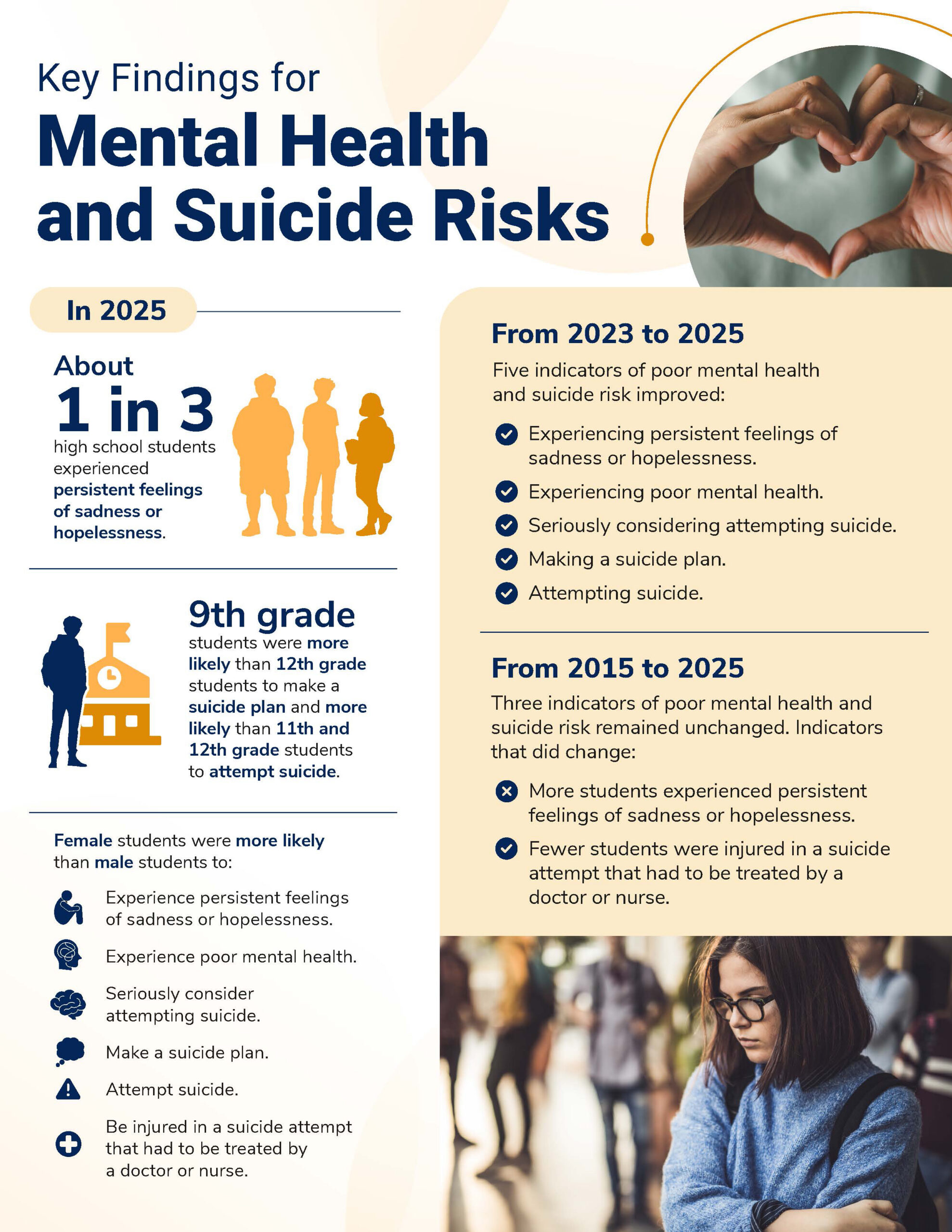
Key findings for mental health and suicide risks.

Infographic titled 'Key Findings for Mental Health and Suicide Risks.' In 2025, about 1 in 3 high school students experienced persistent feelings of sadness or hopelessness. 9th grade students were more likely than 12th grade students to make a suicide plan, and more likely than 11th and 12th grade students to attempt suicide. Female students were more likely than male students to experience persistent feelings of sadness or hopelessness, experience poor mental health, seriously consider attempting suicide, make a suicide plan, attempt suicide, and be injured in a suicide attempt requiring treatment. From 2023 to 2025, five indicators improved: persistent feelings of sadness or hopelessness, poor mental health, seriously considering attempting suicide, making a suicide plan, and attempting suicide. From 2015 to 2025, three indicators remained unchanged; more students experienced persistent feelings of sadness or hopelessness, while fewer students were injured in a suicide attempt requiring treatment. Includes a photo of hands forming a heart shape.

To support the mental health and well-being of their adolescents, parents and families should take care of their own mental health and seek help for themselves or their adolescent, when needed. They can also consider:

  • Talking with their teen about mental health. Having frequent conversations can help build trust and make open and honest conversations easier.
  • Spending time engaging in shared activities to foster connection and help them build safe and stable relationships with you and other caring adults.
  • Providing developmentally appropriate supervision to facilitate healthy decision-making.

Schools can also play an important role in promoting students' mental health and well-being through education, prevention, and early intervention by creating safe and supportive environments, connecting students to caring adults, supporting positive peer relationships, linking students to mental health services, and helping them cope with emergencies.

Schools can consider implementing evidence-based strategies and practices that focus on:

  • Strengthening students' mental health literacy.
  • Increasing connectedness with peers and teachers.
  • Building skills for managing relationships, emotions, and challenges.
  • Teaching coping and problem-solving skills.
  • Training school staff to identify students exhibiting suicide-risk behaviors and make appropriate referrals.

A high school student sitting by herself in front of lockers.

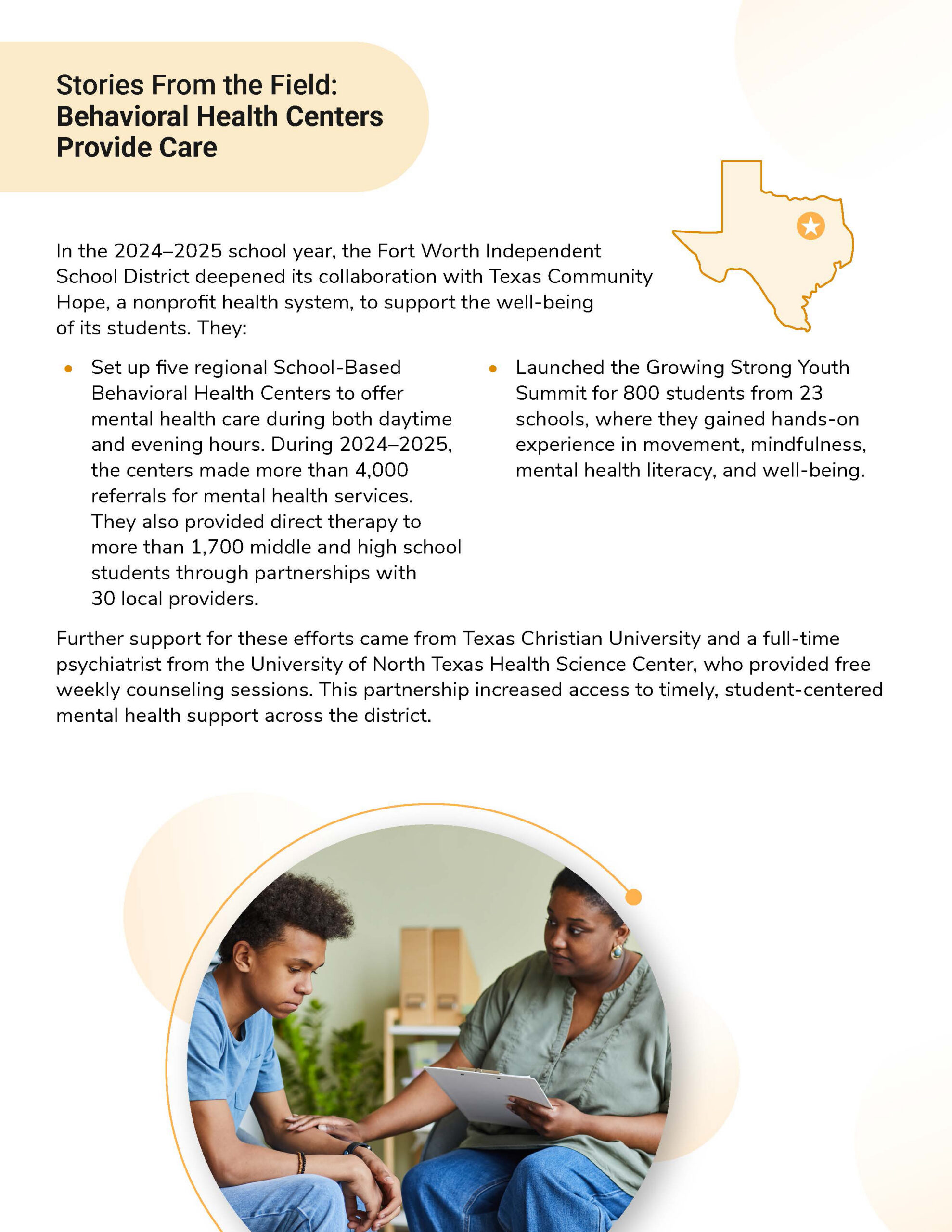
Behavioral health centers provide care.

Story image titled 'Stories From the Field: Behavioral Health Centers Provide Care.' Text explains that in the 2024–2025 school year, the Fort Worth Independent School District deepened its collaboration with Texas Community Hope, a nonprofit health system, to support student well-being. They set up five regional School-Based Behavioral Health Centers offering care during daytime and evening hours, making more than 4,000 referrals for mental health services and providing direct therapy to more than 1,700 middle and high school students through partnerships with 30 local providers. They also launched the Growing Strong Youth Summit for 800 students from 23 schools, focused on movement, mindfulness, mental health literacy, and well-being. Further support came from Texas Christian University and a full-time psychiatrist from the University of North Texas Health Science Center providing free weekly counseling. Includes a map of Texas with Fort Worth marked and a photo of a counselor talking with a teenage boy.

Content Source
Adolescent and School Health; National Center for Chronic Disease Prevention and Health Promotion
About This Page
Published:
Updated: August 14, 2026

This page was last updated on this date. Updates may include minor edits, image changes, or other modifications to page content.

Reviewed: September 18, 2026

The information on this page was last reviewed by subject matter experts to ensure accuracy.