Digital Behaviors

For Everyone

What to know

Digital media and technology play a major role in the daily lives of adolescents, helping them connect with others, learn, and access information. At the same time, some digital behaviors can affect adolescents’ health and safety.
A high school student on his cellphone.

At A Glance

2-year changes and 10-year trends in how high school students are doing across two digital behaviors.

Table titled 'At a Glance' showing 2-year changes (2023–2025) and 10-year (2015–2025) trends for two digital behaviors among high school students. Used social media every hour or more: no change over 2 years, data not available for 10-year trend. Texted or emailed while driving: no change over both periods (assessed only among students who had driven a vehicle in the past 30 days).

Summary

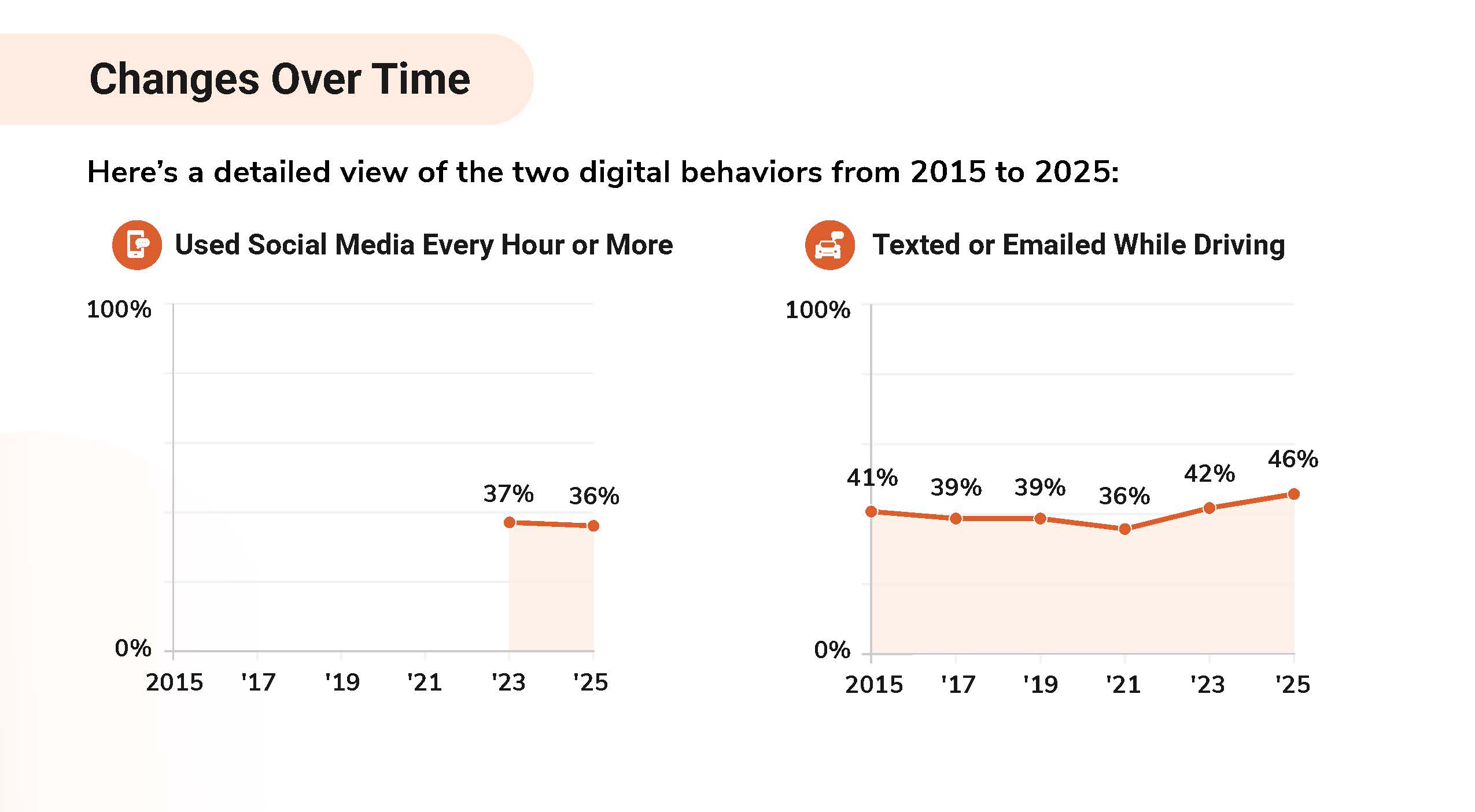
Digital behaviors changes over time.

Two line charts titled 'Changes Over Time' showing percentages of high school students reporting digital behaviors from 2015 to 2025. Used Social Media Every Hour or More: data only available for 2023 (37%) and 2025 (36%). Texted or Emailed While Driving: 41%, 39%, 39%, 36%, 42%, 46% from 2015 to 2025.

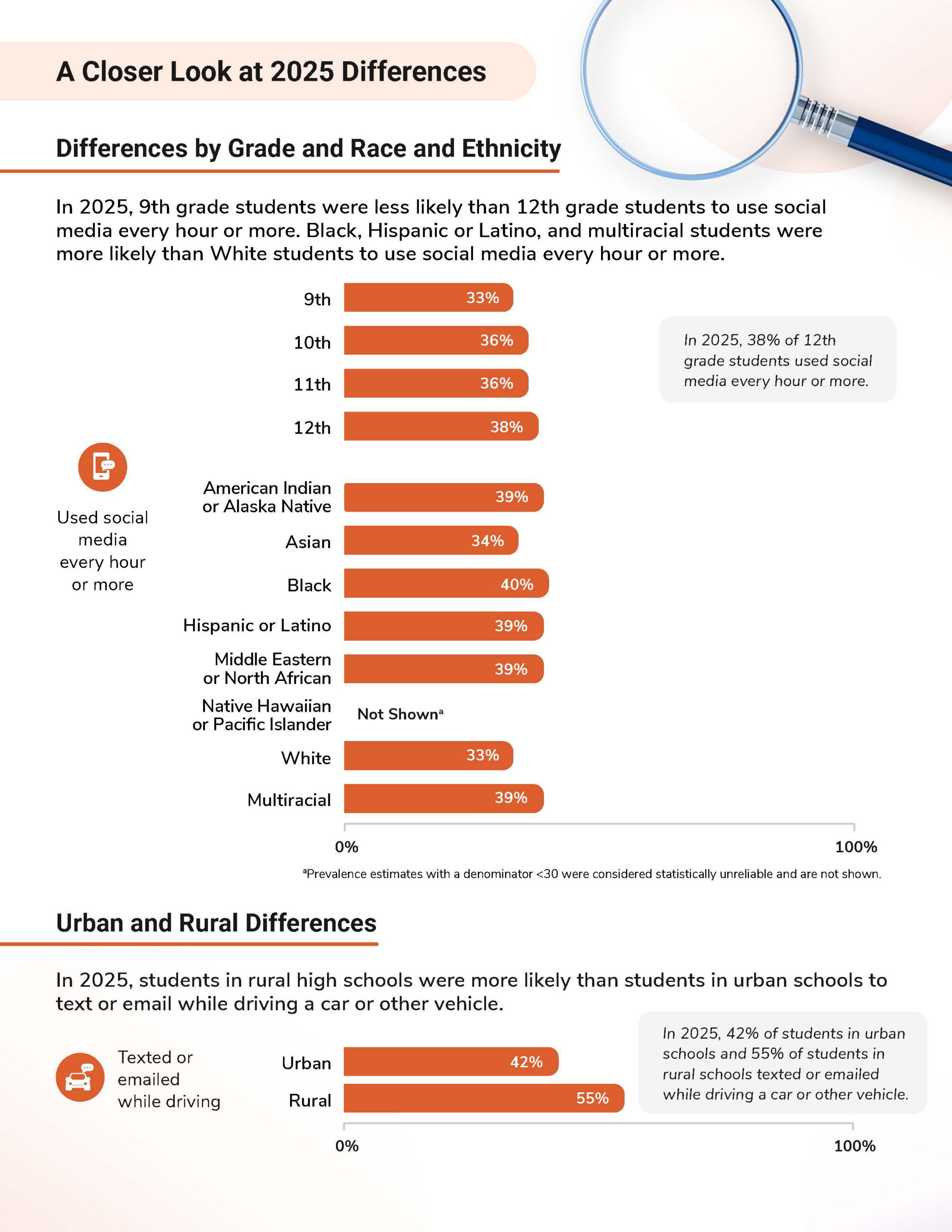
A closer look at 2025 differences in digital behaviors of high school students.

Bar charts titled 'A Closer Look at 2025 Differences.' Differences by Grade and Race/Ethnicity for 'Used social media every hour or more': 9th grade 33%, 10th 36%, 11th 36%, 12th 38%. By race/ethnicity: American Indian or Alaska Native 39%, Asian 34%, Black 40%, Hispanic or Latino 39%, Middle Eastern or North African 39%, Native Hawaiian or Pacific Islander not shown due to small sample size, White 33%, Multiracial 39%. Text notes 9th graders were less likely than 12th graders to use social media hourly, and Black, Hispanic/Latino, and multiracial students were more likely than White students to do so. Urban and Rural Differences for 'Texted or emailed while driving': Urban 42%, Rural 55%, with rural students more likely to text or email while driving.

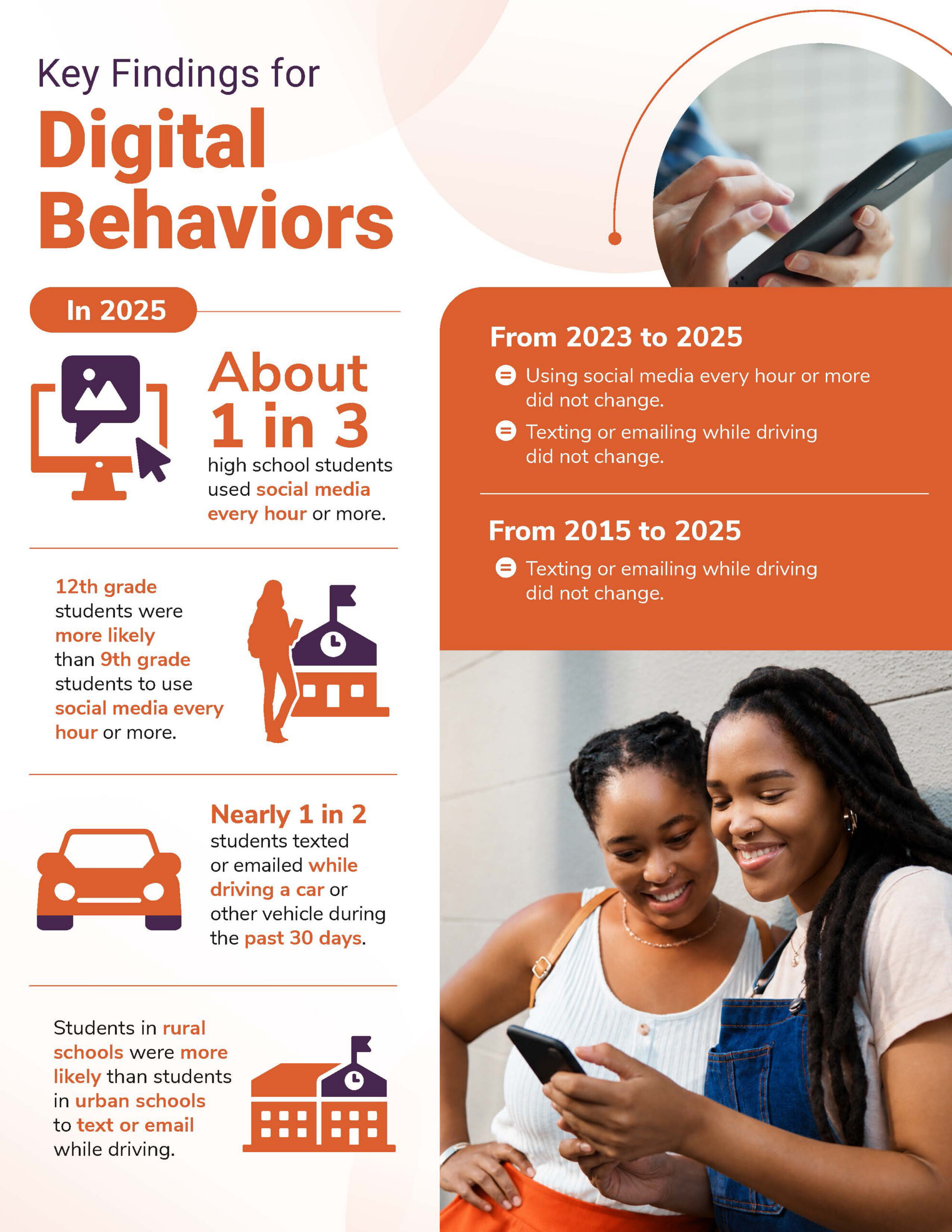
Key findings for digital behaviors.

Infographic titled 'Key Findings for Digital Behaviors.' In 2025, about 1 in 3 high school students used social media every hour or more. 12th grade students were more likely than 9th grade students to use social media every hour or more. Nearly 1 in 2 students texted or emailed while driving a car or other vehicle during the past 30 days. Students in rural schools were more likely than students in urban schools to text or email while driving. From 2023 to 2025, using social media every hour or more did not change, and texting or emailing while driving did not change. From 2015 to 2025, texting or emailing while driving did not change. Includes photos of a person holding a phone and two girls smiling while looking at a phone together.

Digital behaviors can influence many aspects of health, including sleep, physical activity, nutrition, safety, and mental well-being.

Families and community organizations can be valuable partners in shaping policies, educational efforts, and activities that support healthy digital habits. They can help tailor local efforts and reinforce consistent messages about digital media and technology use at home, in school, and throughout the community. Families can consider:

  • Modeling healthy digital behaviors, including limiting screen time use.
  • Storing devices in rooms other than bedrooms.
  • Establishing family rules for permissible online behaviors, including how long to use digital devices and what types of sites are acceptable.

Schools play an important role in helping students develop the skills to use digital technologies in safe, healthy, and responsible ways. For example, they can consider:

  • Educating students about technology and artificial intelligence (AI). Students can learn how to identify trustworthy information, recognize potentially harmful content, and make informed decisions.
  • Teaching students how to manage screen time, protect their privacy, and respond to online challenges in healthy ways.
  • Adding digital and AI literacy to existing health education and driver education programs to help students recognize and address health and safety risks associated with digital behaviors.
  • Reducing distractions from digital devices during the school day by setting clear policies on device use.
  • Providing high-quality digital content and learning experiences that enhance learning and engagement when technology is used in classrooms.

Schools can also consider creating opportunities for students to spend time away from screens, such as device-free times and spaces during the school day and extracurricular activities, clubs, sports, arts programs, and events that encourage in-person interaction and engagement. These experiences help students build relationships, develop interests, and connect with their communities.

A high school student on her cellphone.

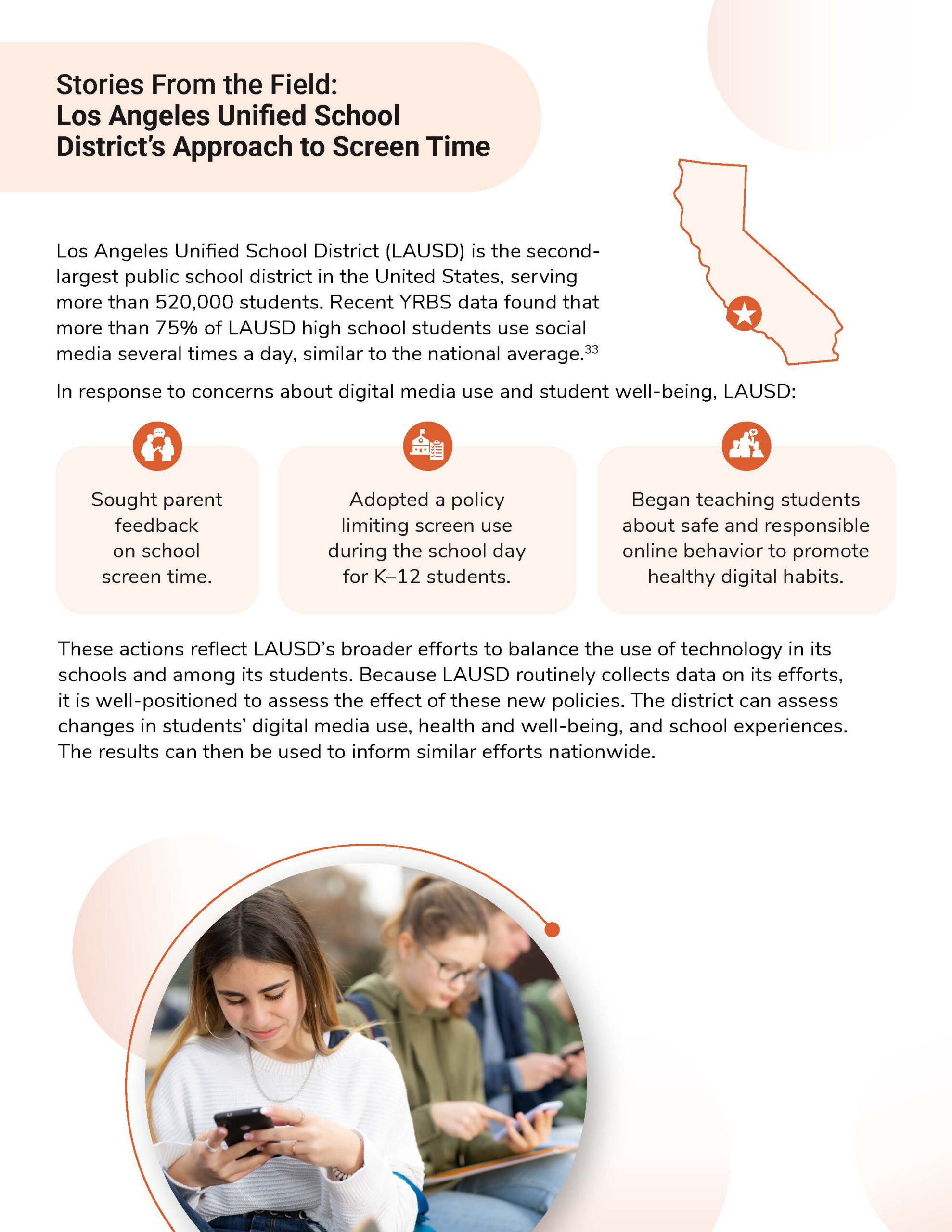
Los Angeles Unified School District's approach to screen time.

Story image titled 'Stories From the Field: Los Angeles Unified School District's Approach to Screen Time.' Text explains that LAUSD is the second-largest public school district in the U.S., serving more than 520,000 students, and that recent YRBS data found more than 75% of LAUSD high school students use social media several times a day, similar to the national average. In response, LAUSD sought parent feedback on school screen time, adopted a policy limiting screen use during the school day for K–12 students, and began teaching students about safe and responsible online behavior. Text notes LAUSD's data collection positions it to assess the effects of these policies on students' digital media use, health, and school experiences, which could inform nationwide efforts. Includes a map of California with Los Angeles marked and a photo of students looking at their phones.

Content Source
Adolescent and School Health; National Center for Chronic Disease Prevention and Health Promotion
About This Page
Published:
Updated: August 14, 2026

This page was last updated on this date. Updates may include minor edits, image changes, or other modifications to page content.

Reviewed: September 18, 2026

The information on this page was last reviewed by subject matter experts to ensure accuracy.