



What to know
The Vision and Eye Health Surveillance System (VEHSS) reports the prevalence of indicators for receiving screening and low vision services using self-reported data from national surveys and additional measures from administrative claims databases. A low vision service is a specialized health care service that helps people make the best use of their remaining vision when it cannot be fully corrected with regular glasses, contact lenses, medication, or surgery.
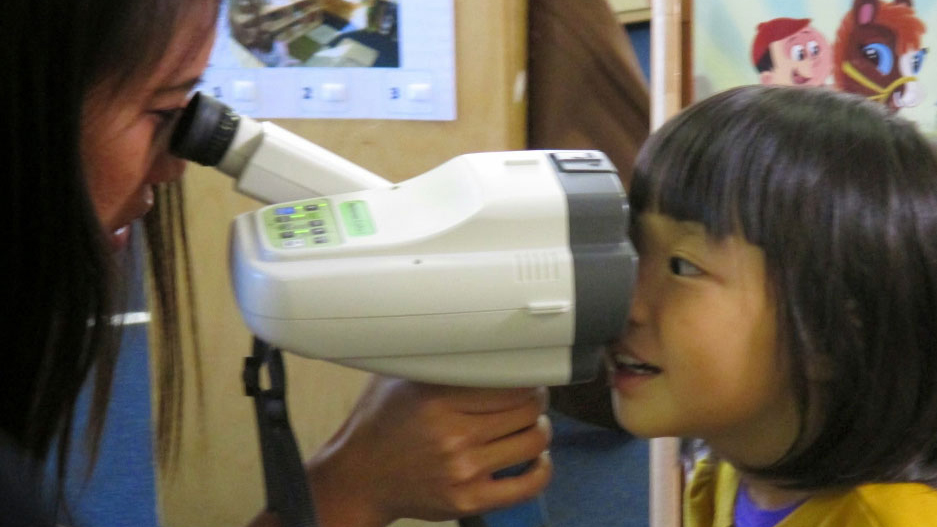
Reported receiving screening
Vision screening includes self-response survey questions from the National Survey of Children’s Health (NSCH) and the National Health Interview Survey (NHIS) indicating that the respondent’s child had a vision test or screening, where the testing occurred, and who did the testing.
Dataset
Description
Question Text
Variable Name(s)
Sample
Response Options
NSCH
Percentage of children who have ever had their vision tested with pictures, shapes, or letters
Has this child EVER had his or her vision tested with pictures, shapes, or letters?
K4Q31_R
Ages 0-17 years
1 - Yes, 2 - No
NSCH
Percentage of children who have ever had their vision tested with pictures, shapes, or letters at an eye doctor or specialist, pediatrician/general doctor’s office, clinic, school, or other
If yes, what kind of place or places did this child have his or her vision tested? Mark ALL that apply.
k4q32x01, k4q32x02, k4q32x03, k4q32x04, k4q32x05
Ages 0-17 years
Eye Doctor, Specialist, Pediatrician / general doctor’s office, Clinic, School, Other
NHIS – Child module
Percentage of children who ever had their vision tested by a doctor or other health professional
Has <child name> had his/her vision tested by a doctor or other health professional?
CVISTST_C
Ages 0-17 years
1 – Yes, 2 - No, 7 – Refused, 9 – Don’t Know
Patients receiving screening services
VEHSS calculates the annual percentage of people who had a vision or eye disease screening claim in administrative claims and electronic health record (EHR) registry data. These prevalence rates and counts only include services that generated an insurance claim or EHR with an included procedure code during the year of observation.
Screening services include the following subgroups:
Subgroup
Included Procedure Codes
Glaucoma screening
G0117, G0118
Telemedicine screening
92227, 92228
Vision screening
99172, 99173, 99174, 99177
Reported use of low vision rehabilitation services
Self-reported use of low vision rehabilitation services includes questions from NHIS that ask if a person uses vision rehabilitation services or has been advised by a health professional that vision rehabilitation services are available.
Dataset
Description
Question Text
Variable Name(s)
Sample
Response Options
NHIS – Adult module
Proportion of persons who have trouble seeing that use vision rehabilitation services
Do you use any vision rehabilitation services, such as job training, counseling, or training in daily living skills and mobility?
AVISREH_A
Ages 18 years and older with any vision difficulty
1 – Yes, 2 – No, 7 – Refused, 9 – Don’t Know
NHIS – Adult module
Proportion of persons with trouble seeing who were told by doctor that vision rehabilitation services or adaptive devices are available to help with vision difficulties
Has a health professional EVER advised you that vision rehabilitation services and assistive, adaptive, or accessibility devices are available to help with your vision difficulties?
AVISSADV_A
Ages 18 years and older with any vision difficulty who do not use rehabilitation services or assistive devices
1 – Yes, 2 – No, 7 – Refused, 9 – Don’t Know
This page was last updated on this date. Updates may include minor edits, image changes, or other modifications to page content.
The information on this page was last reviewed by subject matter experts to ensure accuracy.