



Key points
- PrEP is medicine that greatly reduces your chance of getting HIV from sex or injection drug use.
- PrEP is for people without HIV who may be exposed to HIV through sex or injection drug use.
- Most insurance plans and state Medicaid programs cover some form of PrEP.
Overview
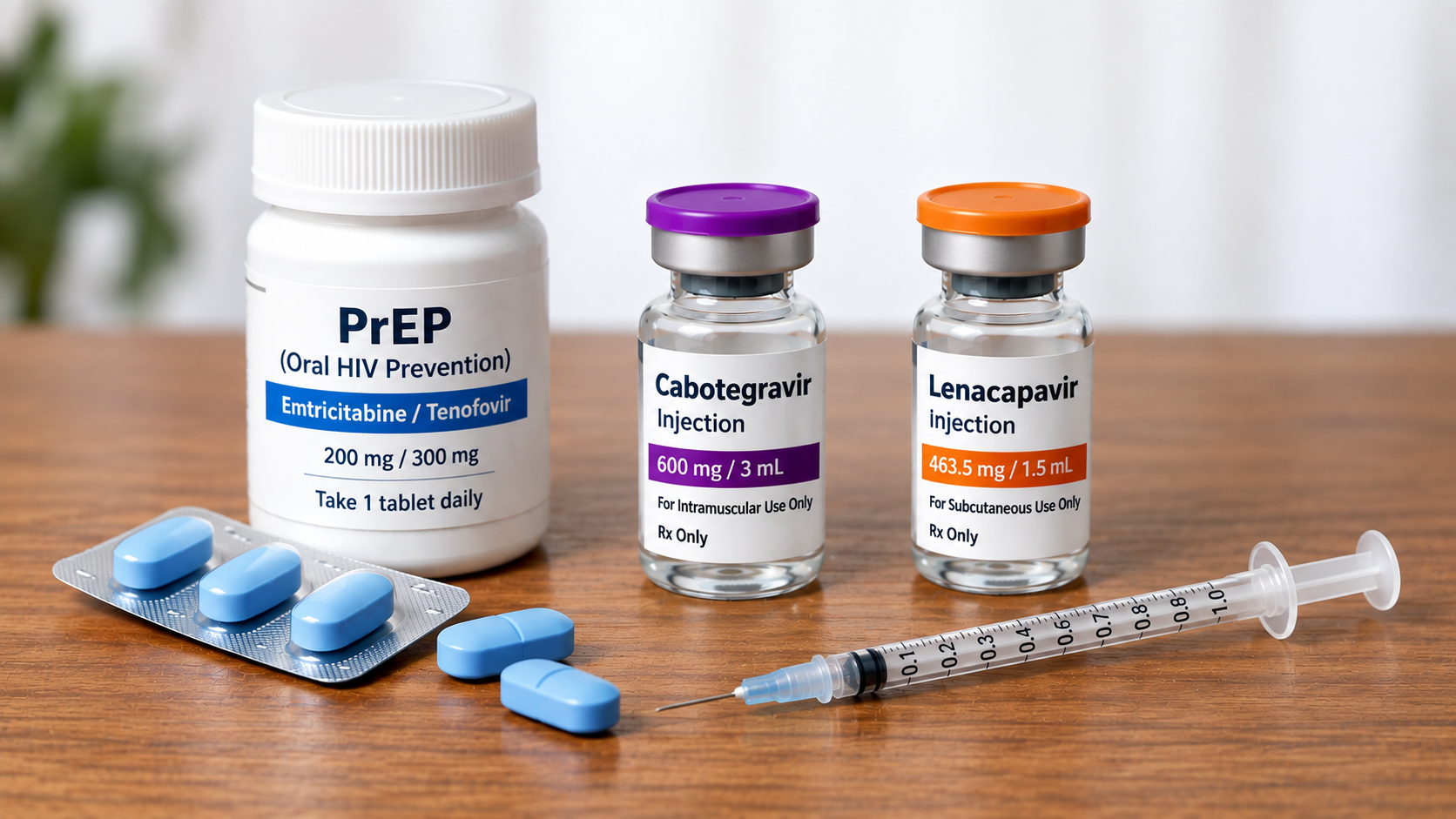
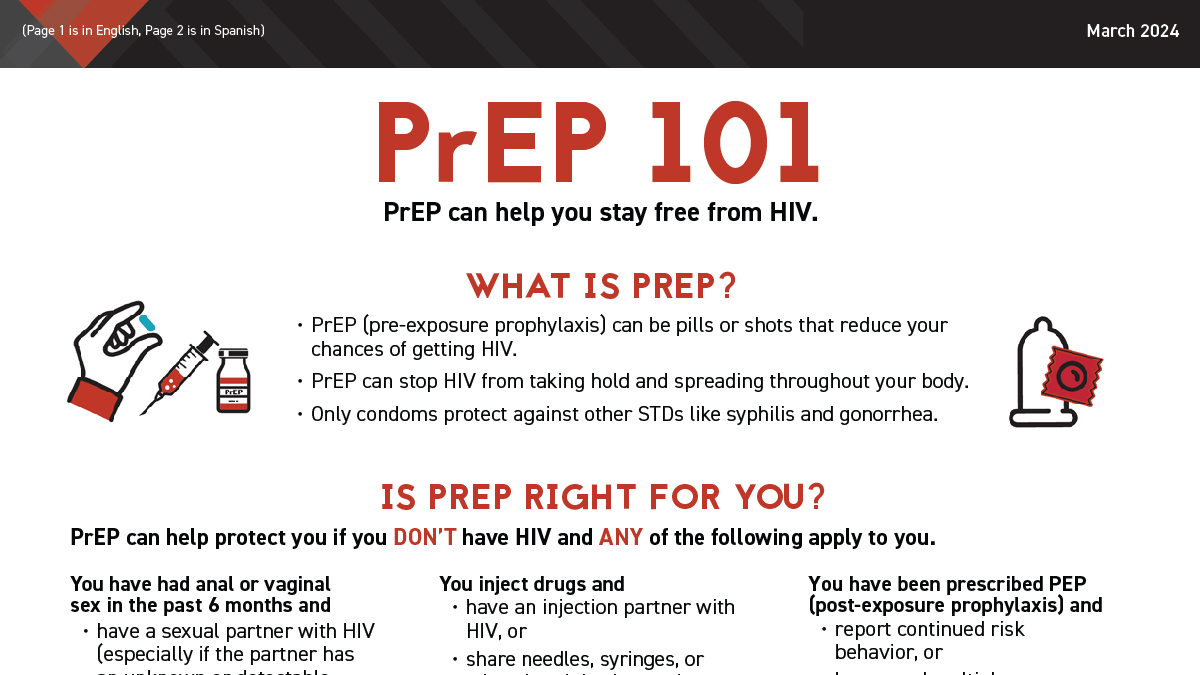
PrEP (pre-exposure prophylaxis) is medicine (pills or shots) that reduces your chance of getting HIV.
PrEP is for adults and adolescents without HIV who may be exposed to HIV through sex or injection drug use.
PrEP can help prevent HIV while trying to conceive, during pregnancy, or while breastfeeding, which also protects their babies from HIV exposure. Talk to your health care provider to see if PrEP is right for you.
PrEP safety and interactions
PrEP is safe to take. Some people experience side effects like diarrhea, nausea, headache, fatigue, stomach pain, or pain at the injection site for PrEP shots. These side effects usually go away over time. However, you should talk to your health care provider about any side effects that are severe or do not go away.
PrEP and birth control
There are no known interactions between PrEP and hormone-based birth control methods, e.g., the pill, patch, ring, shot, implant, or IUD. It is safe to use both at the same time.
PrEP and hormone therapy
There are no known drug conflicts between PrEP and hormone therapy. It is safe to use both at the same time.
PrEP effectiveness
PrEP greatly reduces your chance of getting HIV from sex or injection drug use.
- For receptive anal sex (bottoming), PrEP pills reach maximum protection from HIV at about 7 days of daily use.
- For receptive vaginal sex and injection drug use, PrEP pills reach maximum protection at about 21 days of daily use.
- There are no data available on the time to protection for the insertive partner (top) taking PrEP pills.
- How long PrEP shots take to protect you depends on the type of shot. Some PrEP shots require extra steps when you first start them, such as taking PrEP pills for a short time. Follow your health care provider's instructions to make sure you get the most protection possible.
Deciding if PrEP is right for you
You may be a good candidate for PrEP if you do not have HIV and any of these scenarios apply to you:
You have had anal or vaginal sex in the past 6 months and you
- have a sexual partner with HIV (especially if the partner has an unknown or detectable viral load),
- have not consistently used a condom, or
- have been diagnosed with a sexually transmitted disease in the past 6 months.
You inject drugs and you
- have an injection partner with HIV, or
- share needles, syringes, or other drug injection equipment (for example, cookers).
You have been prescribed PEP (post-exposure prophylaxis) and you
- report continued risk behavior, or
- have used multiple courses of PEP.
You may choose to take PrEP, even if the behaviors listed above don’t apply to you.
Paying for PrEP
Most insurance plans and state Medicaid programs cover PrEP. Under the Affordable Care Act, PrEP must be free under almost all health insurance plans. That means you can't be charged for your medication, clinic visits, and lab tests needed to maintain your prescription.
If you don't have insurance or Medicaid coverage, some companies—like Gilead and ViiVConnect—have assistance programs that can provide free or lower cost PrEP.* Some states have PrEP assistance programs. Some programs cover PrEP medication, while others cover clinic visits and lab tests. Some programs cover both.
*Use of trade names and commercial sources is for identification only and does not imply endorsement by the U.S. Department of Health and Human Services.
Making a plan
Talk to your health care provider if you think PrEP is right for you. PrEP can be prescribed by any health care provider who is licensed to write prescriptions. In some states, pharmacists can also prescribe PrEP. If you don't have a health care provider, you can use the locator below to find a PrEP provider near you.
Starting PrEP
Before starting PrEP, you must take an HIV test to make sure you don't have HIV.
While taking PrEP, you'll have to visit your health care provider routinely as recommended for
- follow-up visits,
- HIV tests, and
- prescription refills or shots.
Ask your health care provider about getting tested for HIV and telehealth services for follow-up visits. If you are receiving PrEP shots, you'll need to visit your health care provider for your shot.
Staying on PrEP
You must take PrEP as prescribed for it to work. If you do not take PrEP as prescribed, there may not be enough medicine in your bloodstream to block the virus. The right amount of medicine in your bloodstream can stop HIV from taking hold and spreading in your body.
Stopping PrEP
There are several reasons why people stop taking PrEP. Talk to your health care provider if you're thinking about stopping PrEP. They'll discuss how to stop PrEP safely and suggest other HIV prevention methods that may work better for you.
On-demand PrEP
Some people take PrEP pills only when they have a high chance of getting HIV. This is known as "on-demand" PrEP or "intermittent," "non-daily," "event-driven," or "off-label" PrEP use.
- The type of "on-demand" PrEP that has been studied is the "2-1-1" schedule. This means taking 2 pills 2-24 hours before sex, 1 pill 24 hours after the first dose, and 1 pill 24 hours after the second dose.
- There is scientific evidence that the "2-1-1" schedule provides effective protection for gay and bisexual men when having anal sex without a condom.
- We don't know how "on-demand" PrEP works for preventing transmission through injection drug use or vaginal sex.
Some health departments in the United States and some health organizations in Europe and Canada offer guidance for "on-demand" PrEP as an alternative to daily PrEP for gay and bisexual men.
Although the updated PrEP guideline provides information on how to correctly use the "2-1-1" schedule, this approach is not approved by the U.S. Food and Drug Administration (FDA) and is not recommended by CDC. Taking PrEP as prescribed is currently the only FDA-approved schedule for taking PrEP to prevent HIV.
This page was last updated on this date. Updates may include minor edits, image changes, or other modifications to page content.
The information on this page was last reviewed by subject matter experts to ensure accuracy.