



What to know
The Investigating Respiratory Viruses in the Acutely Ill (IVY) network was an influenza (flu), COVID-19, and respiratory syncytial virus (RSV) vaccine effectiveness network that consisted of 26 medical centers in 20 U.S. states. IVY enrollment ended in May 2025. This page is for historical purposes and provides background about IVY and how its findings support ongoing public health work.
Background
Prior to December 2022, the network was known as the "Influenza and Other Viruses in the Acutely Ill network." IVY was created in 2019 to estimate how well flu vaccines worked to prevent severe flu illness among intensive care unit (ICU) patients. The network was then expanded to also assess how well flu, COVID-19, and RSV vaccines and preventive products worked to prevent hospitalizations associated with flu, SARS-CoV-2 (the virus that causes COVID-19) and RSV, respectively. In 2024, patients hospitalized with human metapneumovirus (hMPV) were added to monitor hMPV disease among hospitalized adults; there are no licensed vaccines to protect against hMPV. IVY enrollment ended in May 2025.
Flu vaccine effectiveness
Measuring vaccine effectiveness (VE) in hospitalized adults is important to better understand how well flu vaccines work at reducing the risk of flu-associated hospitalizations and intensive care unit (ICU) admissions.
VE among adults 65 years and older is especially important because this group of people has the highest flu-associated hospitalization rates compared with other age groups.
CDC measures VE to evaluate the benefits of flu vaccines in different age groups and against different clinical outcomes, such as hospitalization or ICU admission. These efforts helped convey the importance and impact of flu vaccination.
Although IVY enrollment ended, CDC continues to measure U.S. flu vaccine effectiveness using other flu VE networks.
Sites and study design
26 sites that participated are located in 20 U.S. states
- Baylor Scott & White Medical Center (Texas)
- Baylor University Medical Center (Texas)
- Baystate Medical Center (Massachusetts)
- Beth Israel Deaconess Medical Center (Massachusetts)
- Cleveland Clinic (Ohio)
- Emory University Medical Center (Georgia)
- Hennepin County Medical Center (Minnesota)
- Henry Ford Health (Michigan)
- Intermountain Medical Center (Utah)
- Johns Hopkins Hospital (Maryland)
- Montefiore Medical Center (New York)
- The Ohio State University Wexner Medical Center (Ohio)
- Oregon Health & Science University Hospital (Oregon)
- Stanford University Medical Center (California)
- UCLA Medical Center (California)
- University of Colorado Hospital (Colorado)
- University of Iowa Hospitals (Iowa)
- University of Miami Medical Center (Florida)
- University of Michigan Hospital (Michigan)
- University of Utah (Utah)
- University of Washington (Washington)
- Vanderbilt University Medical Center (Tennessee)
- Wake Forest University Baptist Medical Center (North Carolina)
- Barnes-Jewish Hospital (Missouri)
- University of Arizona Medical Center (Arizona)
- Yale University (Connecticut)
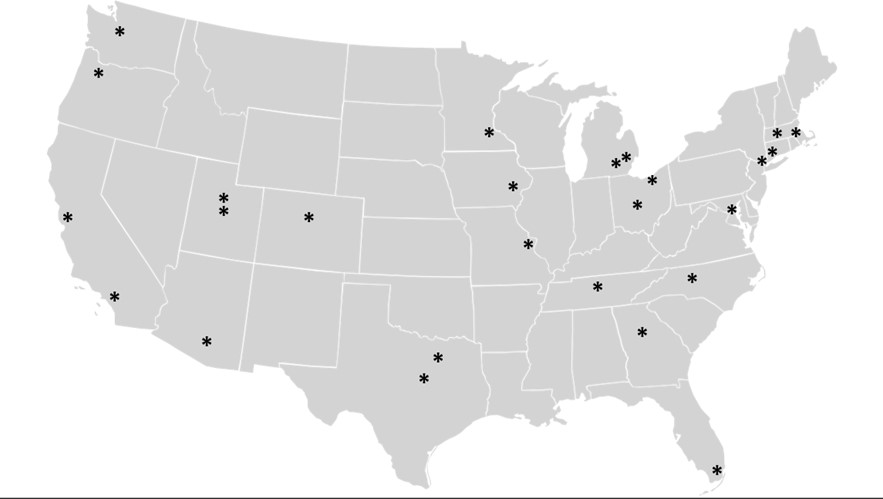
IVY used a test-negative observational study design and collected data at participating hospitals.