



At a glance
As of October 7, 2026
CDC assessed the risk to people in the United States from NWS for the next three months.
- The risk to people in the general U.S. population is very low.
- The risk to people in areas where NWS flies are present is low.
- The risk to people who spend prolonged time outside in areas where NWS flies are present is low.
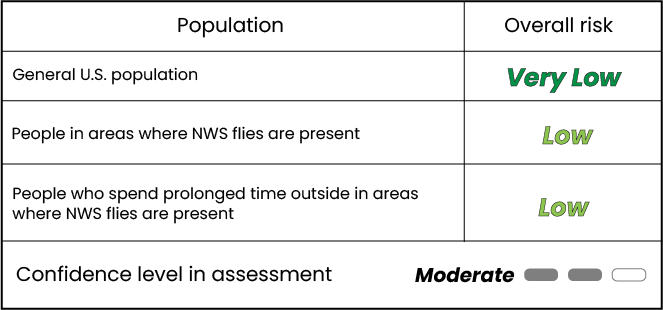
The purpose of this rapid qualitative risk assessment is to inform U.S. preparedness efforts. Risk describes the potential public health implications of an outbreak for human populations assessed. We assessed overall risk to people by considering both likelihood and impact of infestation in each population (see Background and Methods section), under the assumption each population of interest was exposed to the NWS fly. Both the likelihood and impact of infestation are assessed at a population level. Likelihood of infestation considers factors such as pathogen biology and population susceptibility, while impact of infestation considers factors such as disease severity, treatment availability, and public health response resources.
The assessment relied on subject-matter experts evaluating a range of evidence related to risk, including epidemiologic data from the current outbreak and historical data. CDC will continue to monitor the situation, re-evaluate available evidence, and update this risk assessment if new information warrants changes.
Risk to people in the general U.S. population
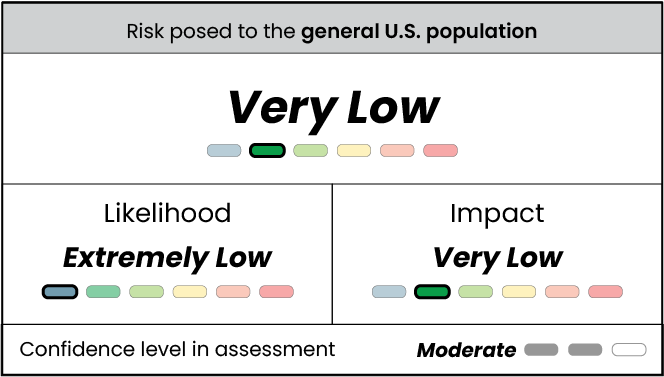
The overall risk to people in the general U.S. population posed by the NWS outbreak is very low. For the purpose of this assessment, the general U.S. population includes all people in the United States where the NWS fly has and has not been detected.
Likelihood
The likelihood of NWS infestation to people in the general U.S. population is extremely low. Factors that informed this assessment of likelihood include the following:
- On June 3, 2026, the United States Department of Agriculture (USDA) confirmed the first NWS animal case in the United States. Cases have primarily occurred in livestock, though domestic dogs have also been infested.
- There are no known domestically acquired human cases in the United States.
- The general U.S. population is very unlikely to be exposed to NWS. NWS is not transmitted directly between humans or between humans and animals; infestation occurs only through exposure to the NWS fly.
- The geographic distribution of the NWS fly and U.S. animal cases is currently limited to areas in the Southwest.
- In Central America and Mexico, human myasis cases due to NWS have been detected in urban areas, demonstrating the fly's presence across both rural and urban environments.
- Individuals traveling to NWS-affected areas, both within and outside of the United States, may be at increased likelihood of exposure to the fly and therefore infestation.
- The United States has capacity to identify human cases, perform morphologic identification of larvae, and provide health education, which increases outbreak responders' ability to understand spread and target mitigation measures.
- A foreign travel-associated human case was identified in the U.S. in 2025, and there was no secondary spread.
- Testing for human myasis cases due to NWS requires a careful specimen collection process, including larvae removal and wound care by a healthcare provider. CDC has provided recommendations regarding correct removal and disposal of larvae and eggs from suspected NWS cases to prevent NWS from continuing the lifecycle and becoming established in new areas.
- Although there are no licensed vaccines or other medical countermeasure that prevent or treat human myasis cases due to NWS, there are steps individuals can take to protect themselves from infestation.
- The United States has a strong capacity for implementing animal case identification, testing, monitoring, and movement control.
- USDA is leading a coordinated One Health response to combat NWS with other federal, and state partners to control the outbreak through animal case investigations, trace-back activities, testing and surveillance (including trapping), sterile fly releases, outreach to animal owners, and coordination with local officials and partners to increase awareness of the outbreak.
- NWS infests live animals, not food products. Food animals presented for slaughter undergo inspection by the USDA Food Safety and Inspection Service, and animals affected by NWS would be identified during the inspection process This is not a food safety issue—the U.S. food supply remains safe.
Impact
The impact of infestation for the general U.S. population is very low. Factors that informed the assessment of impact included the following:
- Although advanced NWS infestation, or myiasis, can lead to significant adverse health outcomes, it is unlikely to be fatal.
- Symptoms of NWS infestation include pain, visible larvae in the wound, bleeding from the wound, difficulty with wound healing, and a foul-smelling odor around the wound.
- Nerve or organ damage is possible if left untreated and based on the proximity of the wound.
- There have been human deaths in this outbreak in Central America and Mexico. These deaths occurred in individuals with factors such as advanced age, limited mobility, poor wound care, and subsequent secondary bacterial infections.
- Clinical outcomes are expected to be better with the specialized care available in the United States.
- There are currently no known medical countermeasures (e.g., vaccines, medications) to treat or prevent NWS infestation in humans.
- The Food and Drug Administration (FDA) has conditionally approved and/or authorized medications for prevention and treatment of NWS in animals.
- Treatment of the infestation is the physical removal of larvae and subsequent wound care and monitoring. Treatment of secondary bacterial infection may be necessary.
- Infestation may go unnoticed in populations such as infants and elderly or infirm individuals, therefore delaying treatment and resulting in more severe illness.
- Individuals who lack access to healthcare may delay treatment or attempt to self-treat, resulting in more severe illness.
- Thorough larvae removal and proper disposal are needed to prevent further spread of NWS.
- U.S. resources are being used for public health response, and this outbreak has captured media attention and public interest.
- The situation is unlikely to cause disruption to normal activities for the general U.S. population.
- NWS has the greatest anticipated impact in livestock production, if not controlled.
- Sale and transport of animals from impacted areas may be restricted to avoid spread to new areas. Infested companion animals may also need to be treated before transport.
- Additional monitoring and control measures may be implemented if further infestations in domestic and wildlife animal populations in impacted areas occur.
- This assessment only considers risk to human health and does not consider the impact on animal health. NWS can have devastating effects on livestock and domestic animal health and cause serious economic impacts.
Risk to people in areas where NWS flies are present
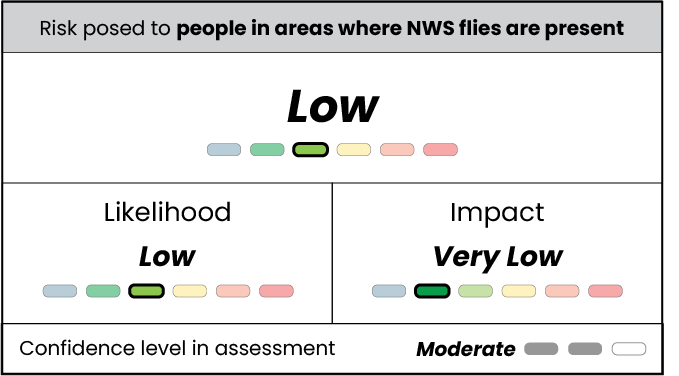
The overall risk posed by the New World screwworm outbreak to people in areas where NWS flies are present is low.
Likelihood
The likelihood of NWS infestation among people in areas where NWS flies are present is low.
- Areas in the United States where NWS cases have been reported in animals remain limited to parts of the Southwest.
- Of the cases reported in this outbreak in Mexico and Central America, there are more than 209,400 NWS cumulative cases reported in animals and 2,600 cases in people, thus, human cases consist of <2% of the total number of cases in outbreak affected areas.
- Human myasis cases due to NWS in Mexico and Central America continue to increase.
- Though human case data is limited in some areas, the presence of animal cases in all countries in Central America and Mexico indicates that the NWS fly is spreading through the region.
- Animals with outdoor access, including companion animals, may be exposed to the NWS fly and are at risk of infestation in these areas, thereby increasing the likelihood of infestation among people in areas where NWS flies are present.
- As a part of the NWS life cycle, larvae pupate in soil before emerging as flies. An infested animal does not transmit this disease directly to humans; however, when flies are present in an area, they may infest any warm-blooded animal, including humans.
- Jurisdictions throughout the United States are collaborating with federal agencies to prepare for and respond to this outbreak.
- Agriculture and animal health agencies in affected jurisdictions and surrounding areas are engaging in animal outbreak preparedness and response operations such as messaging and education, case investigation and tracing, and trapping and identification.
- Public health agencies are conducting monitoring, specimen collection, laboratory testing, and education on human health impacts in affected jurisdictions and surrounding areas.
- USDA, with other federal, state, tribal, local, and territorial partners, is implementing animal movement restrictions in infested areas, increasing sterile fly production, and continuing to expand its robust surveillance to control this outbreak. Not all countries in Central America have the capacity to fully implement this approach at this scale, which may be contributing to higher numbers of human and animal NWS cases outside of the United States.
Impact
The impact of NWS infestation among people in areas where NWS flies are present is very low. In addition to the impact factors listed in the general population assessment above:
- Jurisdictional resources are being used for public health response, and this outbreak has captured media attention and public interest particularly in affected areas.
- The situation may cause disruption to daily activities for people in affected areas:
- NWS prevention activities may include closely monitoring companion animals that spend time outdoors, taking steps to repel the fly, and avoiding spending time outdoors if flies are detected nearby.
- Sale and transport of animals out of affected areas may be restricted.
- If some human myasis cases due to NWS occur in these areas, laboratory and healthcare capacity (including diagnostic resources and treatments) may need additional resources.
- NWS treatment protocol requires monitoring and follow-up, which may pose challenges for people with limited access to healthcare, such as people in rural settings.
Risk to people who spend prolonged time outside in areas where NWS flies are present
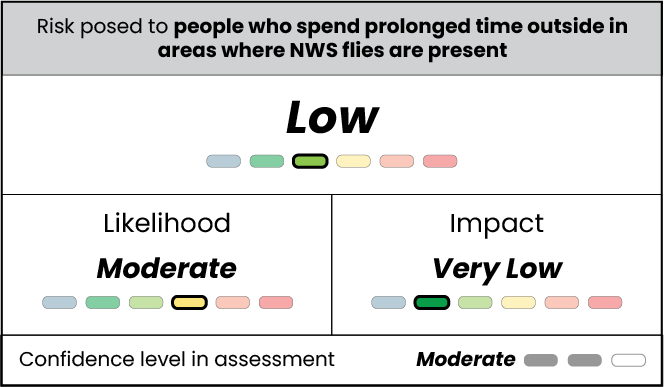
The overall risk posed by the New World screwworm outbreak to people who spend prolonged time outside in areas where NWS flies are present is low.
Likelihood
The likelihood of NWS infestation among people who spend prolonged time outside in areas where NWS flies are present is moderate.
- Individuals whose occupations require prolonged outdoor work, particularly work involving livestock, companion animals, wildlife, or other warm-blooded animals, may have increased opportunities for exposure to NWS flies, and therefore infestation.
- Certain work activities may also result in cuts, abrasions, insect bites, or other breaks in the skin that could provide sites for NWS flies to lay eggs. Working near an infested animal does not result in direct animal-to-human transmission but may indicate that NWS flies are present in the work environment.
- Employers of workers who spend prolonged time outside may leverage prevention measures to reduce the likelihood of infestation, such as providing human insect repellent and other supplies, prevention education for workers, and using insecticide treatment on animals.
- Many cases in this outbreak in Mexico and Central America have involved individuals who spent time outside, however, not all were outdoor workers and occupational data for these cases is limited.
- Individuals who spend a lot of time outside during the day, such as people who sleep outside or are experiencing homelessness, in areas where NWS flies are present may be more likely to be exposed and infested.
- Individuals with open wounds or breaks in the skin, or who have a reduced ability to deter the fly or tend to wounds, may be at additional increased likelihood of exposure and infestation.
- An analysis of cases in Mexico in April 2025-March 2026 indicated that majority of cases occurred in adult men, and a high proportion of these cases had concurrent conditions such as diabetes, alcoholism, hypertension, and others. These findings suggest that chronic health conditions and social vulnerabilities that can impede self-care may contribute to a higher likelihood of infestation.
Impact
The impact of infestation among people who spend prolonged time outside in outbreak areas is very low. In addition to the impact factors listed in the assessments above:
- Some people who spend prolonged time outside in outbreak areas because of their occupation or other circumstances, such as those who work outside or individuals experiencing homelessness, may face barriers to accessing timely healthcare which could delay diagnosis and treatment.
- For workers, factors such as remote work locations or workplace reporting and healthcare-access arrangements may affect how quickly suspected infestation is identified and treated.
Key Uncertainties
CDC has moderate confidence in this assessment. We note uncertainty in the following areas:
- Current animal case surveillance, including monitoring, testing, and data reporting, can vary by animal population (e.g., companion animals, livestock, wildlife).
- Some epidemiological linkages among animal cases in this outbreak are unknown.
- There is uncertainty in the geographic spread of NWS flies.
- Visual identification of NWS larvae may require subject matter expertise that not all local or state laboratories possess.
- Sterile insect technique continues to be in use as production ramps up. Current evidence indicates a small population in the currently-infested areas, and future fly releases are expected to have an impact on geographic spread.
- Historically, winter freezes have restricted the year-round survivable range of NWS in the United States. Timing and degree to which it will be deterred are uncertain.
- Fly populations may be challenging to control and predict, and early infestations can be difficult to identify in pets, livestock, and wildlife.
- There is uncertainty in the number of human and animal cases in other countries with current outbreaks. There are differences in outbreak data reporting, and there may be underreporting due to factors such as healthcare access, self-treatment, and/or laboratory capacity.
- Currently available case data may not consistently capture key case information like occupational exposure. In these cases, specific work tasks, duration or intensity of occupational outdoor exposure, animal contact, skin injuries/wounds, workplace prevention measures, and healthcare access are needed to characterize differences in likelihood and impact of infestation among occupational groups.
Factors that could change this assessment
This risk assessment may be revised as the outbreak evolves. CDC continues to monitor factors that could change this risk assessment, including:
- Detection of NWS cases in animals in more geographic areas in the United States
- Detection of cases of NWS in wildlife, which are more difficult to track, treat, and control
- Detection of first human case acquired domestically in the United States in areas with known NWS cases in animals or fly detections
- Detection of first human case in the United States in an area without known NWS cases in animals or fly detections
- Evidence suggesting changes in clinical severity or infestation dynamics compared to past outbreaks
- Increased availability of medical countermeasures for animals and humans
Background and Methods
New World screwworm (Cochliomyia hominivorax) is an obligate parasitic fly. Females lay eggs in open wounds, and the hatching larvae cause severe myiasis by burrowing into living healthy tissue in mammals and birds.
The New World screwworm is endemic in South America, parts of southern Central America, and some Caribbean islands. The historic range of the New World screwworm once extended upward into the southern and western United States; however, the United States eradicated it in 1966 by using the sterile insect technique and intense monitoring with prompt isolation and treatment of infested animals. The control program eradicated the flies from Mexico through Panama by 2006. However, the NWS impact on human health was not thoroughly documented before its eradication in the United States. USDA and Panama jointly operated and funded a sterile NWS fly production facility for control efforts in North America. From 2006 to 2023, continuous sterile fly releases helped maintain a barrier against NWS at the Darién Gap, preventing NWS from spreading northward from Colombia into Panama.
Since 2023, a growing outbreak of New World screwworm has resulted in a resurgence of human and animal cases across Central America and Mexico.
CDC is supporting response efforts in the current outbreak by working with the USDA, the Department of the Interior (DOI), and other federal and state, local, and tribal partners to prevent further spread of NWS among people and animals using a One Health approach. CDC is providing recommendations on preventing and treating human infestations and on laboratory testing. These efforts builds on longstanding work with international partners on NWS awareness, surveillance, and One Health collaboration.
CDC subject matter experts specializing in qualitative risk assessment methods and New World screwworm collaborated to develop this rapid assessment. Experts initially convened in June 2026 to discuss the need for an assessment of the human health risks posed by NWS in the United States.
Risk was estimated by combining the likelihood of infestation and the impact of the disease. For example, low likelihood of infestation combined with high impact of disease would result in moderate risk. The likelihood of infestation refers to the probability that people in the U.S. general population would acquire NWS over the next three months, which in turn depends on the likelihood of exposure and susceptibility of the population to infestation. The impact of infestation considers several factors affecting the consequences of infestation, including the severity of disease, level of population immunity, availability of treatments and vaccines, and resources needed for the public health response. Experts assigned a degree of confidence to each level of the assessment, considering quality, extent, and corroboration of evidence.
For more details on these methods, please see the risk assessment methods webpage.
This page was last updated on this date. Updates may include minor edits, image changes, or other modifications to page content.
The information on this page was last reviewed by subject matter experts to ensure accuracy.