



At a glance
Overview
We can't do this work alone. Achievement of many PHDS milestones require coordination, collaboration, and partnership across CDC, federal agencies, healthcare partners and state, tribal, local, and territorial (STLT) health departments. Here are some examples of how CDC supports and engages with partners to realize the impact of the PHDS.
Funding for STLT health departments to modernize systems and data infrastructure. Since FY20, CDC has provided more than $1 billion directly to STLT public health departments to support data modernization efforts. Data modernization funding is provided to STLTs through the Epidemiology and Laboratory Capacity Program and the Public Health Infrastructure Grant. In addition, CDC provides technical assistance directly and through partner organizations to accelerate data modernization activities. CDC has also provided funding to establish Implementation Centers, which provide crucial technical support and resources to modernize public health infrastructure.
Workforce development. First launched in 2024 with a $66 million award from CDC through a partnership with the CDC Foundation, the Workforce Acceleration Initiative (WAI) is a national effort to strengthen public health's technical workforce and accelerate public health information system improvements by placing experienced data and technology professionals — including experts in engineering, software development, data analytics, informatics, and IT project management — directly in selected STLT health departments. The results are tangible: many projects that would typically take multiple years are moving forward in 18 months or less.
Resources on artificial intelligence (AI): CDC's AI Strategy outlines the agency's blueprint for harnessing AI to improve threat detection and response, reduce operational burden, and empower innovation. Two accompanying resources for public health partners — Considerations for Generative AI in Public Health and Considerations for Agentic Research in Public Health — offer practical steps for public health partners to consider when using generative AI, emphasizing transparency, security, and human oversight.
Human-centered design and impact-oriented product development approaches. CDC brings together expertise in human-centered design and technology to help inform the development of solutions for case data exchange among STLT health departments and national partners. CDC's Case Service Design efforts have engaged with our STLT partners to co-create the future state for end-to-end data exchange. Service design artifacts such as blueprints, needs and insights, and archetypes have been created to help inform new and ongoing data modernization efforts. Case Service Design focuses on connecting people, processes, and technology so that public health professionals can get the data they need to inform public health action.
Partnering Across the Public Health Ecosystem
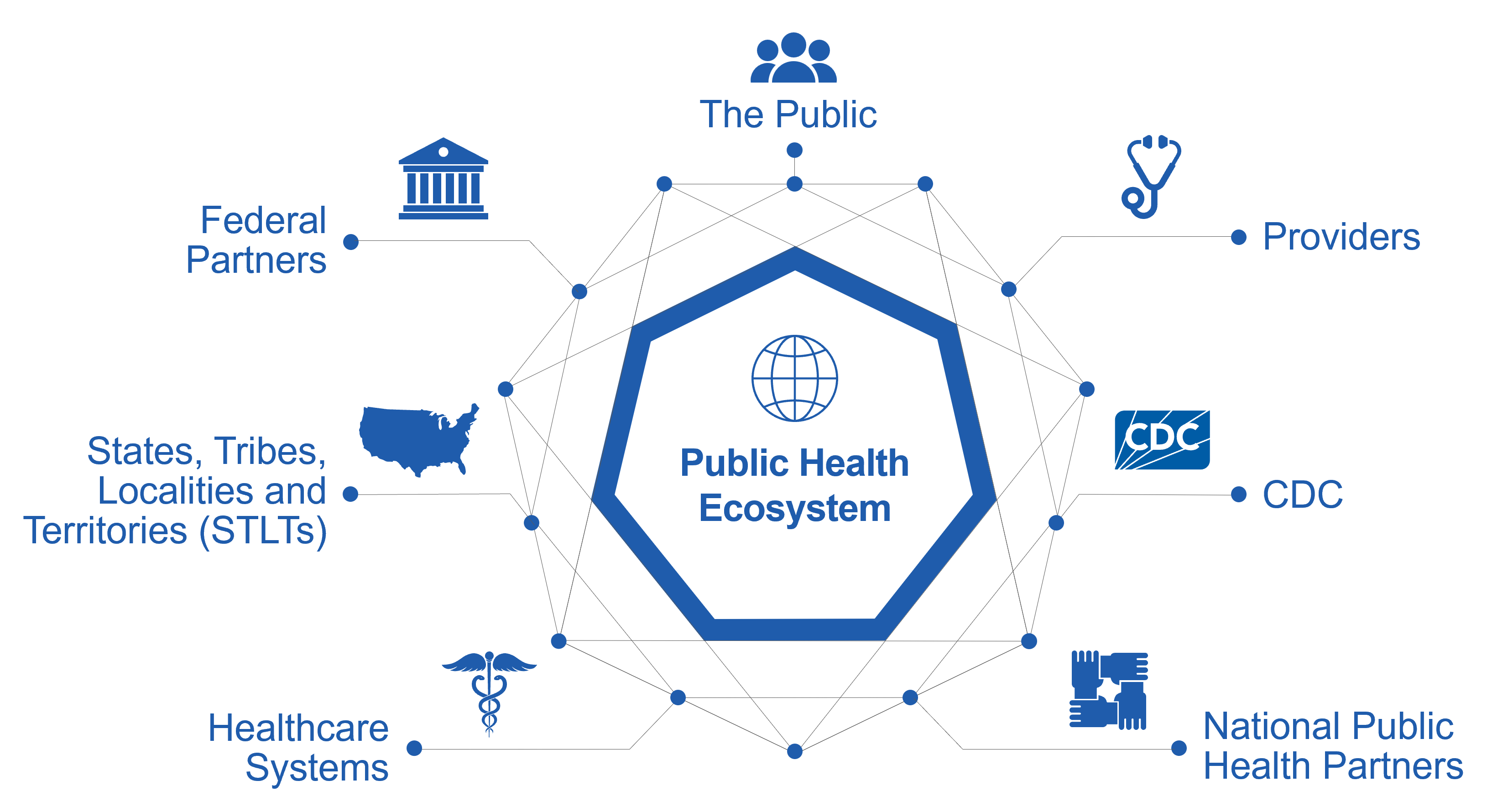
"Public health ecosystem" describes public health's connectivity across the nation for systems that depend on, influence, and interact with each other. This ecosystem also includes the workforce, policies, and technologies used to collect, manage, access, share, analyze, and disseminate the most relevant data.
The PHDS sets a roadmap for the ecosystem to improve our communities and keep people safe. There are many actors in the ecosystem that have critical roles in data and action for public health. It takes a coordinated effort to make progress in data exchange.
Learn more about how CDC works with partners to advance data modernization.
This page was last updated on this date. Updates may include minor edits, image changes, or other modifications to page content.
The information on this page was last reviewed by subject matter experts to ensure accuracy.