Key points
- Time-in focuses on connection, empathy, and supporting children during distress rather than isolating them.
- Check and meet physical needs (hunger, fatigue, discomfort) before using time-in.
- Use time-in for emotional distress; use time-out for unsafe or aggressive behavior.

Overview
Time-in is a method focused on connection and communication. It involves staying with your child during challenging moments and providing support and reassurance. When toddlers or preschoolers act disruptively, fostering a connection with their parents and trusted caregivers becomes crucial.
Before trying a time-in, check whether the child might have an unmet physical need like hunger, tiredness, or discomfort. If so, meet that physical need first.
Time-in prioritizes empathy and understanding and helps guide children back to calm by avoiding separation or isolation, which can make some children's behavior worse.
Steps for using time-in
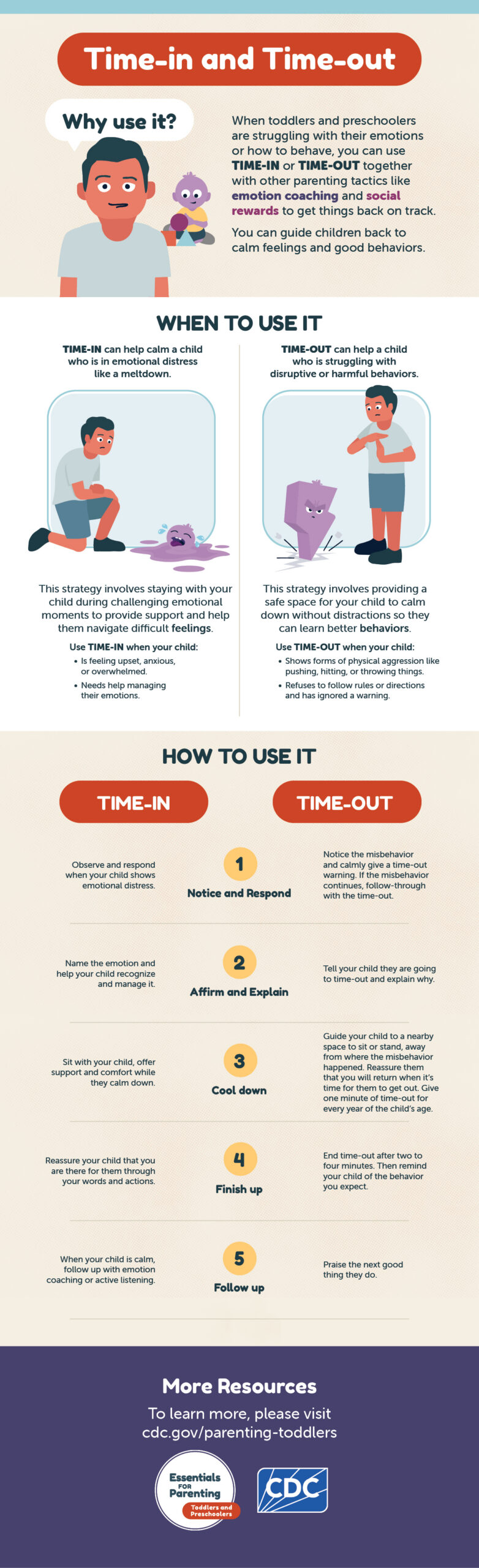
Remember, toddlers and preschoolers need help managing their emotions. Time-in can help calm a child who is in emotional distress like a meltdown.
For example, your child is building a tower out of blocks. Suddenly, the tower falls, and your child gets extremely upset. They start crying and throwing the blocks out of frustration. In this situation, your child's emotional distress may occur because they are unable to handle the frustration of their tower falling.
The time-in strategy involves staying with your child during challenging emotional moments to provide support and help them navigate difficult feelings. You might ask, "should we pick up the blocks and continue to play, or should we put them away?"
Acknowledging your child's emotions, discussing their behavior, and emphasizing your connection helps them know you are invested in finding solutions together.
When your toddler is distressed or upset, it may be a good time to try time-in. Before practicing time-in, it’s important to ensure you are calm, taking a pause if needed. Your emotional state can influence your child’s. When you are ready, observe your child and respond when they show emotional distress.
Name the emotion and help your child recognize and manage it. Noticing and naming emotions, part of emotion coaching, can help your child understand and better manage their emotional response.
Sit with your child to offer support and comfort while they calm down. When your child is experiencing emotional distress in a public area, practicing time-in may be challenging, but it’s still possible. Guide your child away from the situation, offering privacy from onlookers while assisting them in calming down.
Use your words and actions to reassure them that you are there for them. Consider using physical touch to connect, ensuring that you’ve asked your child for permission first. When children are angry or frustrated, they may not want physical touch.
When your child is calm, follow up with emotion coaching or active listening. Using these strategies along with time-in can create a positive environment and strengthen your connection with your child.
When to use time-out or time-in
Time-out and time-in are both helpful strategies used to manage behavior in toddlers and preschoolers, and they can be appropriate for different situations.
Time-out can be effective for unsafe or harmful behaviors like hitting or biting. Consider using time-out when:
- Your child is engaging in forms of physical aggression towards others (e.g., pushing, hitting, etc.).
- Your child needs a safe space to calm down from a tantrum involving screaming, kicking, or throwing things.
- Your child is refusing to follow rules and has ignored a warning.
Time-in can be effective for behaviors like emotional meltdowns or distress. Consider using time-in when:
- Your child is feeling upset, anxious, or overwhelmed.
- You feel calm and realize it’s a good time to practice emotion coaching or active listening with your child.
- Your child needs help managing their emotions.
Responding to your child's behavior can be challenging, and it's important to remember that each child is unique. Consider their personality and stage of development when deciding which approach to use. Parents and caregivers face various situations every day, sometimes requiring both time out and time in strategies.
The key is to stay calm and have realistic expectations for children at this age. Remember, all behavior, even misbehavior, is your child's way of communicating and an opportunity for connection.
Reflection
- Have you ever received a kind word, a smile, or a hug just when you needed it the most? How did you feel at that moment?
- Which behaviors do you wish to encourage in your toddler or preschooler?
- How can you express praise to encourage positive behavior in your toddler or preschooler?
- What gestures or physical signs can you use to express that you use to convey your pride in your toddler or preschooler's efforts?
- How will you respectfully ask your child for permission before offering hugs or pats on the back?
- Sometimes it's easier to spot negative behaviors in your child. How can you notice and encourage your child's positive behaviors?
- Have you noticed your child positively responding to time-in?
- How has the practice of time-in influenced your connection with your toddler or preschooler? Has it had any impact on your other family relationships?