



Key points
- CDC established the Norovirus Sentinel Testing and Tracking (NoroSTAT) network in August 2012.
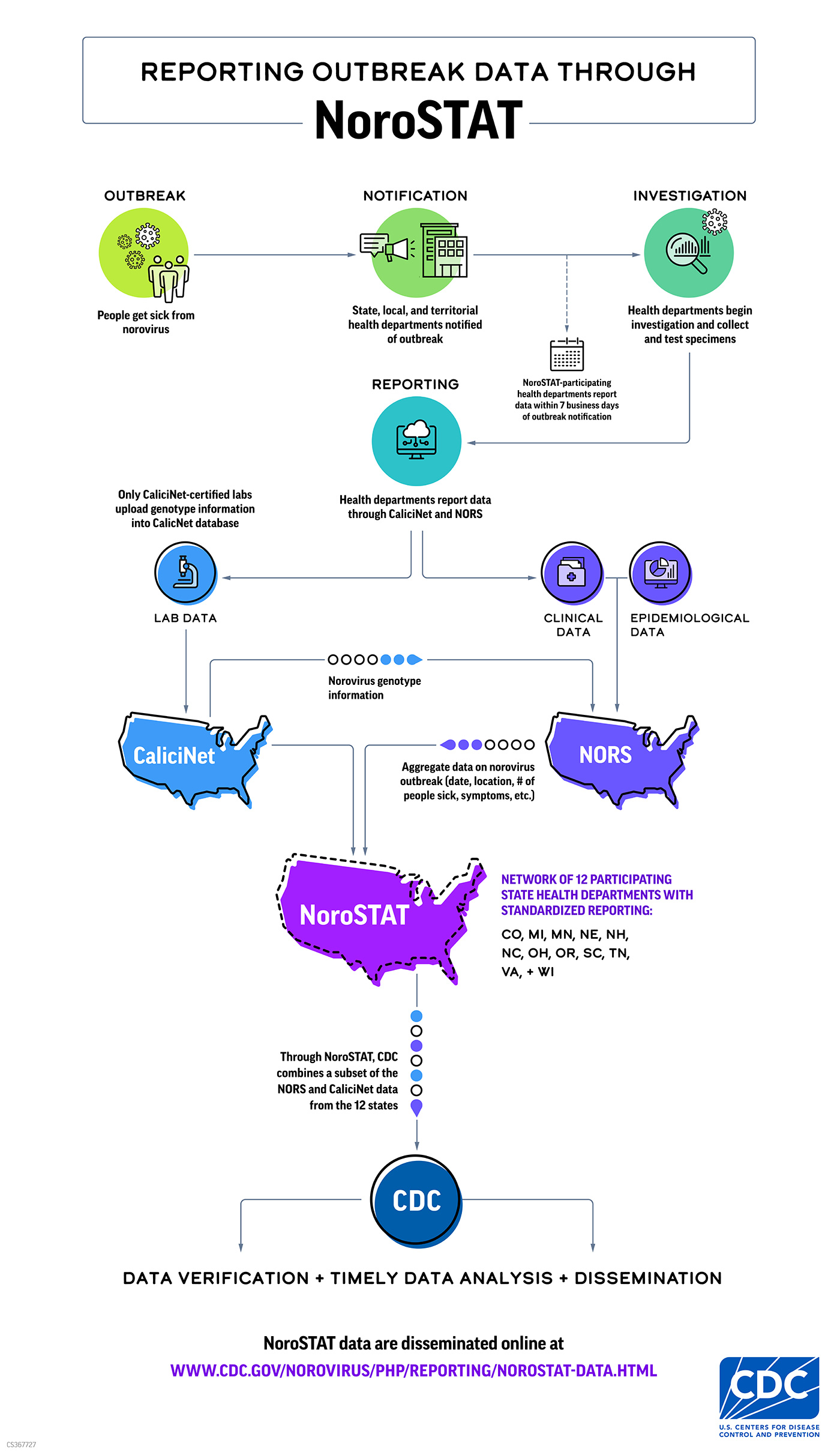
- Through NoroSTAT, CDC combines a subset of the NORS and CaliciNet data from the 12 participating states with standardized reporting.
Format: JPG
Dimensions: 1400 x 2424 pixels
Language: English (US)
Size: 456 KB
Last updated: September 17, 2026
Text equivalent
Reporting Outbreak Data Through NoroSTAT
- During an outbreak, people get sick from norovirus.
- State, local, and territorial health departments are notified of outbreak.
- NoroSTAT-participating health departments report data within 7 business days of outbreak notification.
- Health departments begin investigation and collect and test specimens.
- Health departments report data through CaliciNet and NORS.
- Lab data reported to CaliciNet and integrated into NoroSTAT. Only CaliciNet-certified labs upload genotype information into CaliciNet database.
- Aggregate clinical data and epidemiological data reported to NORS.
- CaliciNet data linked to NORS to provide genotype information.
- NoroSTAT is a network of 12 participating state health departments with standardized reporting: CO, MI, MN, NE, NH, NC, OH, OR, SC, TN, VA, and WI
- For NoroSTAT, CDC combines a subset of the NORS and CaliciNet data from the 12 states.
- CDC oversees data verification, timely data analysis, and data dissemination.
- NoroSTAT data are disseminated online at https://www.cdc.gov/norovirus/php/reporting/norostat-data.html.
Content Source
National Center for Immunization and Respiratory Diseases; Division of Viral Diseases
About This Page
Published: May 15, 2024
Updated: September 17, 2026
This page was last updated on this date. Updates may include minor edits, image changes, or other modifications to page content.
Reviewed: September 17, 2026
The information on this page was last reviewed by subject matter experts to ensure accuracy.