



At a glance
- View hearing loss statistics among workers in all U.S. industries.
- Approximately 11% of all workers have hearing difficulty.
- About 8% of all workers have tinnitus.
- 53% of noise-exposed workers report not wearing hearing protection.
Noise, ototoxic chemicals, and hearing protection
- About 28% of all workers have been exposed to hazardous noise, with 16% (27 million) exposed in the last year.1
- Approximately 13% of all workers (22 million) have been exposed to ototoxic chemicals in the last year.1These chemicals can cause damage to different parts of the ear.
- About 7% of all workers have been exposed to both hazardous noise and ototoxic chemicals in the last year.1
- 53% of noise-exposed workers report not wearing hearing protection.2
Hearing loss and tinnitus
- Approximately 11% of all workers have hearing difficulty.1
- About 8% of all workers have tinnitus, which is an annoying buzzing, rushing, or ringing noise in your ears or in your head.3
- About 20% of noise-exposed tested workers have a material hearing impairment.4 Hearing impairment is hearing loss that impacts day-to-day activities. Material hearing impairment is hearing loss severe enough that a person has difficulty understanding speech.
- 13% of noise-exposed tested workers have hearing impairment in both ears.5
Trends in hearing loss
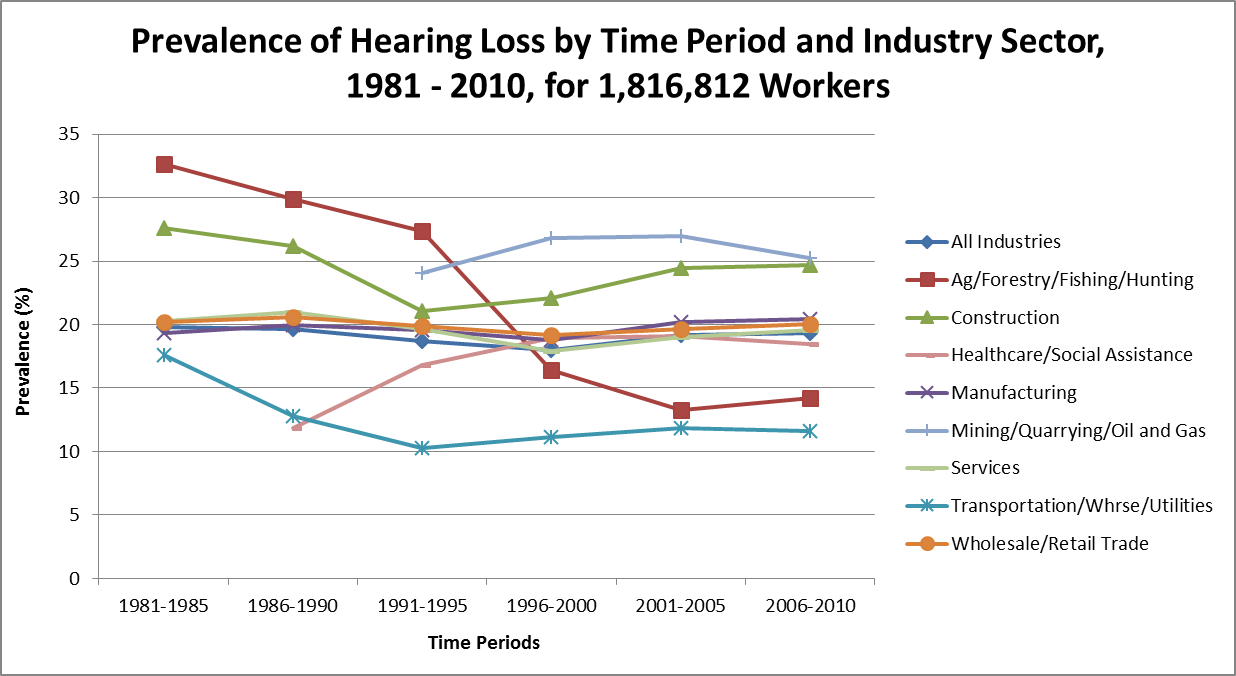
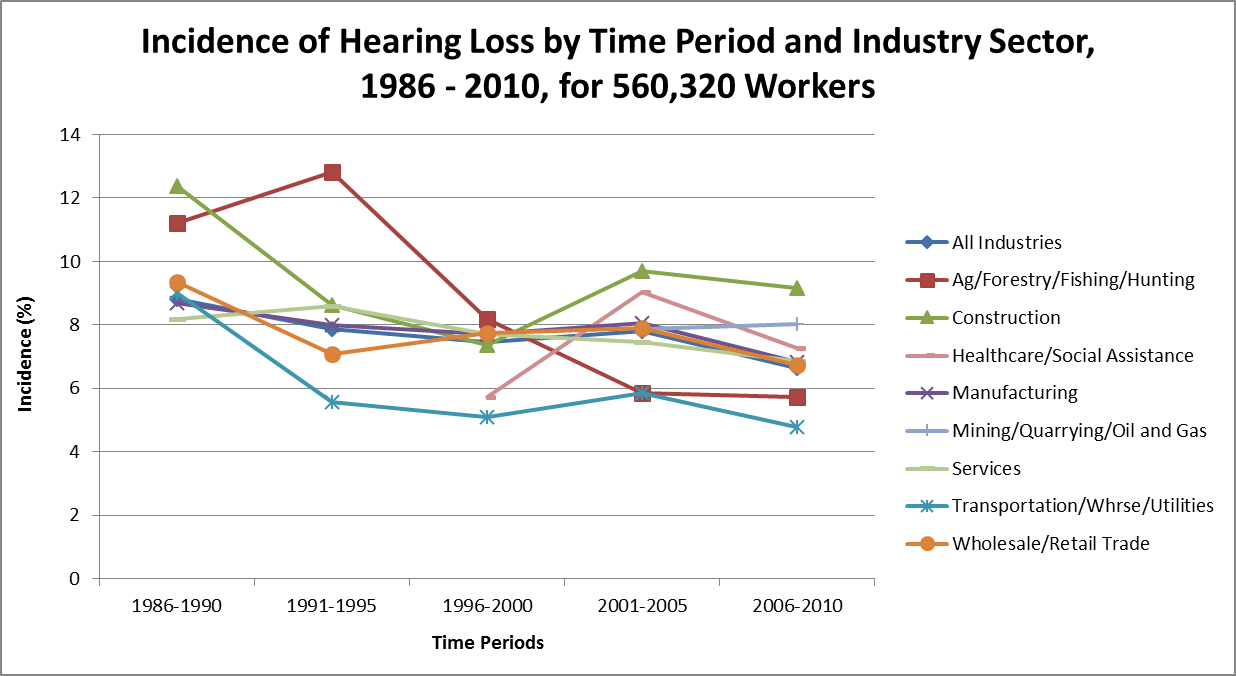
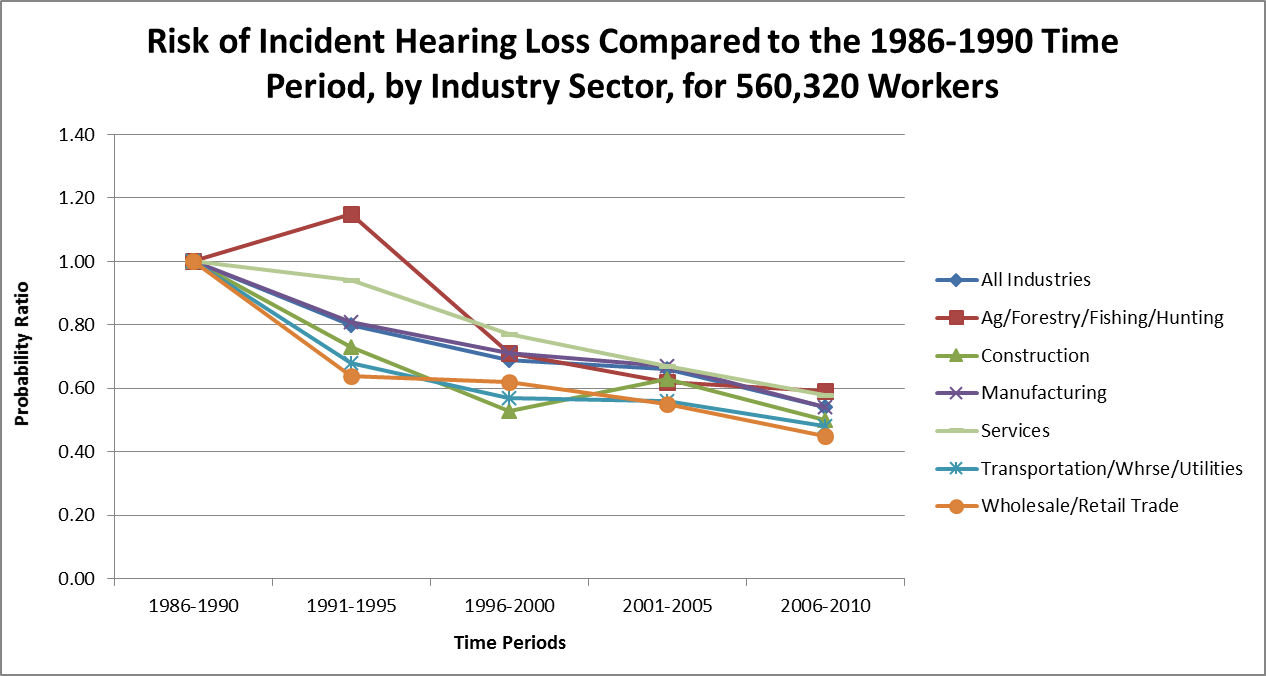
Trends in hearing loss among noise-exposed tested workers (1981-2010)6
- The prevalence for all industries combined decreased less than 1% over 30 years (1981-2010).
- The incidence for all industries combined decreased 2% over 25 years (1986-2010).
- The adjusted risk for all industries combined decreased 46% over 25 years (1986-2010).
Content Source:
National Institute for Occupational Safety and Health
- Masterson EA, Morata TC, Themann CL [2025]. Prevalence of ototoxic chemical exposure, noise exposure and hearing difficulty among workers in the United States, 2023. J Occup Environ Med, 67(10):785-797.
- Green DR, Masterson EA, Themann CL [2021]. Prevalence of hearing protection device non-use among noise-exposed U.S. workers in 2007 and 2014. Am J Ind Med, 64(12):1002-1017.
- Masterson EA, Themann CL, Luckhaupt SE, Li J, Calvert GM [2016]. Hearing difficulty and tinnitus among U.S. workers and non-workers in 2007. Am J Ind Med, 59:290-300.
- Masterson, EA, Themann, CL [2024]. Prevalence of hearing loss among noise-exposed U.S. workers within the Utilities sector, 2010-2019. J Occup Environ Med, 66(8):648-653.
- Masterson EA, Bushnell PT, Themann CL, Morata TC [2016]. Hearing impairment among noise-exposed workers — United States, 2003–2012. MMWR, 65(15):389-394.
- Masterson EA, Deddens JA, Themann CL, Bertke S, Calvert GM [2015]. Trends in worker hearing loss by industry sector, 1981-2010. Am J Ind Med, 58:392-401.