



Key points
- Implementation science is the study of methods and strategies to increase the adoption of evidence-based interventions in real world settings to improve individual and population health.
- Implementation science approaches can help occupational safety and health (OSH) researchers and practitioners gain generalizable knowledge about what strategies work to move promising OSH solutions into practice to benefit workers.
Background

What is Implementation Science?
Implementation science is the study of methods and strategies to increase the uptake (adoption, implementation, and maintenance) of evidence-based interventions in real world settings to improve individual and population health. The implementation science field is multidisciplinary — with roots in agriculture, sociology, education, communication, marketing, and management — and has expanded rapidly in the past three decades.
Why is Implementation Science important?
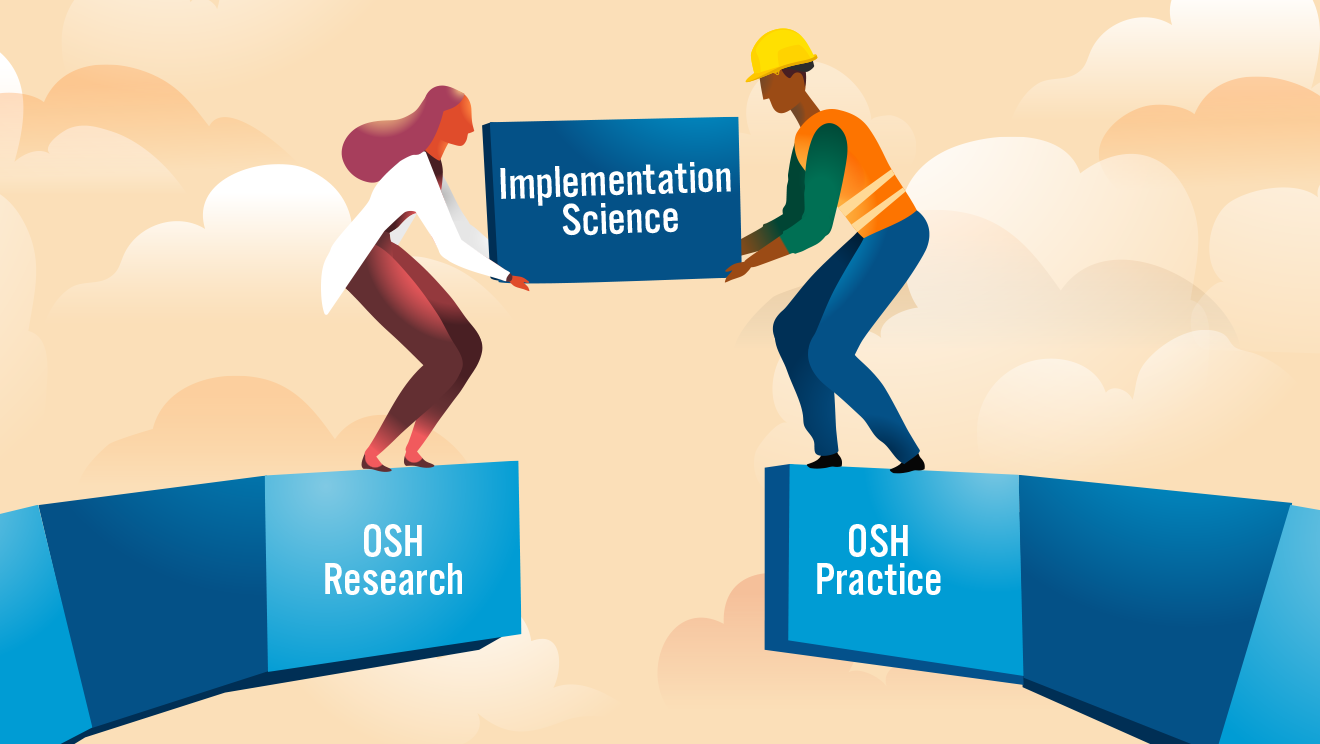
Image by NIOSH.
Barriers in moving effective OSH solutions into sustained practice can seriously impact worker safety, health, and well-being. Estimates indicate that in some high-risk industries only about one-fifth of OSH solutions are used by or benefit workers. Implementation science can help researchers and OSH professionals move promising solutions into sustained practice to protect workers.
When does Implementation Science happen in the research lifecycle?
Typically, implementation science research occurs downstream in the research-to-practice pipeline once an OSH solution has demonstrated positive effects on worker safety and health. In the figure below, that's in the T3 and T4 (translational) stages. But for positive impact to be achieved, it is important to a) plan for implementation, dissemination, and sustainability from the beginning of a new research/outreach effort and to b) engage partners on an ongoing basis. Finally, it's important to recognize that moving research into practice is not a linear process. Information at a later stage informs research at earlier stages. Depending on the outcomes at any given timepoint, it may be necessary to go back to an earlier stage.

Guerin RJ, Glasgow RE, Tyler A, Rabin BA, Huebschmann AG. Methods to improve the translation of evidence-based interventions: A primer on dissemination and implementation science for occupational safety and health researchers and practitioners. Saf Sci. 2022;152:105763. doi:10.1016/j.ssci.2022.105763
Where does Implementation Science fit at NIOSH?
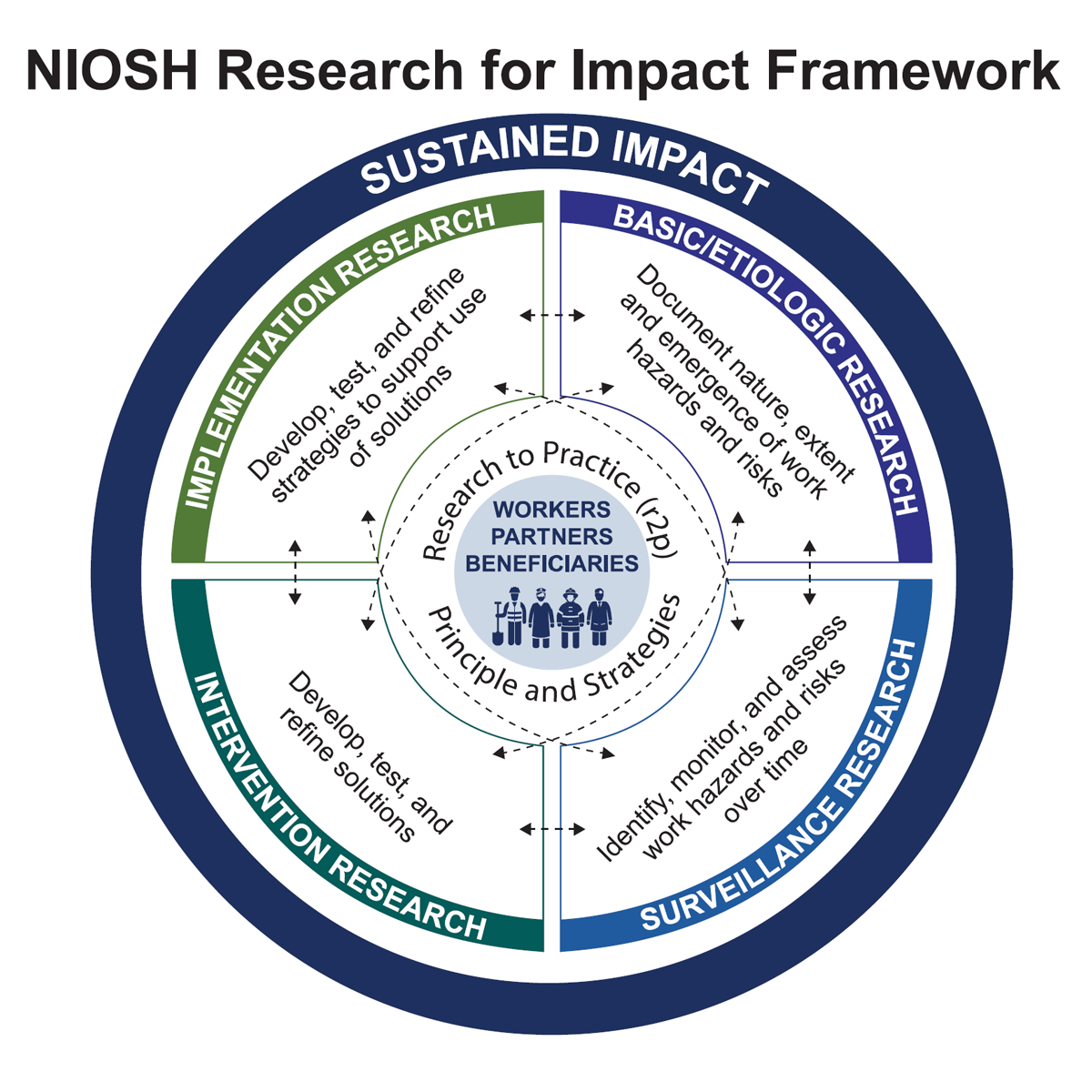
The NIOSH Research for Impact Framework illustrates the interaction of the four priority research areas outlined in the NIOSH Strategic Plan, one of which is implementation science research (formerly referred to at NIOSH as translation research).
Interventions developed through basic and intervention research and informed through surveillance can be the subject of implementation research. Central to the Framework are the partners with whom we collaborate and the beneficiaries of research. Research to Practice (r2p) is a fundamental guiding principle that all NIOSH research make a real-world, positive impact.
R.J. Guerin, B.A. Rabin, A. Downes, and the NIOSH Implementation Science Workgroup.
Accomplishments
- A new NIOSH manuscript introduces the 9Ps—an evaluation and planning tool that includes the domains 1) (OSH) Problem 2) Programs, 3) Practices, 4) Principles, 5) Procedures, 6) Products, 7) Policies, 8) People, and 9) Partnerships. By applying this tool to 11 multidisciplinary case studies, the authors demonstrates how NIOSH scientists successfully moved promising OSH research into sustained, real-world workplace practice.
- Advanced implementation science as a key topic area under the NIOSH Evaluation Capacity-Building Plan.
- Integrated an OSH perspective into an updated chapter in a foundational, implementation science textbook used broadly in research and practice communities.
- Developed and published a primer for applying implementation science frameworks, methods, and tools to move occupational safety and health research into practice.
- Developed and published considerations for applying implementation science approaches to Total Worker Health® practices and programs and for protecting workers exposed to nanomaterials.
What's ahead
- Develop a new tool to apply implementation science methods to planning new research activities and to evaluate existing ones for potential impact.
- Publish results from a large implementation study.
- Expand awareness in the OSH community, in the United States and internationally, about potential applications of implementation science frameworks, methods, and measures.
This page was last updated on this date. Updates may include minor edits, image changes, or other modifications to page content.
The information on this page was last reviewed by subject matter experts to ensure accuracy.