


What to know

Summary
It's National Lead Poisoning Prevention week! Did you know that most high blood lead levels still come from workplace exposures? Workers in lead-acid battery manufacturing and recycling continue to face some of the highest exposures, with levels far above those seen in other industries. This week is a chance to raise awareness, support prevention, and remind workers and employers that lead exposure remains a serious but preventable health concern.
Still a workplace concern: Lead battery industry
Recent data from NIOSH's Adult Blood Lead Epidemiology and Surveillance (ABLES) program found that almost 90% of adults with known lead exposure were exposed at their job.
There are four main industries that tend to carry the highest risk of lead exposure, among which manufacturing ranks the highest. ABLES data from 2022 show that 60% of workers with blood lead levels (BLLs) of 25 ug/dL or higher worked in manufacturing. Among those workers, over 70% worked in battery manufacturing. The U.S. Census Bureau estimates approximately 51,000 people worked in battery manufacturing in 2024, which includes the workers who produce and recycle lead-acid batteries.
To understand the risks these workers face, it's important to understand the basics of lead-acid battery manufacturing and recycling.
About battery manufacturing and recycling
Battery production is a circular process, meaning that nearly all the materials that go into a lead battery are either reused or recycled. According to the EPA, over 99% of lead batteries are recycled, with most materials recovered to make new batteries or other products. However, the lead exposure risks can vary among workers who recycle batteries compared to those who assemble them.
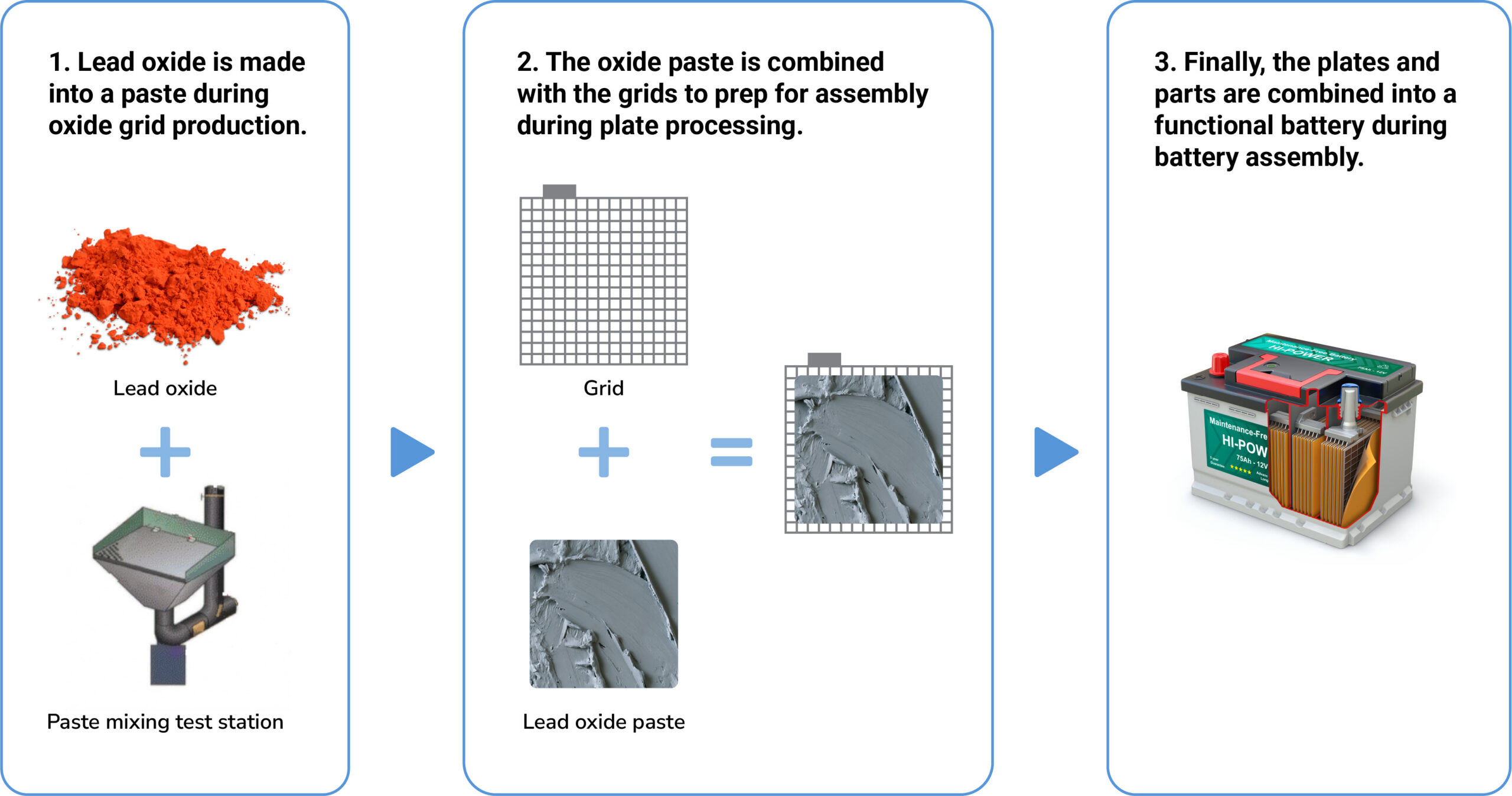
Battery manufacturing workers perform many operations, starting with handling lead oxide and ending with a fully assembled battery. Here's a short overview of the steps in the process, but each of these steps involves much more than what is captured below. Visit OSHA's website for a more detailed look.
Lead batteries are then used in a variety of ways, from cars to back-up power sources. Once the batteries are drained, they are collected. Because lead from batteries can be used indefinitely, spent batteries will re-enter the production cycle, this time to be broken down and recycled. Here's a short overview of the steps in the process, but each of these steps involves much more than what is captured below. Review this NIOSH report for a more detailed look.
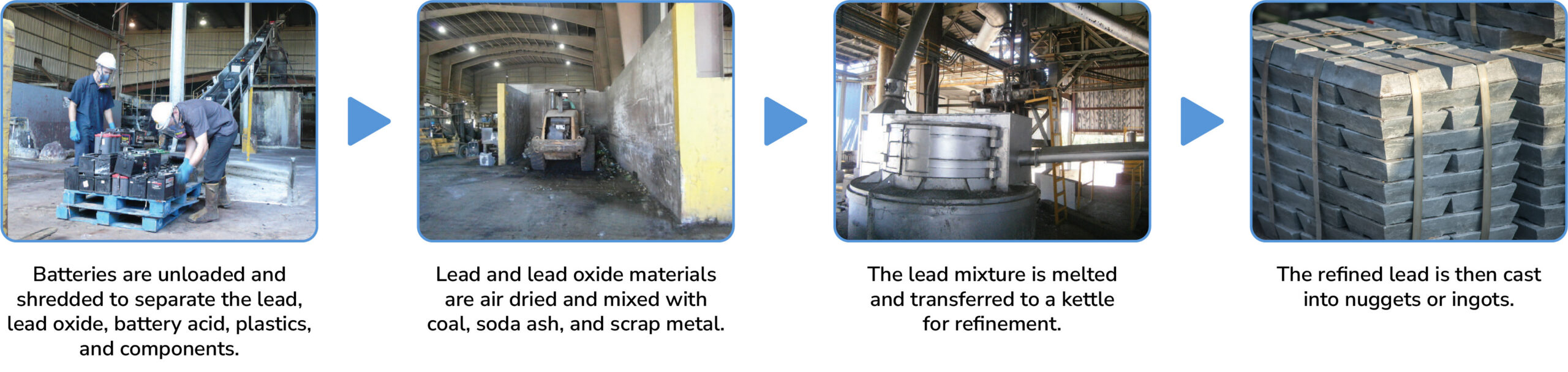
Lead exposure is a risk throughout both the manufacturing and recycling processes.
Findings from the field
NIOSH has a long history of examining workplace lead exposure through a range of studies and programs. The NIOSH Health Hazard Evaluation (HHE) Program investigates specific on-the-job exposures, including those faced by workers in the lead-acid battery industry. To help understand what these workers experience, here's a brief look at two of these investigations and the lead exposure risks they found.
Evaluation at a battery manufacturing plant
The HHE team examined lead exposure concerns among workers at a battery manufacturing plant. Below is a summary of some of the main concerns the HHE team noted during their worksite assessment and why these issues are a concern.
Air contaminated with lead dust was flowing into worker locker rooms, the cafeteria, and offices.
Lead dust can be breathed in or ingested without realizing it. In this case, workers who don’t directly handle lead are at risk for exposure as these areas are expected to be clean and safe.
Workers had lead dust on their uniforms, boots, and skin while going from work areas to break and eating areas.
Lead was spreading into areas that were meant to be clean. Inhalation, ingestion, and absorption are all a concern.
Workers felt dry sweeping the floors was more effective than using vacuums to clean up leaded dust. Many workers were also not wearing respirators during overall cleanup activities even though one was required.
Dry sweeping spreads the dust into the air and onto other surfaces, whereas vacuuming contains it better. Additionally, the lack of respirator use means workers weren’t protected from breathing in the dust kicked up from dry sweeping.
Respiratory cartridges weren't changed on a clear schedule, and employees were observed with facial hair that prevented a good seal between the respirator and worker’s face. Machines to wash the respirators may have been overloaded.
If respirators aren’t clean, well-maintained, or worn properly, they won’t protect workers.
Evaluation at an automotive lead-acid battery recycling company
The NIOSH HHE team examined lead exposure concerns among workers at a battery recycling plant. The company collected automotive batteries and operated a secondary lead smelter 24 hours a day, 365 days a year. Below is a summary of some of the main concerns the HHE team noted during worker interviews and the worksite assessment and why these issues are a concern.
Lead was found on most work surfaces sampled.
Lead dust could get on workers’ skin or clothes when contacting surfaces.
85% of the workers interviewed reported at least one symptom that could be related to lead overexposure.
Workers were most likely experiencing adverse health effects from lead exposure.
Lead was found on workers’ skin after showering.
It’s difficult to remove lead dust from skin, so preventing lead exposure to begin with would be the main goal.
Local exhaust ventilation was poor or not used in areas with high airborne lead exposures.
Clouds of lead dust were emitted into the air with no ventilation collecting the dust, which could cause air and surface lead exposure.
Workers were walking in their socks in the dirty locker room.
This could cross-contaminate workers’ personal clothing, which means they could also bring lead home to their families.
Exposure is preventable
It's unlikely the value of the lead battery will fade anytime soon. Even with the growth of electric vehicles, lead-based batteries remain essential for vehicles with internal combustion engines. With continuing use of lead comes continuing risk of exposure, not only to workers, but also their families and others living in their homes.
The good news is that exposure is preventable. The following resources offer suggestions to reduce lead exposure in the workplace, cars, and homes.
Author information
Amy Mobley, MEn, is a Health Communications Specialist in NIOSH's Health Informatics Branch in the Division of Field Studies and Engineering.
Rebecca Tsai, PhD, is an Epidemiologist in NIOSH's Health Informatics Branch in the Division of Field Studies and Engineering.
James Couch, PhD, CIH, is Chief of the NIOSH Hazard Evaluation and Technical Assistance Branch in the Division of Field Studies and Engineering.
This page was last updated on this date. Updates may include minor edits, image changes, or other modifications to page content.
The information on this page was last reviewed by subject matter experts to ensure accuracy.