 An official website of the United States government



Incidence of SARS-CoV-2 Infection, Emergency Department Visits, and Hospitalizations Because of COVID-19 Among Persons Aged ≥12 Years, by COVID-19 Vaccination Status — Oregon and Washington, July 4–September 25, 2021
Weekly / November 19, 2021 / 70(46);1608–1612
Allison L. Naleway, PhD1; Holly C. Groom, MPH1; Phil M. Crawford, MS1; S. Bianca Salas, MPH1; Michelle L. Henninger, PhD1; Judy L. Donald, MA1; Ning Smith, PhD1; Mark G. Thompson, PhD2,3; Lenee H. Blanton, MPH2,3; Catherine H. Bozio, PhD2,3; Eduardo Azziz-Baumgartner, MD2,3 (View author affiliations)
View suggested citationSummary
What is already known about this topic?
Studies have demonstrated that SARS-CoV-2 infection, need for emergency department (ED) visits, and hospitalization were uncommon in fully vaccinated persons before the widespread circulation of the SARS-CoV-2 B.1.617.2 (Delta) variant.
What is added by this report?
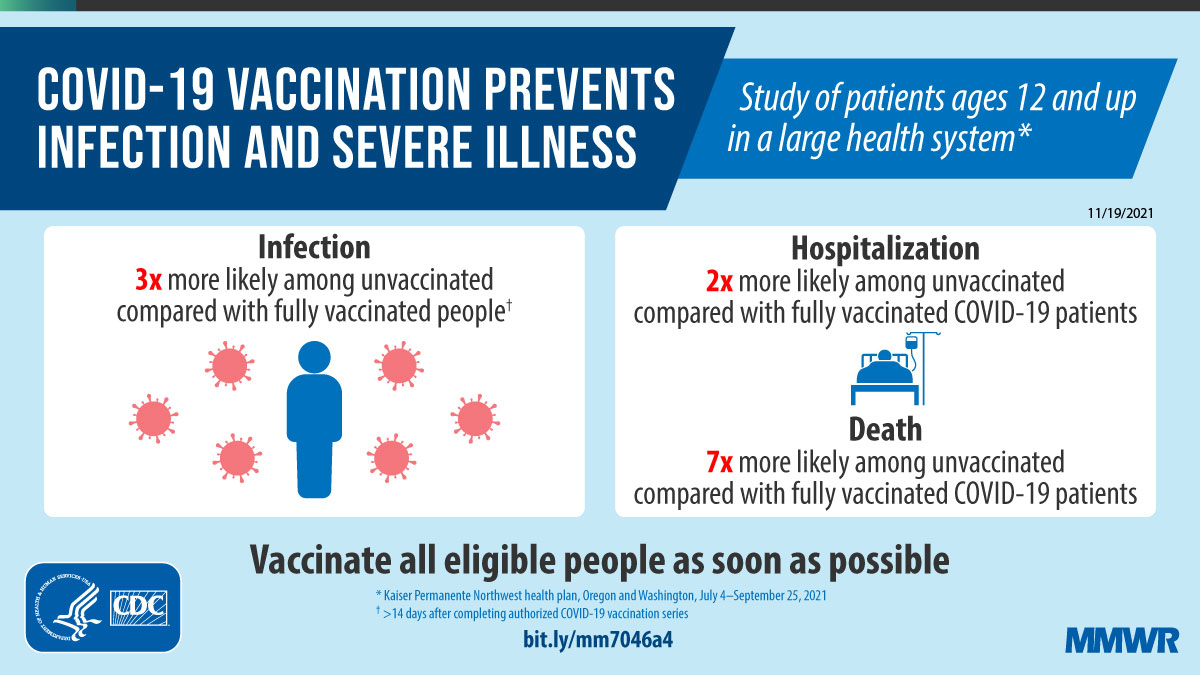
Among persons aged ≥12 years enrolled in a Pacific Northwest health plan, unvaccinated persons with SARS-CoV-2 infection were approximately twice as likely to receive ED care or to be hospitalized than were vaccinated persons with COVID-19.
What are the implications for public health practice?
The findings in this report support CDC’s current recommendation that all persons aged ≥5 years should receive full COVID-19 vaccination, including additional and booster doses, to prevent illness and reduce transmission of SARS-CoV-2.
Altmetric:
Discussion
Previous studies have demonstrated that symptomatic COVID-19 requiring emergency care and hospitalization was uncommon in fully vaccinated persons before widespread circulation of the SARS-CoV-2 Delta variant (6,7). Incidence among fully vaccinated persons during the period of Delta predominance was approximately three times lower than that in unvaccinated persons across all sex, race, ethnicity, and age groups evaluated. In addition, fully vaccinated persons with SARS-CoV-2 infection were one half as likely to have an ED visit or hospitalization as were unvaccinated patients. Among those hospitalized, vaccinated patients were older than unvaccinated patients, and a higher percentage had at least one underlying medical condition. The crude risk for COVID-19–related death in fully vaccinated persons was sevenfold lower than that among unvaccinated COVID-19 patients. These findings are consistent with another recently published report regarding COVID-19 incidence during Delta circulation, which showed that vaccination is protective against severe illness from COVID-19 (8).
The findings in this report are subject to at least six limitations. First, some persons might have received COVID-19 vaccines outside of KPNW (e.g., at a mass vaccination site) and might have been misclassified as unvaccinated if the record was not available in the EMR or immunization information system. Second, persons who had a positive SARS-CoV-2 rapid antigen or other test result at home, school, or the workplace might have been missed, and information about previous SARS-CoV-2 infection was not collected. Third, race and ethnicity were unknown in >10% of the study population, and multiple racial groups were combined into a non-White, non-Hispanic category for some analyses to address small sample sizes. Fourth, medical encounters other than hospitalizations among persons with SARS-CoV-2 infections were not manually reviewed to determine whether symptoms, diagnoses, and treatments were consistent with COVID-19. It is not possible, therefore, to classify all identified infections as symptomatic or asymptomatic. Fifth, the crude rates reported in this report were not adjusted for factors that could influence the risk for infection between the vaccinated and unvaccinated groups. Finally, information about length of hospital stay and death was unavailable for nine hospitalizations that were ongoing at the time of this report.
During this period of widespread Delta variant circulation (July–September, 2021), incidence of SARS-CoV2 infections was lower in fully vaccinated persons and was less likely to result in an ED visit, hospitalization, or death compared with cases in unvaccinated persons. These data support CDC recommendations for COVID-19 vaccination, including additional and booster doses, for the public to protect itself against severe COVID-19, including illness and hospitalization caused by the Delta variant. CDC currently recommends that all persons aged ≥5 years should be fully vaccinated against COVID-19 to prevent illness and reduce transmission of SARS-CoV-2 (1).
Corresponding author: Eduardo Azziz-Baumgartner, eha9@cdc.gov.
1Center for Health Research, Kaiser Permanente Northwest, Portland, Oregon; 2CDC COVID-19 Response Epidemiology and Surveillance Task Force; 3Influenza Division, National Center for Immunization and Respiratory Diseases, CDC.
All authors have completed and submitted the International Committee of Medical Journal Editors form for disclosure of potential conflicts of interest. Allison L. Naleway reported institutional funding from Pfizer for a meningococcal B vaccine study and Vir Biotechnology for an influenza vaccine study unrelated to the submitted work. Michelle L. Henninger reports institutional support from the Garfield Memorial Fund. No other potential conflicts of interest were disclosed.
* Two mRNA vaccines authorized for use in the United States include Pfizer-BioNTech (BNT162b2) and Moderna (mRNA-1273). The Janssen (Johnson & Johnson [Ad26.COV2]) COVID-19 vaccine contains double-stranded DNA encoding a variant of the SARS-CoV-2 spike glycoprotein inserted into a replication-incompetent human adenovirus type 26 viral vector.
† 45 C.F.R. part 46, 21 C.F.R. part 56; 42 U.S.C. Sect. 241(d); 5 U.S.C. Sect. 552a; 44 U.S.C. Sect. 3501 et seq.
References
- CDC. ACIP vaccine recommendations and guidelines. Atlanta, GA: US Department of Health and Human Services, CDC; 2021. Accessed November 15, 2021. https://www.cdc.gov/vaccines/hcp/acip-recs/vacc-specific/covid-19.html
- CDC. COVID data tracker. Atlanta, GA: US Department of Health and Human Services, CDC; 2021. Accessed November 15, 2021. https://covid.cdc.gov/covid-data-tracker/#datatracker-home
- CDC. Delta variant: what we know about the science. Atlanta, GA: US Department of Health and Human Services, CDC; 2021. Accessed October 27, 2021. https://www.cdc.gov/coronavirus/2019-ncov/variants/delta-variant.html
- CDC. COVID-19 data tracker. COVID-19 vaccinations in the United States. Atlanta, GA: US Department of Health and Human Services, CDC; 2021. Accessed November 15, 2021. https://covid.cdc.gov/covid-data-tracker/#vaccinations_vacc-total-admin-rate-total
- COVID-19 Treatment Guidelines Panel. Coronavirus disease 2019 (COVID-19) treatment guidelines. Bethesda, MD: US Department of Health and Human Services, National Institutes of Health; 2021. Accessed October 27, 2021. https://www.covid19treatmentguidelines.nih.gov/
- Bahl A, Johnson S, Maine G, et al. Vaccination reduces need for emergency care in breakthrough COVID-19 infections: a multicenter cohort study. Lancet Reg Health Am 2021. Epub September 9, 2021. https://doi.org/10.1016/j.lana.2021.100065
- Juthani PV, Gupta A, Borges KA, et al. Hospitalisation among vaccine breakthrough COVID-19 infections. Lancet Infect Dis 2021;21:1485–6. https://doi.org/10.1016/S1473-3099(21)00558-2 PMID:34506735
- Scobie HM, Johnson AG, Suthar AB, et al. Monitoring incidence of COVID-19 cases, hospitalizations, and deaths, by vaccination status—13 U.S. jurisdictions, April 4–July 17, 2021. MMWR Morb Mortal Wkly Rep 2021;70:1284–90. https://doi.org/10.15585/mmwr.mm7037e1 PMID:34529637

Abbreviations: AA = African American; AI/AN = American Indian or Alaska Native; IRR = incidence rate ratio; NA = not applicable; NH = non-Hispanic; NHPI = Native Hawaiian or Other Pacific Islander.
* Received ≥2 doses of Pfizer-BioNTech or Moderna vaccine or 1 dose of Janssen (Johnson & Johnson) COVID-19 vaccine.
† Positive SARS-CoV-2 molecular test result >14 days after second dose of Pfizer-BioNTech or Moderna vaccine dose or first dose of Janssen COVID-19 vaccine.
§ Cases per 1,000 vaccinated persons.
¶ Cases per 1,000 unvaccinated persons.
** To be more conservative given the large sample size, sensitivity analyses with α levels of 0.01 and 0.005 were conducted, and study findings and conclusions remain unchanged.
†† Persons who self-identified as Hispanic or Latino ethnicity were categorized as Hispanic. Persons who identified as AI/AN, Black, AA, NHPI, multiracial, or any other race were categorized as non-White, NH. The non-White, NH category most commonly included persons who identified as Asian (26,758) or Black (13,075).
§§ Persons of unknown sex (177 vaccinated and 183 unvaccinated) are not represented.
Abbreviations: ED = emergency department; NA = not applicable; NH = non-Hispanic.
* Health care encounters were defined as hospitalizations, ED visits, outpatient visits, or virtual care visits identified in the period 3 days before through 14 days after the first positive SARS-CoV-2 molecular test date; numbers shown represent the number and percentage of persons with each type of encounter; persons might have received care in multiple encounter settings.
† In-person ambulatory clinic or urgent care visit.
§ Telephone or video visit, email messages, online intake, and text chats.
¶ Persons who self-identified as Hispanic or Latino ethnicity were categorized as Hispanic. Persons who identified as American Indian, Alaskan Native, Black, African American, Native Hawaiian, Other Pacific Islander, multiracial, or any other race were categorized as non-White, NH. The non-White, NH category most commonly included persons who identified as Asian or Black.
Abbreviations: BMI = body mass index; COPD = chronic obstructive pulmonary disease; NA = not applicable; NH = non-Hispanic.
* Excludes 17 of 117 hospitalizations among vaccinated persons and 27 of 375 among unvaccinated persons that were determined after medical record review to be unrelated to COVID-19.
† Persons who self-identified as Hispanic or Latino ethnicity were categorized as Hispanic. Persons who identified as American Indian, Alaskan Native, Black, African American, Native Hawaiian, Other Pacific Islander, multiracial, or any other race were categorized as non-White, NH. The non-White, NH category most commonly included persons who identified as Asian or Black.
§ Includes nine ongoing hospitalizations at the time of reporting; length of stay and death data for these hospitalizations are incomplete; these patients are included in the intensive care unit, intubation, and mechanical ventilation totals.
¶ Death counts exclude persons with ongoing hospitalization at the time of the final data pull (one vaccinated and eight unvaccinated persons). Death counts also exclude two deaths (one vaccinated and one unvaccinated person) that occurred without hospitalization. These two deaths are included in the crude mortality rate reported in the text.
Suggested citation for this article: Naleway AL, Groom HC, Crawford PM, et al. Incidence of SARS-CoV-2 Infection, Emergency Department Visits, and Hospitalizations Because of COVID-19 Among Persons Aged ≥12 Years, by COVID-19 Vaccination Status — Oregon and Washington, July 4–September 25, 2021. MMWR Morb Mortal Wkly Rep 2021;70:1608–1612. DOI: http://dx.doi.org/10.15585/mmwr.mm7046a4.
MMWR and Morbidity and Mortality Weekly Report are service marks of the U.S. Department of Health and Human Services.
Use of trade names and commercial sources is for identification only and does not imply endorsement by the U.S. Department of
Health and Human Services.
References to non-CDC sites on the Internet are
provided as a service to MMWR readers and do not constitute or imply
endorsement of these organizations or their programs by CDC or the U.S.
Department of Health and Human Services. CDC is not responsible for the content
of pages found at these sites. URL addresses listed in MMWR were current as of
the date of publication.
All HTML versions of MMWR articles are generated from final proofs through an automated process. This conversion might result in character translation or format errors in the HTML version. Users are referred to the electronic PDF version (https://www.cdc.gov/mmwr) and/or the original MMWR paper copy for printable versions of official text, figures, and tables.
Questions or messages regarding errors in formatting should be addressed to mmwrq@cdc.gov.