The graphic reads, “MMWR Clinician’s Newsletter,” with an image of a clinician reading a report on a tablet.

Newsletter

MMWR  Homepage

September 2025


Candida auris and hemodialysis
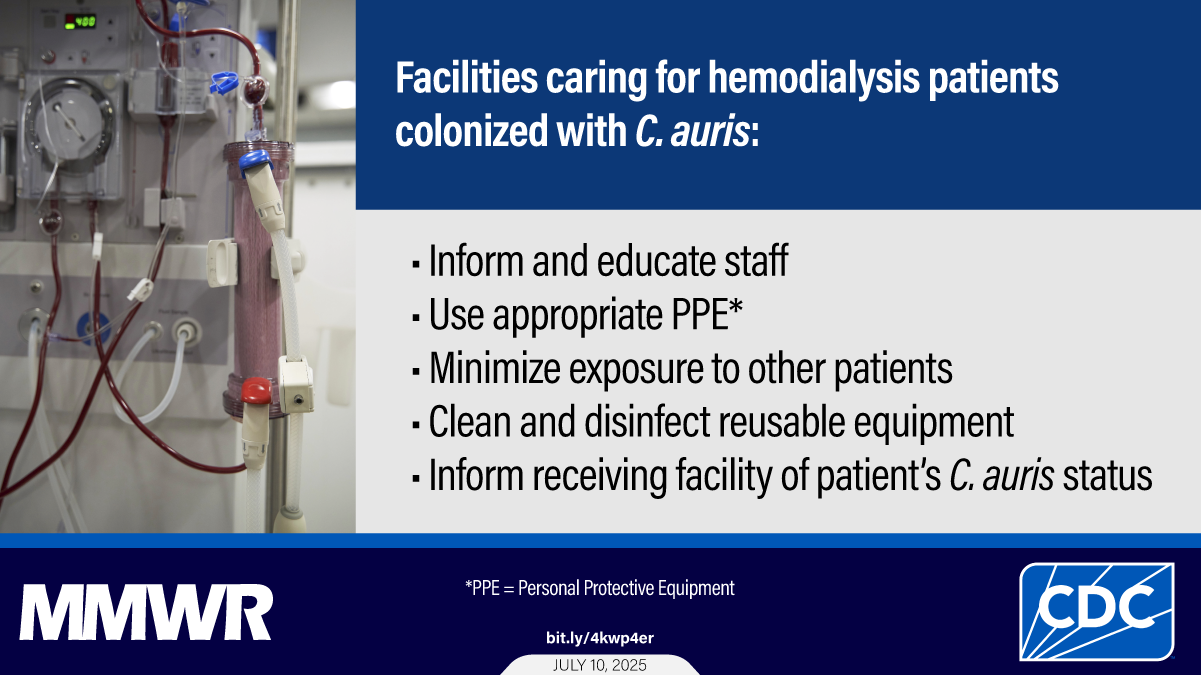
The graphic shows a dialysis machine. Text reads, “Facilities caring for hemodialysis patients colonized with C. auris: Inform and educate staff; use appropriate PPE; minimize exposure to other patients; clean and disinfect reusable equipment; inform receiving facility of patient’s C. auris status.”

Candida auris, a frequently multidrug-resistant fungal pathogen, can spread within health care facilities. In five facilities providing dialysis in four states during 2020–2023, six patients infected or colonized with C. auris received dialysis for up to 4 months without transmission to other patients. Health care personnel at all five facilities had no knowledge of the patients’ C. auris status and had implemented standard dialysis infection prevention and control (IPC) only. Adherence to standard IPC practices appeared to enable safe provision of dialysis to patients with C. auris colonization or infection without transmission to other dialysis patients.

Bottom Line:
  • Improved interfacility communication regarding patients’ infection or colonization status with multidrug-resistant organisms is needed to ensure prompt implementation of all recommended IPC practices.
  • Dialysis-specific C. auris IPC measures, detailed in image above and including for those with asymptomatic colonization, remain an important component of prevention of transmission of multidrug-resistant organisms in health care settings.
Learn more:

MMWR: Candida auris Containment Responses in Health Care Facilities that Provide Hemodialysis Services — New Jersey, North Carolina, South Carolina, and Tennessee, 2020–2023 | MMWR

CDC: Guidelines, Recommendations and Resources | Dialysis Safety | CDC
Infection Control Guidance: Candida auris | Candida auris (C. auris) | CDC


Plague
The graphic shows an image of a veterinarian holding a cat and text that reads, “A pet cat with an abscess transmitted plague to its owner, who had a finger laceration. This case was reported earlier in the calendar year than any human plague case in Oregon in 90 years.”

Plague, caused by Yersinia pestis, is a rare but potentially life-threatening illness treatable with antibiotics if diagnosed early. Patients usually become infected through the bite of an infected rodent flea but Y. pestis can be transmitted to humans through exposure to ill pets, especially cats. An Oregon man sought care at an emergency department for signs and symptoms of plague on January 30, 2024, the earliest calendar date of plague recorded in the state’s history, possibly indicating a shift in the seasonality of plague incidence. The patient did not have direct contact with rodents, but did have contact with his infected cat, who had an abscess, after cutting his finger.

Bottom Line:
  • Maintain a high index of suspicion for Y. pestis infection in patients with a febrile illness associated with animal exposure in areas where Y. pestis is enzootic, regardless of season.
  • Initiate antibiotic therapy for plague based on risk factors (e.g., recent flea bite, exposure to areas with rodents, or contact with a sick or dead animal in endemic areas) and clinical signs and symptoms (including fever, headache, chills, weakness, one or more swollen and painful lymph nodes, shortness of breath, chest pain, and cough).
  • Gentamicin and fluoroquinolones are first-line antibiotic treatments for Y. pestis infection in the United States.
Learn more:

MMWR: Notes from the Field: Early-Season Human Plague Transmitted from an Infected Cat — Oregon, January 2024 | MMWR

CDC: Clinical Testing and Diagnosis for Plague | Plague | CDC
Clinical Care of Plague | Plague | CDC


Tetrahydrocannabinol (THC)
The graphic shows an image of a pizza and text that reads, “Customers at a Midwest restaurant developed symptoms of THC intoxication after eating pizza and bread dough made using THC-infused oil from a co-located business selling edibles. Consider THC-intoxication in patients with multiple symptoms: dizziness, sleepiness, anxiety, memory change, nauseas, tachycardia.”

Tetrahydrocannabinol (THC), a psychoactive substance found in Cannabis sativa plants, is increasingly being used in consumer products. During October 22–24, 2024, at least 85 persons, ranging from age 1–91 years, ate food from a restaurant in Wisconsin and experienced symptoms consistent with THC intoxication. The restaurant was in a building with a shared kitchen used by a state-licensed vendor who produced edible THC products. The restaurant mistakenly used THC-infused cooking oil from the cooperative kitchen to prepare dough.

Bottom Line:
  • Be alert to the possibility of mass THC intoxication events via edibles and food.
  • Symptoms include sudden unexplained onset of dizziness, sleepiness, anxiety, altered reality perception, increased heart rate, nausea, and other symptoms.
Learn more:

MMWR: Tetrahydrocannabinol Intoxication from Food at a Restaurant — Wisconsin, October 2024 | MMWR

CDC: About Cannabis | Cannabis and Public Health | CDC


Raccoon roundworm
The image shows an image of a raccoon and an image of an eye illustrating a live subretinal nematode. Text reads, “Clinicians: Consider raccoon roundworm infection in patients with neurologic symptoms and eosinophilia, especially in: young children, people with developmental disabilities, people with pica. Early treatment with albendazole may be life-saving.”

Baylisascaris procyonis, a roundworm parasite commonly found in raccoons, can cause baylisascariasis, a potentially severe disease in humans. In 2024, two baylisascariasis cases characterized by encephalopathy, ocular larva migrans, peripheral and cerebrospinal fluid eosinophilia, and abnormal brain imaging results were diagnosed in unrelated children in Los Angeles County, California. Baylisascariasis is associated with ingestion of raccoon feces and soil potentially contaminated with Bprocyonis. A potential source of infection, a raccoon latrine, was identified for one patient. A substantial delay in diagnosis for one patient led to severe neurologic sequelae.

Bottom Line:
  • Suspect B. procyonis infection in patients with eosinophilic meningoencephalitis, especially young children or persons with developmental disabilities or pica.
  • Diagnostic findings include peripheral and CSF eosinophilia, deep white matter abnormalities on MRI, and positive B. procyonis antibody titers on serologic testing of CSF or serum.
  • Consider empiric treatment with albendazole pending confirmation of the diagnosis.
Learn more:

MMWR: Baylisascariasis (Raccoon Roundworm Infection) in Two Unrelated Children — Los Angeles County, California, 2024 | MMWR

CDC: About Raccoon Roundworm | Raccoon Roundworm (Baylisascaris Infection) | CDC
Clinical Treatment of Raccoon Roundworm | Raccoon Roundworm (Baylisascaris Infection) | CDC


Did you know? Medscape & MMWR have FREE CME activities

The graphic is a clinician smiling.

Continuing medical education credits are available from Medscape on select MMWRs.

Learn more about FREE CME

Subscribe to our newsletter

Get our monthly newsletter delivered to your email inbox.

Read Past Newsletters