Key points
- Jamestown Canyon virus disease (Jamestown Canyon) is caused by a virus typically spread through the bite of a mosquito.
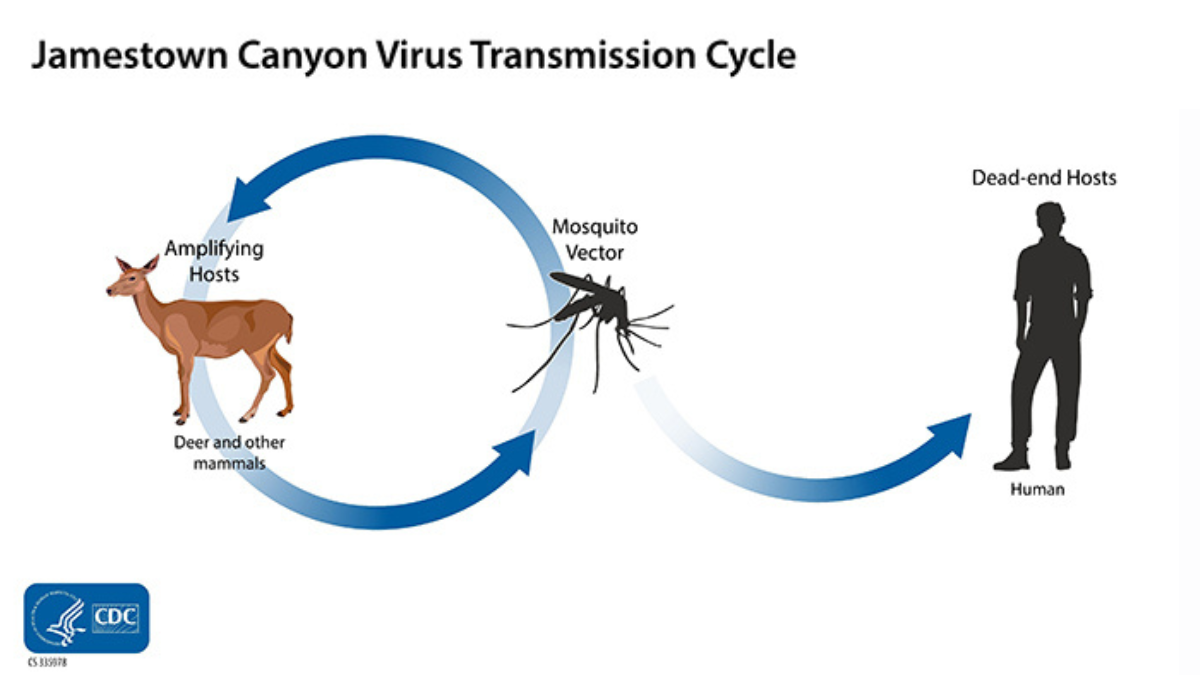
- Jamestown Canyon virus circulates in the environment between mosquitoes and animals, typically deer.
- People are considered "dead-end" hosts, meaning they do not spread the virus to uninfected mosquitoes that bite them.
Primary cause
Jamestown Canyon is caused by a virus that is found in North America.
About the virus
Jamestown Canyon virus is a California serogroup virus, in the genus Orthobunyavirus, family Peribunyaviridae. Other California serogroup viruses found in the United States include California encephalitis virus, La Crosse virus, Snowshoe hare virus, and Trivittatus virus.
Members of the family Peribunyaviridae have three segments of negative-sense, single-stranded RNA. The virus particles are spherical or oval, enveloped, and are 90-100 nanometers in diameter.
How it spreads
Jamestown Canyon virus spreads to people and animals through the bites of infected mosquitoes.
People are considered "dead-end" hosts, meaning they do not spread the virus to uninfected mosquitoes that bite them. Jamestown Canyon virus does not spread by coughing, sneezing, touching, or other contact with someone who is infected.

Transmission cycle
Jamestown Canyon virus can be spread by many types of mosquitoes, depending on location and time of year.
Mosquitoes become infected when they feed on deer and other animals that have the virus in their blood (also referred to as amplifying hosts or natural reservoirs). Infected mosquitoes can then spread the virus to people and other animals by biting them.