



At a glance
Map
Data sources
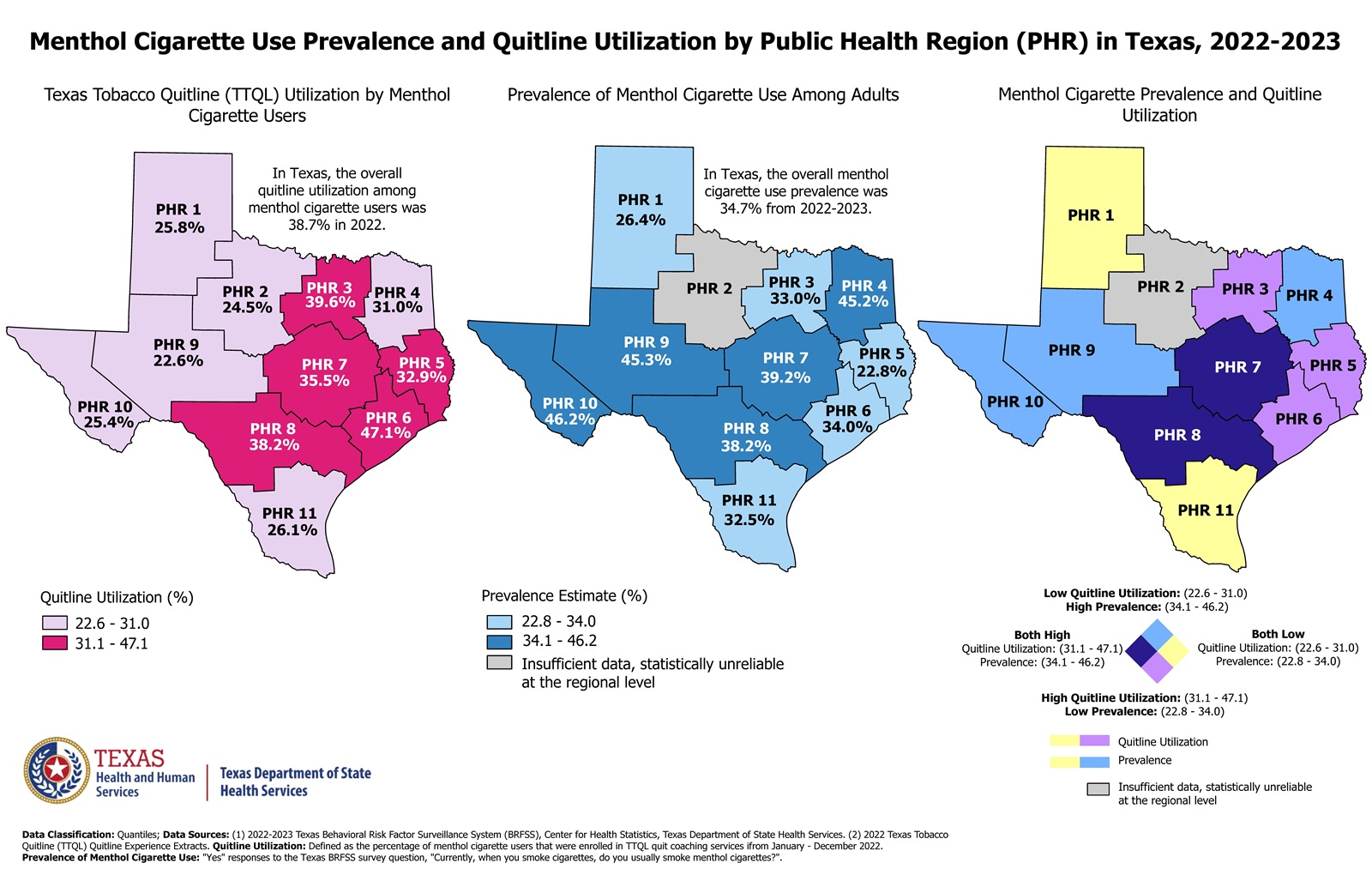
This map series displays 2022 Texas Tobacco Quitline (TTQL) utilization among menthol cigarette users enrolled in TTQL quit coaching services (left map) by Public Health Region (PHR), the 2022-2023 Behavioral Risk Factor Surveillance System (BRFSS) menthol cigarette use prevalence estimates among adults by PHR (middle map), and a bivariate map of these two variables (right map).
The TTQL provides confidential, free, and convenient cessation services to Texas residents ages 13 and older to assist them in quitting all tobacco products, including e-cigarettes, through individualized support services. In 2022, 38.7% of TTQL callers who utilized the quitline reported using menthol cigarettes. PHRs with the highest quitline utilization by menthol cigarette users were PHR 6 (47.1%), PHR 3 (39.6%), and PHR 8 (38.2%). Regions with the lowest quitline utilization among menthol cigarette users were located in the West and Northwest areas of Texas, with the lowest utilization in PHR 10 (25.4%).
The aggregate 2022-2023 BRFSS menthol cigarette use prevalence in Texas is 34.7%. Regions with the highest prevalence of menthol cigarette users are PHR 10 (46.2%), PHR 9 (45.3%), and PHR 4 (45.2%). The PHR with the lowest prevalence of menthol cigarette users is PHR 5 (22.8%).
Looking at the bivariate map showing the comparison of menthol cigarette use prevalence and quitline utilization among menthol cigarette users, we see that there are various areas in the state where there is low utilization of the TTQL by menthol cigarette users yet high menthol cigarette use prevalence. These regions include PHRs 9 and 10, located in Western Texas. Additionally, Region 4 had both high menthol cigarette use prevalence and low quitline utilization by menthol cigarette users.
ArcGIS Pro Desktop; Adobe Acrobat Pro
BRFSS/PLACES; Texas Tobacco Quitline Experience Extracts.
To create this map series, I first classified the prevalence of menthol cigarette use and the prevalence of Texas Tobacco Quitline (TTQL) utilization among menthol users into tertiles. I then created a bivariate choropleth map to depict where the two measures do and do not overlap. The BRFSS menthol cigarette use data was analyzed using SAS 9.4 to create an aggregated 2022-2023 dataset since the prevalence estimates were much less stable with only one year of data. Additionally, SAS 9.4 was used to determine the number and percentage of menthol cigarette users enrolled in Texas Tobacco Quitline (TTQL) quit coaching services in 2022.
This map series will be utilized to visualize menthol cigarette use in the state as well as highlight areas of Texas where utilization of the TTQL by menthol cigarette users is low and where menthol cigarette use prevalence is high. With this knowledge, the Texas Department of State Health Services Tobacco Prevention and Control Branch programmatic staff will be able to target areas where more outreach, quitline-related resources, and focused interventions are necessary to increase quitline utilization among menthol cigarette users.
Delaney LaBrutta, Epidemiologist II
Texas Department of State Health Services
delaney.labrutta@dshs.texas.gov
Delaney LaBrutta, Epidemiologist II, Texas Department of State Health Services. Accessed from the Centers for Disease Control and Prevention's Chronic Disease Map Gallery.