



What to know
- A series of events must happen before a foodborne outbreak can be reported by public health officials.
- The time it takes between a person getting sick and public health officials reporting the case as linked to an outbreak is called a reporting lag.
- Reporting lags are why the number of illnesses in a foodborne outbreak can increase even after the contaminated food is off the market.
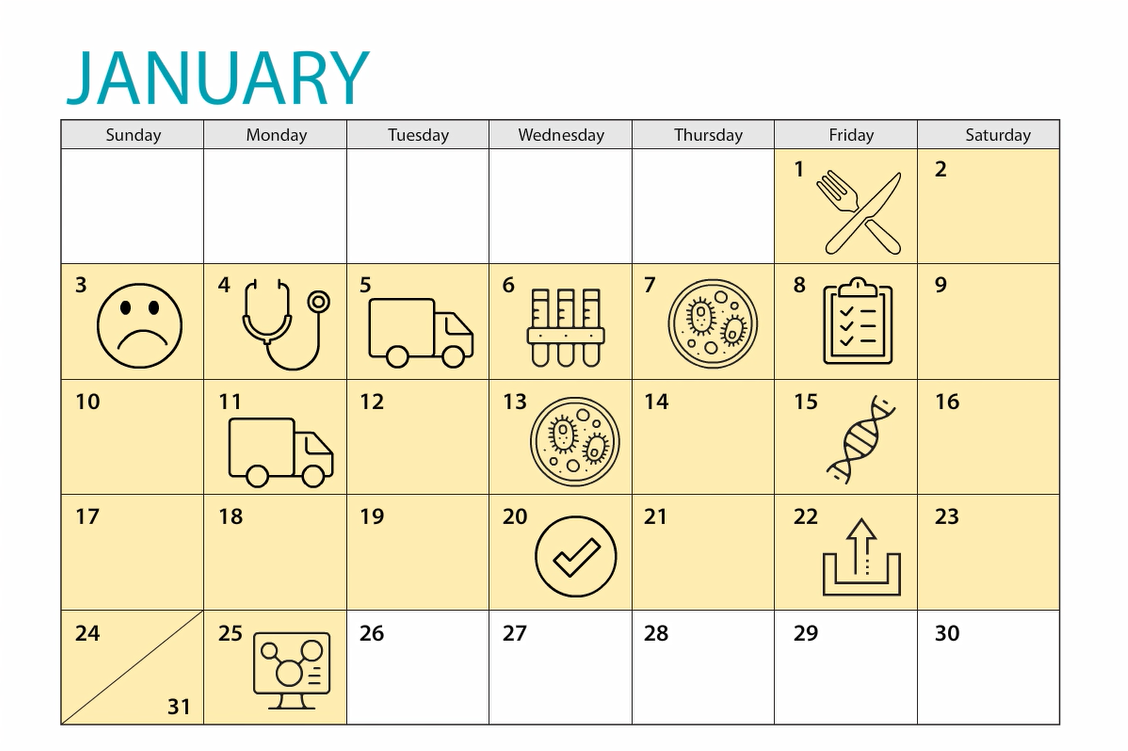
How outbreaks unfold
A series of events happen before public health officials can report that a case of illness is linked to an outbreak. Each event takes a certain amount of time. This time is known as the "reporting lag" or "lag window" of an outbreak. This lag is why the number of illnesses in a foodborne outbreak can increase for weeks, even after the contaminated food is off the market.
The reporting lag for a foodborne outbreak is usually 3–4 weeks. For illnesses caused by some bacteria, such as Listeria, it may be longer. Public health officials work to speed up this process when possible.
Foodborne germs and how long symptoms take to appear
The following chart describes how long it typically takes for someone to have symptoms after being infected with some of the most common foodborne bacteria. These times can contribute to reporting lags.
Campylobacter
2-5 days
E. coli
3-4 days
Listeria
Within 2 weeks
Salmonella
6 hours to 6 days
Vibrio
1-2 days
Understanding reporting lags
Sample outbreak timeline
The steps below outline what typically happens from the day someone eats a contaminated food to the day their illness is linked to a multistate foodborne outbreak investigated by CDC.
Day 1:
Exposure to foodborne germs
You eat a food containing harmful bacteria.
Day 3:
You start to feel sick
Symptoms of food poisoning (such as nausea and diarrhea) could start anywhere from a few hours to a few weeks later, depending on the bacteria you ingested.
Day 5:
You see a healthcare provider
You still feel sick with nausea or diarrhea, so you decide to see a healthcare provider.
- To learn which germ is making you sick, the healthcare provider collects a sample of your stool (poop), urine (pee), or blood.
- The provider sends your sample to a clinical laboratory for testing.
Day 6:
The clinical lab tests your sample
After receiving your sample, the laboratory takes 1–3 days to run tests, depending on their capacity.
Day 9:
Test results show what germ is causing your illness
- The clinical laboratory identifies the germ making you sick and reports the test results to your healthcare provider.
- The clinical laboratory should also report test results to the state or local public health department, and they notify CDC.
Days 9–16:
Sample sent to a public health lab
- The clinical laboratory ships the bacteria found in your sample to a public health laboratory for whole genome sequencing (WGS) analysis.
- Shipping can take up to a week, depending on transportation arrangements in your state and the distance between the two laboratories.
Days 16–21:
The public health lab performs additional testing
- The public health laboratory performs Whole Genome Sequencing (WGS) and other tests to determine the bacteria's DNA fingerprint and other characteristics.
- WGS testing and analysis of the results, including whether the bacteria is resistant to any antibiotics, can take 2–10 days depending on the bacteria.
Day 22:
WGS results sent to CDC
Within a day of analyzing the WGS results, state public health officials add the DNA fingerprint from the bacteria to PulseNet, a national laboratory network coordinated by CDC. PulseNet connects foodborne illnesses in order to identify outbreaks.
Day 23:
Outbreak identified
- CDC scientists determine whether the bacteria causing your illness is closely related genetically to any other recent WGS results from other people in PulseNet.
- If it is closely related to bacteria causing recent illnesses in other people, CDC may begin an outbreak investigation or add your illness to an ongoing investigation.