



At a glance

Abstract
Immunization against influenza and COVID-19 can reduce severe illness among pregnant women and infants; maternal respiratory syncytial virus (RSV) vaccination and infant RSV monoclonal antibodies protect infants from severe RSV disease. To assess end-of-season maternal vaccination coverage and infant RSV immunization coverage during the 2025–26 respiratory virus season, CDC analyzed data from an Internet panel survey conducted March 31–May 11, 2026. Among eligible women, 49.5% reported receipt of influenza vaccine before or during pregnancy, 28.9% reported receipt of the 2025–26 COVID-19 vaccine before or during pregnancy, and 44.7% reported receipt of RSV vaccine during pregnancy. Among women with eligible infants, born during April 1, 2025–March 31, 2026, 57.8% reported that their infant received RSV monoclonal antibody; 69.5% of infants were reported to be protected through maternal RSV vaccination, infant immunization, or both (10.9%). Provider recommendations and vaccine-related conversations might help increase immunization coverage among pregnant women and infants.
Introduction
Pregnancy increases the risk of severe influenzaA and COVID-19B disease. Numerous studies have shown maternal vaccines to be safe and effective in protecting pregnant women against severe illness associated with influenza and COVID-19 and their infants against severe illness associated with influenza, COVID-19, and respiratory syncytial virus (RSV).C,D For the 2025–26 respiratory virus season, Centers for Disease Control and Prevention (CDC) recommended influenza vaccine before or during pregnancy for all women who are or might become pregnant, ideally offered during September–October, and as early as July–August for women who are in the third trimester of pregnancy1; and COVID-19 vaccine for all adults 18 years and older and children 6 months-17 years with moderate or severe immunocompromise; for all other children, it is recommended through shared clinical decision making.E To protect all infants against RSV-associated lower respiratory tract infection, CDC recommends either RSV vaccine for pregnant women at 32–36 weeks gestation using seasonal administration from September–January2, or administration of a long-acting RSV monoclonal antibody (mAb) for infants aged <8 months born during or entering their first RSV season during October–March in most of the continental United States3. This report provides estimates of reported maternal vaccination coverage for respiratory virus vaccines (influenza, COVID-19, and RSV), infant receipt of RSV mAb, and the overall proportion of infants reported to be protected against RSV in the United States during the 2025–26 season.
Methods
Data Source and Study Participants
CDC conducted Internet panel surveysF during March 31–May 11, 2026, to assess reported end-of-season maternal vaccination coverage among pregnant women and reported RSV mAb coverage among infants, as previously described; similar surveys have been conducted since the 2011–12 season4. Questions about maternal influenza, COVID-19, and RSV vaccination receipt, as well as RSV mAb administration for infants and maternal plans to vaccinate their child were included. Women aged 18–49 years who reported being pregnant any time since August 1, 2025, and those who delivered an infant since April 1, 2025, were eligible to participate in the survey. Among 4,322 eligible women, 4,006 completed the survey (completion rate = 92.7%G). Data were weighted to align the sample with pregnancy status and outcomeH at the time of survey completion, age, race and ethnicity, and geographic distribution of the total U.S. population of pregnant women.
Data Analysis
The analysis included 4,001 currently and recently pregnant women (5 respondents were excluded during data cleaning).I Analysis of influenza vaccination coverage included 2,626 women pregnant any time during October 2025–January 2026; women who reported receipt of influenza vaccine since July 1, 2025, before or during most recent pregnancy, were considered vaccinated. Analysis of COVID-19 vaccination coverage included 3,111 women who were pregnant any time from September 2025 through the time of survey completion; women who reported receiving a 2025–26 COVID-19 vaccineJ before or during pregnancy were considered vaccinated. Analysis of maternal RSV vaccination coverage included 914 women who were 32–36 gestational weeks pregnant any time during September 2025–January 2026; women who reported receiving an RSV vaccine any time during their pregnancy were considered vaccinated. Analysis of reported RSV mAb coverage among infants was assessed among 1,918 women with eligible infants, born during April 2025–March 2026, who would have been recommended to receive RSV mAb during October 2025–March 2026. Infant protection against severe RSV included 1,917 eligible infants (one woman with unknown maternal RSV vaccination status was excluded); infants were considered protected if mothers reported either receipt of maternal RSV vaccination or infant receipt of RSV mAb.K
SAS (version 9.4, SAS Institute) was used to conduct all analyses. Weighted proportions and corresponding 95% confidence intervals (CI) for maternal vaccination and infant RSV immunization coverage were estimated overall and by selected demographics. Differences in vaccination coverage between groups were assessed using t-tests, with p-values <0.05 considered statistically significant. This activity was reviewed by CDC, deemed not research, and was conducted consistent with applicable federal law and CDC policy.L
Results
Influenza and COVID-19 Maternal Vaccination Coverage
For the 2025–26 respiratory virus season, end-of-season reported vaccination coverage among eligible pregnant women was 49.5% for influenza and 28.9% for COVID-19 vaccines (Table 1). Maternal influenza vaccination coverage was similar to last season but remained lower than pre-pandemic coverage in the 2019−20 season (Figure 1). Coverage for each vaccine varied by demographic factors including race and ethnicity, education, employment status, poverty status, and insurance coverage. Reported vaccination coverage for both vaccines was significantly higher among women with a provider recommendation for the vaccine (Table 1).
Maternal and Infant RSV Immunization Coverage and Infant Protection Against RSV
Reported maternal RSV vaccination coverage among eligible pregnant women was 44.7%. Among women with an eligible infant, reported infant coverage with RSV mAb was 57.8%. Overall, 69.5% of women reported infant protection against RSV by either maternal RSV vaccination, RSV mAb, or both (10.9%). There were fewer significant differences by demographics for infant protection against RSV, and the magnitude of the differences were smaller than those observed for influenza and COVID-19 vaccinations. RSV immunization coverage was higher among those who received a provider recommendation (Table 2).
Discussion
Findings from this survey indicate that approximately half of pregnant women received an influenza vaccine, and less than one third received a COVID-19 vaccine during the 2025–26 respiratory virus season. Maternal and infant immunization coverage for influenza, COVID-19, and RSV were similar this season compared with last season4. The estimate from this study on infant protection against RSV was similar but slightly higher compared with self-reported coverage from the National Immunization Survey (NIS) (65.1%).M In this study, 10.9% of women reported infant protection from both maternal and infant RSV immunizations, although for most infants only one is recommended, indicating a possible need to address complexities in RSV prevention recommendations or maternal and infant care coordination. Not receiving recommended immunizations leaves pregnant women and their infants more vulnerable to influenza, COVID-19, and RSV and potentially serious complications including adverse birth outcomes, hospitalization, and death.N Equipping healthcare providers to deliver strong, proactive immunization recommendations may be key to increasing coverage and protecting pregnant women and children.
Limitations
The findings in this report are subject to at least four limitations, some of which have been previously described4. First, this was a nonprobability sample, and results might not be generalizable to all pregnant women in the United States. There may be some self-selection bias or bias due to exclusion of women with no Internet access or other socioeconomic characteristics. Second, maternal and infant immunization status was self-reported and might be subject to recall or social desirability bias. Third, because of small sample sizes, immunization coverage could not be assessed separately among some racial and ethnic groups. Finally, statistical tests based on the assumption of probability were used to ascertain differences in immunization coverage among groups in this nonprobability sample.O Despite these limitations, Internet panel surveys are a useful assessment tool for timely evaluation of immunization coverage among pregnant women and their infants.
Implications for Public Health Practice
CDC has resources to assist providers in effectively communicating the importance of vaccination, such as sharing specific reasons that certain vaccines are recommended for the patient and highlighting positive personal or clinical experiences with vaccines.PIn addition, the American College of Obstetricians and Gynecologists has an immunization tool kitQ that includes communication strategies for providers. Recommendations for immunizations from health care providers are critical to improving immunization coverage for both pregnant women and their infants and reducing risk of severe respiratory disease.
Tables and Figures
| Characteristic | Influenza vaccine† | 2025–2026 COVID-19 vaccine§ | ||
|---|---|---|---|---|
| Total N (weighted %)¶ |
Weighted % Vaccinated (95% CI)** |
Total N (weighted %)¶ |
Weighted % Vaccinated (95% CI)** |
|
| Overall | 2626 | 49.5 (46.8–52.1) | 3111 | 28.9 (26.9–31.0) |
| Maternal age group, years | ||||
| 18–24 | 434 (21.2) | 45.8 (39.3–52.5) | 525 (21.7) | 28.3 (23.2–33.8) |
| 25–34 | 1214 (57.7) | 49.8 (46.1–53.6) | 1425 (57.0) | 27.9 (25.3–30.7) |
| 35–49 (Ref) | 978 (21.1) | 52.1 (47.9–56.3) | 1161 (21.3) | 32.2 (28.7–35.9) |
| Maternal race and ethnicity†† | ||||
| White, non-Hispanic (Ref) | 1410 (47.6) | 47.9 (44.6–51.3) | 1671 (47.6) | 26.4 (24.0–28.9) |
| Black, non-Hispanic | 519 (16.7) | 47.5 (40.3–54.8) | 618 (16.6) | 29.2 (24.5–34.2) |
| Hispanic or Latino | 414 (25.8) | 52.9 (46.6–59.2) | 492 (26.2) | 30.8 (25.9–36.0) |
| Other, non-Hispanic | 283 (9.9) | 51.5 (43.6–59.3) | 330 (9.6) | 35.8 (29.8–42.2)§§ |
| Maternal education | ||||
| High school diploma or less | 767 (32.8) | 36.1 (31.2–41.1)§§ | 932 (33.0) | 20.0 (16.8–23.5)§§ |
| Some college, no degree | 471 (18.4) | 45.0 (38.5–51.6)§§ | 569 (19.0) | 24.9 (20.3–30.0)§§ |
| College degree | 1056 (38.5) | 58.0 (53.7–62.1)§§ | 1226 (37.5) | 35.8 (32.3–39.4) |
| Higher than college degree (Ref) | 332 (10.4) | 68.5 (62.0–74.4) | 383 (10.4) | 40.1 (33.7–46.7) |
| Maternal employment status | ||||
| Employed (Ref) | 1892 (69.3) | 55.1 (51.8–58.3) | 2228 (69.5) | 33.7 (31.1–36.3) |
| Unemployed | 733 (30.7) | 36.8 (32.1–41.7)§§ | 881 (30.5) | 18.1 (15.1–21.3)§§ |
| Poverty status¶¶ | ||||
| At or above poverty (Ref) | 1996 (71.8) | 54.2 (51.1–57.2) | 2364 (72.7) | 31.5 (29.1–33.9) |
| Below poverty | 621 (28.2) | 37.6 (32.0–43.4)§§ | 735 (27.3) | 22.0 (18.1–26.4)§§ |
| Area of residence*** | ||||
| Rural | 490 (18.9) | 36.0 (30.7–41.5)§§ | 571 (18.3) | 17.0 (13.8–20.6)§§ |
| Nonrural (Ref) | 2134 (81.1) | 52.7 (49.6–55.7) | 2537 (81.7) | 31.6 (29.3–34.0) |
| Region††† | ||||
| Northeast (Ref) | 436 (17.3) | 54.3 (47.2–61.3) | 507 (17.1) | 31.8 (26.5–37.5) |
| Midwest | 529 (20.7) | 46.8 (41.0–52.7) | 624 (20.5) | 25.0 (20.8–29.7) |
| South | 1177 (38.9) | 49.4 (45.3–53.5) | 1397 (38.5) | 30.4 (27.2–33.6) |
| West | 482 (23.2) | 48.5 (42.2–54.9) | 580 (23.8) | 28.0 (23.6–32.7) |
| Prenatal insurance coverage§§§ | ||||
| Private or military insurance only (Ref) | 1392 (49.8) | 61.5 (57.9–65.0) | 1627 (49.5) | 34.8 (31.8–37.9) |
| Any public insurance | 1130 (45.9) | 37.2 (33.4–41.2)§§ | 1345 (45.8) | 22.0 (19.3–24.8)§§ |
| No insurance | 104 (4.2) | —¶¶¶ | 138 (4.7) | 34.6 (22.3–48.6) |
| Provider vaccination recommendation | ||||
| Recommendation (Ref) | 1950 (71.6) | 62.2 (59.1–65.3) | 1662 (50.0) | 51.5 (48.1–54.9) |
| No recommendation | 676 (28.4) | 17.3 (13.3–21.9)§§ | 1445 (50.0) | 6.5 (5.0–8.2)§§ |
Abbreviations: CI = confidence interval; Ref = referent group.
* https://www.dynata.com/ & https://www.prodege.com/
† Respondents pregnant any time during October 2025–January 2026 were included in the analyses to assess influenza vaccination coverage for the 2025–26 season. Women who reported receiving an influenza vaccination since July 1, 2025, before or during their pregnancy, were considered vaccinated.
§ Respondents pregnant any time from September 2025 through the time of survey completion were included in the analysis. Those who reported receiving a 2025–2026 COVID-19 vaccine before or during their pregnancy were considered vaccinated.
¶ The total unweighted number and weighted proportion of respondents in the sample.
** Modified Clopper-Pearson 95% CI according to the approach of Korn and Graubard. 4356-eng.pdf
†† Race and ethnicity were self-reported. Respondents identifying as Hispanic or Latino might be of any race. The "Other" race category included Asian, American Indian or Alaska Native, Native Hawaiian or Pacific Islander, Middle Eastern or North African, and women who selected multiple races.
§§ Statistically significant difference compared with a referent group.
¶¶ Poverty status was defined based on the reported number of persons living in the household and annual household income, according to U.S. Census Bureau poverty thresholds. https://www.census.gov/data/tables/time-series/demo/income-poverty/historical-poverty-thresholds.html
*** Rurality was defined using zip code areas in which >50% of the population lives in a nonmetropolitan county, a rural U.S. Census Bureau tract, or both, according to the Health Resources and Services Administration's definition of rural population. https://www.hrsa.gov/rural-health/about-us/what-is-rural
††† https://www2.census.gov/geo/pdfs/maps-data/maps/reference/us_regdiv.pdf
§§§ Respondents pregnant on their survey date were asked what medical insurance or medical care coverage they had; respondents who had already delivered were asked what coverage they had during their most recent pregnancy. Women considered to have public insurance selected at least one of the following options: Medicaid, Medicare, state-sponsored medical plan, or other government plan. Respondents considered to have private or military insurance selected private medical insurance, military medical care, or both and did not select any type of public insurance.
¶¶¶ Estimates do not meet the National Center for Health Statistics' standards of reliability. https://www.cdc.gov/nchs/data/series/sr_02/sr02_175.pdf
| Characteristic | Maternal RSV vaccination† | Receipt of RSV mAb by infant§ | Maternal RSV vaccination or receipt of RSV mAb by infant¶ | |||
|---|---|---|---|---|---|---|
| Total N (weighted %)** |
Weighted % vaccinated (95% CI)†† |
Total N (weighted %)** |
Weighted % vaccinated (95% CI)†† |
Total N (weighted %)** |
Weighted % vaccinated (95% CI)†† |
|
| Overall | 914 | 44.7 (40.5–49.0) | 1918 | 57.8 (55.3–60.3) | 1917 | 69.5 (67.1–71.8) |
| Maternal age group, years | ||||||
| 18–24 | 135 (22.1) | 35.0 (25.3–45.6)§§ | 270 (20.4) | 60.1 (53.4–66.6) | 269 (20.3) | 68.6 (62.0–74.6) |
| 25–34 | 452 (57.0) | 44.8 (39.4–50.4)§§ | 949 (58.3) | 55.7 (52.3–59.1)§§ | 949 (58.3) | 68.3 (65.0–71.4)§§ |
| 35–49 (Ref) | 327 (20.9) | 54.6 (47.5–61.5) | 699 (21.3) | 61.3 (57.1–65.3) | 699 (21.3) | 73.8 (70.0–77.3) |
| Maternal race and ethnicity¶¶ | ||||||
| White, non-Hispanic (Ref) | 524 (46.9) | 43.9 (38.8–49.0) | 1109 (50.0) | 56.9 (53.7–60.1) | 1108 (50.0) | 68.1 (65.0–71.2) |
| Black, non-Hispanic | 141 (13.5) | 42.3 (31.0–54.2) | 338 (13.4) | 54.1 (48.2–59.9) | 338 (13.4) | 63.5 (57.7–69.0) |
| Hispanic or Latino | 155 (29.2) | 43.0 (33.1–53.3) | 298 (26.9) | 58.8 (52.7–64.7) | 298 (26.9) | 71.1 (65.1–76.6) |
| Other, non-Hispanic | 94 (10.4) | 56.5 (44.6–68.0)§§ | 173 (9.7) | 64.3 (56.2–71.8) | 173 (9.7) | 80.2 (72.9–86.3)§§ |
| Maternal education | ||||||
| High school diploma or less | 278 (37.9) | 32.2 (25.2–39.8)§§ | 586 (33.9) | 56.4 (51.7–61.0) | 585 (33.8) | 65.2 (60.6–69.6)§§ |
| Some college, no degree | 177 (17.3) | 50.7 (42.0–59.3) | 331 (17.3) | 57.9 (51.5–64.0) | 331 (17.3) | 69.4 (63.3–75.0) |
| College degree | 348 (34.8) | 53.7 (47.5–59.9) | 765 (38.4) | 59.0 (55.0–62.9) | 765 (38.5) | 72.0 (68.2–75.5) |
| Higher than college degree (Ref) | 110 (10.0) | 51.0 (38.7–63.2) | 235 (10.4) | 58.0 (50.3–65.4) | 235 (10.4) | 74.9 (67.7–81.2) |
| Maternal employment status | ||||||
| Employed (Ref) | 600 (62.9) | 47.7 (42.3–53.1) | 1259 (63.1) | 59.0 (55.8–62.0) | 1258 (63.1) | 71.6 (68.7–74.4) |
| Unemployed | 313 (37.1) | 39.8 (32.9–47.0) | 657 (36.9) | 55.8 (51.4–60.2) | 657 (36.9) | 66.0 (61.6–70.1)§§ |
| Poverty status*** | ||||||
| At or above poverty (Ref) | 666 (67.8) | 49.0 (44.3–53.7) | 1428 (72.6) | 57.8 (54.9–60.7) | 1428 (72.6) | 70.5 (67.8–73.1) |
| Below poverty | 245 (32.2) | 35.9 (27.9–44.5)§§ | 477 (27.4) | 57.9 (52.6–63.1) | 476 (27.4) | 67.2 (62.0–72.1) |
| Area of residence††† | ||||||
| Rural | 200 (20.7) | 40.0 (32.0–48.5) | 390 (19.9) | 60.6 (55.0–66.1) | 389 (19.9) | 70.9 (65.6–75.9) |
| Nonrural (Ref) | 713 (79.3) | 46.0 (41.1–51.0) | 1525 (80.1) | 57.1 (54.2–59.9) | 1525 (80.1) | 69.1 (66.4–71.8) |
| Region§§§ | ||||||
| Northeast (Ref) | 134 (16.6) | 47.8 (35.3–60.6) | 292 (16.0) | 62.6 (56.3–68.5) | 292 (16.1) | 73.5 (67.6–78.9) |
| Midwest | 183 (19.9) | 50.5 (41.9–59.1) | 390 (20.4) | 58.9 (53.3–64.4) | 390 (20.4) | 72.5 (67.2–77.3) |
| South | 399 (40.8) | 42.4 (35.9–49.0) | 812 (40.4) | 58.3 (54.4–62.1) | 811 (40.4) | 69.0 (65.3–72.6) |
| West | 197 (22.7) | 41.8 (33.1–50.9) | 420 (23.1) | 52.7 (46.8–58.5)§§ | 420 (23.1) | 65.1 (59.2–70.7)§§ |
| Prenatal insurance coverage¶¶¶ | ||||||
| Private or military insurance only (Ref) | 458 (47.3) | 54.0 (48.2–59.8) | 969 (48.9) | 55.5 (51.9–59.0) | 969 (48.9) | 70.5 (67.1–73.7) |
| Any public insurance | 428 (48.4) | 38.0 (32.1–44.1)§§ | 871 (46.9) | 61.1 (57.3–64.8)§§ | 870 (46.8) | 69.8 (66.1–73.3) |
| No insurance | 27 (4.3) | —**** | 77 (4.2) | 48.2 (34.3–62.4) | 77 (4.3) | 55.6 (41.4–69.1)§§ |
| Provider recommendation of RSV vaccination or RSV mAb administration†††† | ||||||
| Recommendation (Ref) | 569 (59.9) | 70.4 (65.2–75.3) | 1181 (62.4) | 71.8 (68.7–74.8) | 1474 (77.4) | 80.9 (78.4–83.2) |
| No recommendation | 344 (40.1) | 6.3 (3.8–9.6)§§ | 731 (37.6) | 34.8 (30.9–38.8)§§ | 438 (22.6) | 30.8 (26.0–35.9)§§ |
Abbreviations: CI = confidence interval; Ref = referent group; RSV = respiratory syncytial virus; mAb = monoclonal RSV antibody.
* https://www.dynata.com/ & https://www.prodege.com/
† Respondents 32–36 gestational weeks pregnant any time during September 1, 2025–January 31, 2026, were included in the analyses. Women who reported receipt of an RSV vaccination any time during their pregnancy were considered immunized.
§ Infants born to survey participants during April 2025–March 2026 were included in the analysis. Infants with reported receipt of RSV monoclonal antibody were considered immunized.
¶ Infants born to survey participants during April 2025–March 2026 were included in the analysis. Infants with reported RSV monoclonal antibody receipt, or those born to women 32–36 weeks pregnant at any time during September 2025–January 2026 who reported receiving an RSV vaccination any time during their pregnancy, were considered immunized. One participant had unknown maternal RSV vaccination status and reported infant did not receive RSV mAb; therefore excluded as infant protection could not be determined.
** The total unweighted number and weighted proportion of respondents in the sample.
†† Modified Clopper-Pearson 95% CI according to the approach of Korn and Graubard. 4356-eng.pdf
§§ Statistically significant difference compared with a referent group.
¶¶ Race and ethnicity were self-reported. Respondents identifying as Hispanic or Latino might be of any race. The "Other" race category included Asian, American Indian or Alaska Native, Native Hawaiian or Pacific Islander, Middle Eastern or North African, and women who selected multiple races.
*** Poverty status was defined based on the reported number of persons living in the household and annual household income, according to U.S. Census Bureau poverty thresholds. https://www.census.gov/data/tables/time-series/demo/income-poverty/historical-poverty-thresholds.html
††† Rurality was defined using zip code areas in which >50% of the population lives in a nonmetropolitan county, a rural U.S. Census Bureau tract, or both, according to the Health Resources and Services Administration's definition of rural population. https://www.hrsa.gov/rural-health/about-us/what-is-rural
§§§ https://www2.census.gov/geo/pdfs/maps-data/maps/reference/us_regdiv.pdf
¶¶¶ Respondents pregnant on their survey date were asked what medical insurance or medical care coverage they had; respondents who had already delivered were asked what coverage they had during their most recent pregnancy. Women considered to have public insurance selected at least one of the following options: Medicaid, Medicare, state-sponsored medical plan, or other government plan. Respondents considered to have private or military insurance selected private medical insurance, military medical care, or both and did not select any type of public insurance.
**** Estimates do not meet the National Center for Health Statistics' standards of reliability. https://www.cdc.gov/nchs/data/series/sr_02/sr02_175.pdf
†††† Respondents were asked "Has any doctor, nurse, or other medical professional recommended that you protect your baby from RSV either by getting an RSV vaccination for yourself or an RSV antibody shot for your baby?"; if answered with yes then respondents were further asked "Did any doctor, nurse, or other medical professional(s) recommend any of the options below? Recommendations could have come from different medical professionals. (1) Only recommended RSV vaccine for yourself, (2) Only recommended RSV antibody shot for your baby, (3) Recommended RSV vaccine for yourself and RSV antibody shot for your baby". Reported (1) or (3) were considered recommendation of RSV vaccine, reported (2) or (3) were considered recommendation of RSV mAb, reported yes to first question were considered recommendation of RSV vaccine or RSV mAb.
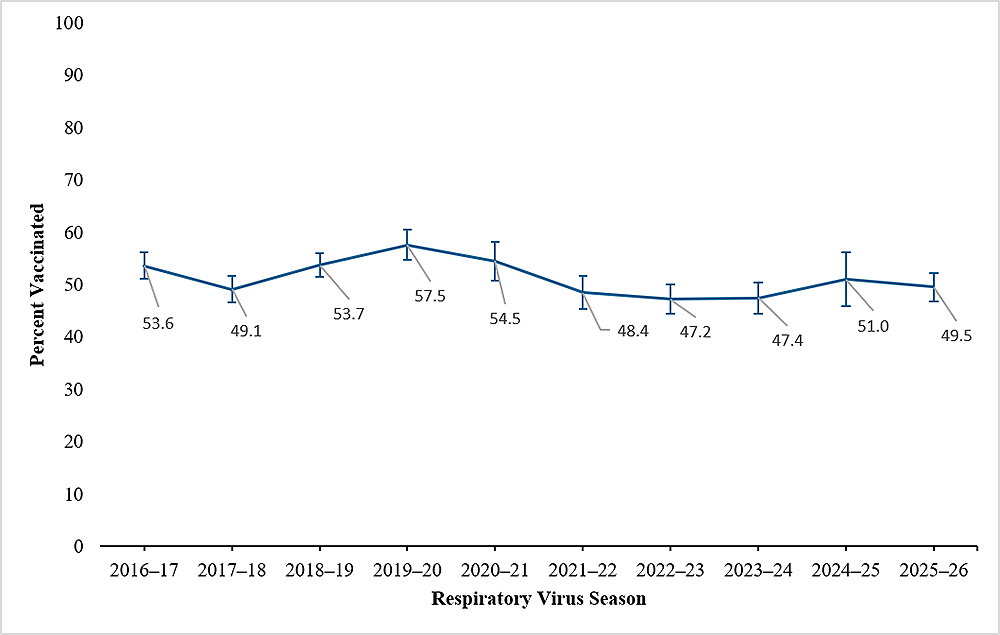
- Received influenza vaccination before or during pregnancy from July 1st of each year through the time of survey completion among women pregnant during October through January.
† https://www.dynata.com/ & https://www.prodege.com/
§ To further minimize bias, a change in the weighting methodology was employed beginning with the 2020–21 survey. Similar to previous survey years, sample weights for the 2020–21 survey were created so that the distribution of the weighted sample matched population control totals by region, age group, race/ethnicity and age group by race and ethnicity. Beginning with the 2020–21 survey, the sample weights were constructed to additionally match population control totals by current pregnancy status and outcome at the time of the survey as well as all two-way interactions between region, age group, race and ethnicity and current pregnancy status and outcome. The new weighting methodology had a minimal effect for most of the characteristics studied. Estimates for 2019–20 included here are re-weighted estimates. https://www.cdc.gov/flu/fluvaxview/pregnant-women-apr2021.html
Authors
Hilda Razzaghi, PhD1; Emma Garacci, MS2; Katherine E. Kahn, MPH3; Mehreen Meghani, MPH1; Jefferson M. Jones, MD4; Sascha Ellington, PhD5; Carla L. Black, PhD1
1Immunization Services Division, National Center for Immunization and Respiratory Diseases, CDC; 2Cherokee Nation Operational Solutions, Tulsa, Oklahoma; 3Eagle Health Analytics, LLC, Atlanta, GA; 4Coronavirus and Other Respiratory Viruses Division, National Center for Immunization and Respiratory Diseases, CDC; 5Influenza Division, National Center for Immunization and Respiratory Diseases, CDC
This page was last updated on this date. Updates may include minor edits, image changes, or other modifications to page content.
The information on this page was last reviewed by subject matter experts to ensure accuracy.
- Flu & Pregnancy
- COVID-19 Vaccination for Women Who Are Pregnant or Breastfeeding
- Vaccine Safety for Moms-To-Be
- RSV Vaccine Guidance for Pregnant Women
- Interim Clinical Considerations for Use of COVID-19 Vaccines in the United States
- Pregnant women were recruited from two large, preexisting, opt-in Internet panels of the general population, operated by Dynata and Prodege.
- A survey response rate requires specification of the denominator at each stage of sampling. During recruitment of an online opt-in survey sample, such as the Internet panels described in this report, these numbers are not available; therefore, a response rate cannot be calculated. Instead, the survey completion rate is provided.
- Pregnancy status and outcomes included currently pregnant, recently pregnant with a live birth, recently pregnant without a live birth (including miscarriage or spontaneous abortion, stillbirth, fetal loss, induced abortion, and ectopic or tubal pregnancy).
- Given the nuances of recommendations for each of the immunization products included in this study, analysis of each product was restricted to a subsample of the study participants who were eligible for the specific product.
- 2025─2026 COVID-19 vaccine formulations became available in late August 2025. COVID-19 Vaccines (2025-2026 Formula) for Use in the United States Beginning in Fall 2025 | FDA
- Forty-two women reported multiple births (total of 94 infants); for the analysis, these births were considered as a single infant. Infant immunization status was the same for infants born to the same mother (either reported that all or none of their babies received RSV monoclonal antibody) except for one mother who reported one of her two infants received RSV monoclonal antibody where the infant was considered immunized.
- 45 C.F.R. part 46; 21 C.F.R. part 56; 42 U.S.C. Sect. 241(d); 5 U.S.C. Sect. 552a; 44 U.S.C. Sect. 3501 et seq.
- Infant Protection Against Respiratory Syncytial Virus (RSV) by Maternal RSV Vaccination or Receipt of RSV Monoclonal Antibody, and Intent for RSV Monoclonal Antibody Receipt, United States
- Why Maternal Vaccines Are Important
- Report of the AAPOR task force on non-probability sampling
- Adult Immunization Standards
- https://www.acog.org/programs/immunization-for-women/physician-tools
- Grohskopf LA, Blanton LH, Ferdinands JM, et al. Prevention and Control of Seasonal Influenza with Vaccines: Recommendations of the Advisory Committee on Immunization Practices - United States, 2025-26 Influenza Season. MMWR Morb Mortal Wkly Rep 2025;74:500-507.
- Fleming-Dutra KE, Jones JM, Roper LE, et al. Use of the Pfizer Respiratory Syncytial Virus Vaccine During Pregnancy for the Prevention of Respiratory Syncytial Virus-Associated Lower Respiratory Tract Disease in Infants: Recommendations of the Advisory Committee on Immunization Practices - United States, 2023. MMWR Morb Mortal Wkly Rep 2023; 72:1115-1122.
- Jones JM, Fleming-Dutra KE, Prill MM, et al. Use of Nirsevimab for the Prevention of Respiratory Syncytial Virus Disease Among Infants and Young Children: Recommendations of the Advisory Committee on Immunization Practices - United States, 2023. MMWR Morb Mortal Wkly Rep 2023;72:920-925.
- Razzaghi H, Garacci E, Kahn KE, et al. Maternal and infant immunizations for respiratory diseases, United States, May 2025. Vaccine 2026;88:128823.