



At a glance
Use this practice to increase awareness of and protect the public from illnesses and diseases caused by ticks and mosquitoes. Missouri created story maps to share key information through a highly visual format.

Background
All people in Missouri are at risk of contracting illnesses and diseases caused by ticks and mosquitoes, especially those who spend time in outdoor environments.
Tickborne diseases have been on an increasing annual trend throughout the state and continue to be a public health concern. In 2024, there were 864 reported cases of tickborne diseases in Missouri, compared to 440 reported cases in 2009. In addition, mosquito-borne diseases such as West Nile virus are a recurring concern each year, with cases typically peaking in September. Residents are also at risk of contracting mosquito-borne diseases when visiting other countries and when there is a local, imported transmission of diseases such as dengue virus.
Key actions
The Missouri Department of Health and Senior Services developed two story maps – one focused on illnesses and diseases caused by ticks and the other focused on mosquitoes – to help increase awareness of and protect the public from these risks. Story maps are visual, interactive online tools that combine maps, multimedia content, and other information for awareness, education, data presentation, and other purposes.
Each story map contains information about the different types of tickborne and mosquito-borne illnesses and diseases reported in Missouri, including signs and symptoms, annual case counts, and maps showing rates by county. The story maps also contain guidance and information on strategies to help prevent tick and mosquito bites outdoors, including active ingredients to seek out in insect repellants.
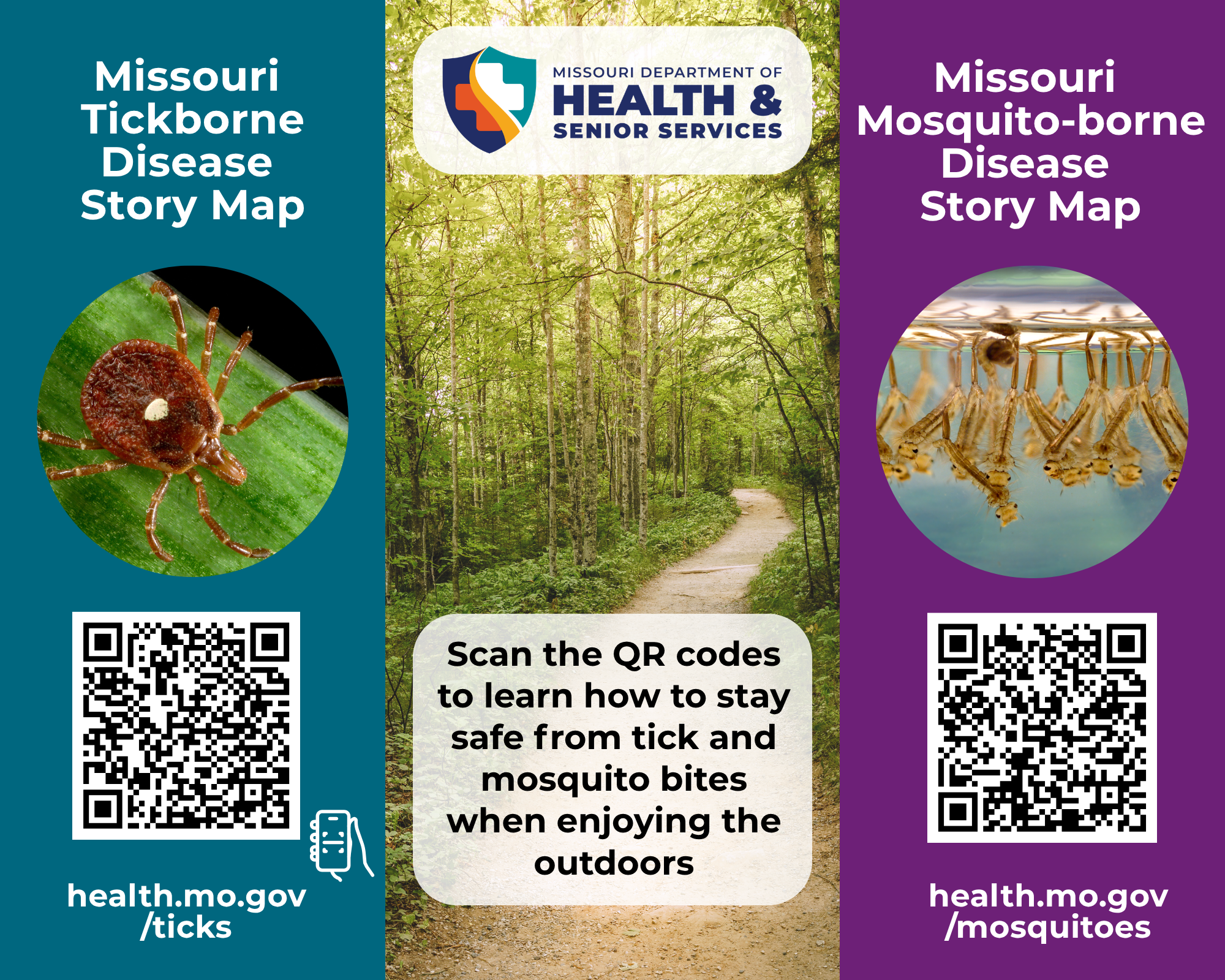
The goal is to promote awareness and education on these topics among Missouri residents. The health department promoted the tickborne disease story map and related messaging through radio advertisements, social media, and videos featuring a well-known outdoor influencer in the state. They also promoted the story map at in-person outreach events for people who spend time outdoors doing sports, hunting, or fishing. For example, they handed out a 'tickborne disease kit' containing tweezers for tick removal, an insect repellent wipe, and information cards about ticks and tickborne disease at an expo event featuring fishing equipment, tractors, and other supplies. The tickborne disease kit had a label with a QR code leading to the story map.
Using this practice
We selected this practice as an example of environmental public health successfully applied in the field. We based our selection on the following four domains:
- Effectiveness: Did it solve or help solve the environmental health problem?
- Feasibility: What conditions and resources are needed to use it?
- Sustainability: Is it realistically able to continue going forward?
- Transferability: Could other health departments use it with little to no changes?
Effectiveness
The health department focuses on tracking web views and marketing metrics as a measure of effectiveness. Views of the Tickborne Disease Story Map and the health department's tick-related web pages increased significantly after marketing campaigns. Views of tick information increased more than 1,000% since releasing and promoting the tick story map (from a yearly average of 565 webpage views to more than 11,000 views of both the webpage and story map).
While a reduction in tick- and mosquito-borne disease cases might indicate success, increased awareness could instead lead to higher reported case counts as more people recognize symptoms and seek care. The health department monitors annual case counts for decreases, but they primarily measure success by increases in web traffic to tick and mosquito-borne disease story maps.
Feasibility
Overall costs to implement this practice are fairly minimal, particularly if staff have access to ArcGIS software, existing technical knowledge and expertise in data analysis and visualization, and do not require additional training.
Costs to maintain the story maps are typically low once they are brought online. Most costs may be associated with promoting the story maps. For example, collaborating with a marketing company can be costly (approximately $5,000 per month). However, even short marketing campaigns with a small budget that target outdoor populations have proven very effective. Marketing costs could cover steps such as creating public health messaging, paid marketing on social media and radio stations, and providing marketing metrics to assess impact.
Programs may need the following capacity:
- Technical knowledge and expertise in tickborne and mosquito-borne illnesses and data analysis
- Access and expertise using ArcGIS software to create story maps
Sustainability
Once posted online, the story maps required minimal maintenance. Health departments using this practice could monitor and update the maps as new information and data become available. Health departments may need more funding to pursue future promotional campaigns.
Transferability
The creation of the tickborne and mosquito-borne disease story maps is a highly transferrable practice. An ArcGIS story map provides a user-friendly platform to communicate text-heavy information in a simple format with the addition of images and graphs to illustrate text.
Successes and challenges
This practice was a successful, low-cost way to increase public awareness and understanding about how to reduce risks and protect themselves, particularly outdoors.
Time was the biggest challenge. When creating the tick story map, health department staff provided technical expertise and drafted content on illnesses and diseases. State information technology staff created the tick story map. These staff had demanding workloads and competing priorities. Health department staff met regularly to brainstorm ways to overcome obstacles, such as how to allocate staff time to the project given competing priorities. To improve time challenges, a team member with sufficient ArcGIS skills created the mosquito story map.
Connections to Essential Services
Documenting how programs contribute to the Essential Public Health Services may help health departments in the accreditation process with the Public Health Accreditation Board. The activities in this practice support and align with these services:
- Educate (3)
- Improve or innovate (9)
Resources
Missouri Department of Health and Senior Services
- Missouri tickborne disease story map
- Missouri mosquito-borne disease story map
- Fall ticks and dressing to avoid ticks (videos from local radio personality who partnered with the health department)
CDC
- Communication resources (vector-borne diseases)
- Mosquitoes
- Ticks
- Vector control training (VCEHP)
Citation
In citing this practice in articles, presentations, or elsewhere, we suggest the following citation:
Centers for Disease Control and Prevention. National Center for Environmental Health. Environmental Public Health Practices Gateway. Story maps for ticks and mosquitoes: A practice from the Missouri Department of Health and Senior Services. U.S. Department of Health and Human Services, CDC, 2026, https://www.cdc.gov/environmental-health-practice/php/gateway/story-maps-for-ticks-and-mosquitoes.html