



Key points
- Cyclosporiasis is an intestinal infection that spreads when people ingest food or water contaminated with the Cyclospora parasite.
- Cyclosporiasis can be treated with an antibiotic regimen of trimethoprim-sulfamethoxazole (TMP-SMX).
- Testing for Cyclospora is not routinely conducted in most U.S. laboratories. Healthcare providers should specifically request testing if indicated.
Overview
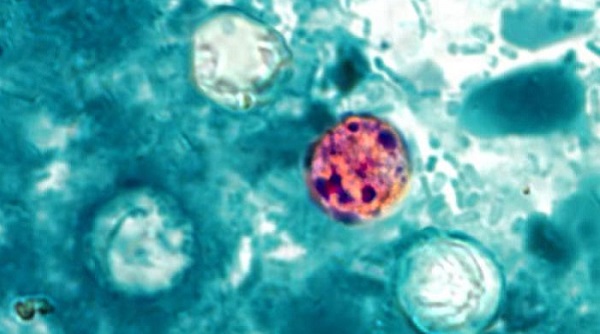
Cyclospora cayetanensis is a unicellular parasite that causes an intestinal infection called cyclosporiasis. Because Cyclospora is a coccidian parasite, infected people shed oocysts (rather than cysts or ova) in their stool. Cyclosporiasis spreads when people ingest food or water contaminated with the parasite.
Cyclospora infection is diagnosed by examining stool specimens. Diagnosis and testing can be difficult, in part because even symptomatic patients might not shed enough oocysts in their stool to be readily detectable by laboratory examinations. Testing for Cyclospora is not routinely conducted in most U.S. laboratories, even when stool is tested for parasites. Healthcare providers should specifically request testing for Cyclospora if indicated.
Risk factors
Anyone can be at risk for infection. People living or traveling in the tropics and subtropics may be at increased risk for infection because cyclosporiasis is endemic in some countries in these zones. In all regions where cyclosporiasis is endemic the infection appears to be seasonal, though seasonality varies in different settings and is not well understood.
Incubation
Some infected people are asymptomatic, particularly in settings where cyclosporiasis is endemic. Among symptomatic patients, the incubation period averages one week (ranging as soon as 2 days to 2 weeks or more).
How it spreads
Cyclospora infection is transmitted by ingesting food or water that has been contaminated with Cyclospora oocysts. Foodborne outbreaks of cyclosporiasis in the United States have been linked to consumption of fresh produce.
Cyclospora cayetanensis completes its life cycle in humans. However, the oocysts shed in the stool of infected people must mature (sporulate) outside the host, in the environment, to become infective for someone else. This process is thought to require at least 1–2 weeks in favorable environmental conditions. Therefore, direct person-to-person (fecal-oral) transmission of Cyclospora is unlikely.
Clinical features
Cyclospora infects the small intestine and typically causes watery diarrhea with frequent bowel movements.
- Watery diarrhea
- Loss of appetite
- Weight loss
- Abdominal cramping and bloating
- Increased flatus
- Nausea
- Prolonged fatigue
- Vomiting
- Body aches
- Headaches
- Low-grade fever
If untreated, the illness may last for a few days to a month or longer and may follow a remitting-relapsing course. Symptomatic reinfection can occur.
Complications
Although cyclosporiasis usually is not life threatening, reported complications have included malabsorption, cholecystitis, and reactive arthritis.
Prevention
The best way for people to prevent infection is to avoid consuming food or water that may be contaminated with stool. Travelers to cyclosporiasis-endemic areas should be aware that although food and water precautions for Cyclospora are similar to precautions for other intestinal pathogens, Cyclospora is unlikely to be killed by routine chemical disinfection or sanitizing methods.
Diagnosis and testing
Consider Cyclospora as a potential cause of prolonged diarrheal illness, particularly in patients with a history of recent travel to Cyclospora-endemic areas such as tropical and subtropical regions. Cyclospora infection is diagnosed by examining stool specimens. Testing for Cyclospora is not routinely conducted in most U.S. laboratories, even when stool is tested for parasites. Healthcare providers should specifically request testing for Cyclospora if indicated.
Treatment
Trimethoprim-sulfamethoxazole (TMP-SMX) (sold as Bactrim,A Septra,A or Cotrim)A is the treatment of choice. The typical regimen for immunocompetent adults is:
- TMP 160 mg plus SMX 800 mg (one double-strength tablet), orally, twice a day, for 7–10 days. People with weakened immune systems may need longer courses of therapy.
This page was last updated on this date. Updates may include minor edits, image changes, or other modifications to page content.
The information on this page was last reviewed by subject matter experts to ensure accuracy.
- Use of trade names is for identification only and does not imply endorsement by the Public Health Service or by the U.S. Department of Health and Human Services.