



Purpose
When is it appropriate to use modeling?
Modeling is an important tool for decision-makers and public health practitioners and can be used to inform decision-making. Different models can be thought of as making up different parts of a modeling timeline, each corresponding to separate questions. It is important to think carefully about whether the model used is a good fit for the question at hand, as misapplication of these tools to the wrong parts of this timeline can lead to inaccurate conclusions.
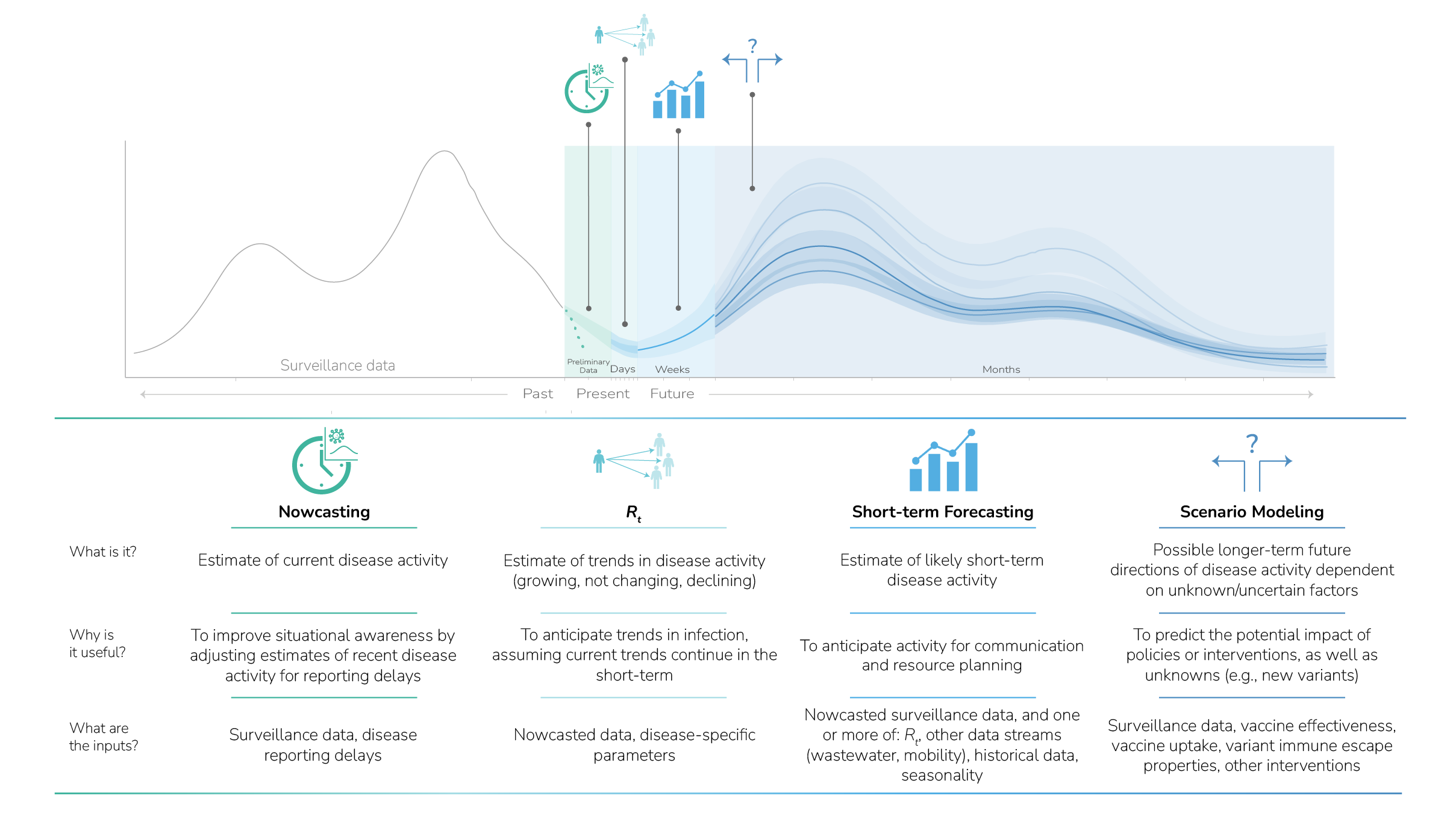
Modeling to understand the present
Disease surveillance data have an inherent delay from the time of the event to the reporting of it. When looking at the most recent data available, this delay can often give the appearance that key metrics like cases, hospitalizations, and deaths are declining, even when they are increasing. Nowcasting allows us to adjust our estimates to account for these delays, improving situational awareness of what is likely happening in the present. This adjustment gives decision-makers earlier actionable information about disease trends than if they waited and relied only on the final reported data, which could be delayed by days to weeks.
Rt, the time varying reproduction number, uses data from the recent past, combined with what is known about the transmission dynamics for a particular disease, to assess whether the number of new infections is truly growing or declining. Both Nowcasting and Rt deal with changes in disease transmission happening on the scale of weeks or days and can be used to provide situational awareness for a particular disease.
Modeling for the near future
Disease forecasts shift focus to the future, making statements of what is expected to happen, with an associated level of uncertainty to reflect the range of outcomes that are plausible. Forecasting models specifically make predictions about disease trends in the near future. Because of this timeframe, we often refer to them as short-term forecasts. These models predict what will happen with respect to a specific disease on the scale of 1 to 4 weeks. Forecasting models often use statistical models but can incorporate some elements of transmission models, and use both recent data as well as long-term past trends. They can also be supplemented with alternative data streams, where appropriate. These models are judged by how well they match, over time, the actual outcomes that are measured after the forecasts are made.
Modeling for the long-term future
Scenario modeling can be used to generate long-term projections of disease activity under different public health interventions, or to understand the potential impacts of disease variables like intensity of spread or the introduction of new variants. These models look further into the future than short-term forecasts—far enough that projecting future disease activity requires making assumptions about factors that have not happened yet, such as vaccination rates, changes in behavior, or the emergence of new variants. Scenario modeling projections therefore take the form of "if ... then" statements; for example: "If no major new variants arise and vaccine uptake continues on its current trajectory, then hospitalization burden will be _____." Scenario models that assess multiple different scenarios allow decision-makers to consider the consequences of alternative decisions such as vaccine or treatment recommendations. Because they project further into the future, scenario modeling uses transmission models, which aim to represent the mechanisms underlying disease transmission.