



Key points
- Laboratory and clinical staff must follow specific specimen collection, shipping, and processing processes for samples that require anthrax testing.
- Sample sites depend on the type of suspected anthrax.
- Consult with your state health department if anthrax is suspected.
- Consult with your state health department and CDC to obtain authorization before shipping samples for anthrax testing.
- Anthrax is confirmed through testing at laboratories in the Laboratory Response Network.

Overview
Anthrax is caused by Bacillus anthracis bacteria. Culturing B. anthracis from clinical specimens is the gold standard for diagnosing anthrax. Depending on the type of symptoms or exposure route, B. anthracis can be cultured from the following specimens:
- Ascites fluid
- Biopsy tissue
- Blood
- Cerebrospinal fluid (CSF)
- Pleural fluid
- Rectal swab (if gastrointestinal anthrax is suspected)
- Skin lesion fluid
Healthcare providers in the United States rarely see a patient with anthrax. CDC clinical guidance and case definitions are available to help clinicians:
- Diagnose anthrax
- Take patient histories to determine sources of exposure
- Order necessary diagnostic tests
Specimen collection overview
To accurately diagnose anthrax, specimens ideally should be taken before the patient starts antibiotic treatment as long as it doesn't delay treatment. Which types of specimens collected for testing depends on the patient's exposure route and/or symptoms.
Blood, plasma, and serum
Blood samples
Blood samples help diagnose inhalation and gastrointestinal anthrax, especially if a patient shows signs of systemic infection. Blood will be tested using real-time polymerase chain reaction (PCR) to confirm an anthrax diagnosis.
- Collect 10 mL of blood in EDTA or Sodium Citrate (purple or blue top tubes) when testing for anthrax.
- For pediatric cases, collect volumes allowable.
- Samples for blood culture and real-time PCR should be shipped using cold packs.
Plasma
Plasma is the preferred sample for anthrax lethal factor (LF) toxin testing for all types of anthrax.
- Samples for LF toxin testing may be collected from zero to 18 days after suspected exposure or the onset of symptoms.
- Earlier sample collection is preferred because of gradual declines in toxin levels during antimicrobial therapy.
When testing for anthrax LF toxin:
- Collect 10 mL of plasma using EDTA purple top tube.
- Keep the specimen on ice for 30 minutes then centrifuge it.
- Plasma should be shipped using dry ice.
Serum
Serum can be used to test for anthrax LF toxin.
- Samples for testing may be collected from zero to 18 days after suspected exposure or the onset of symptoms.
- Earlier sample collection is preferred because of gradual declines in toxin levels during antimicrobial therapy.
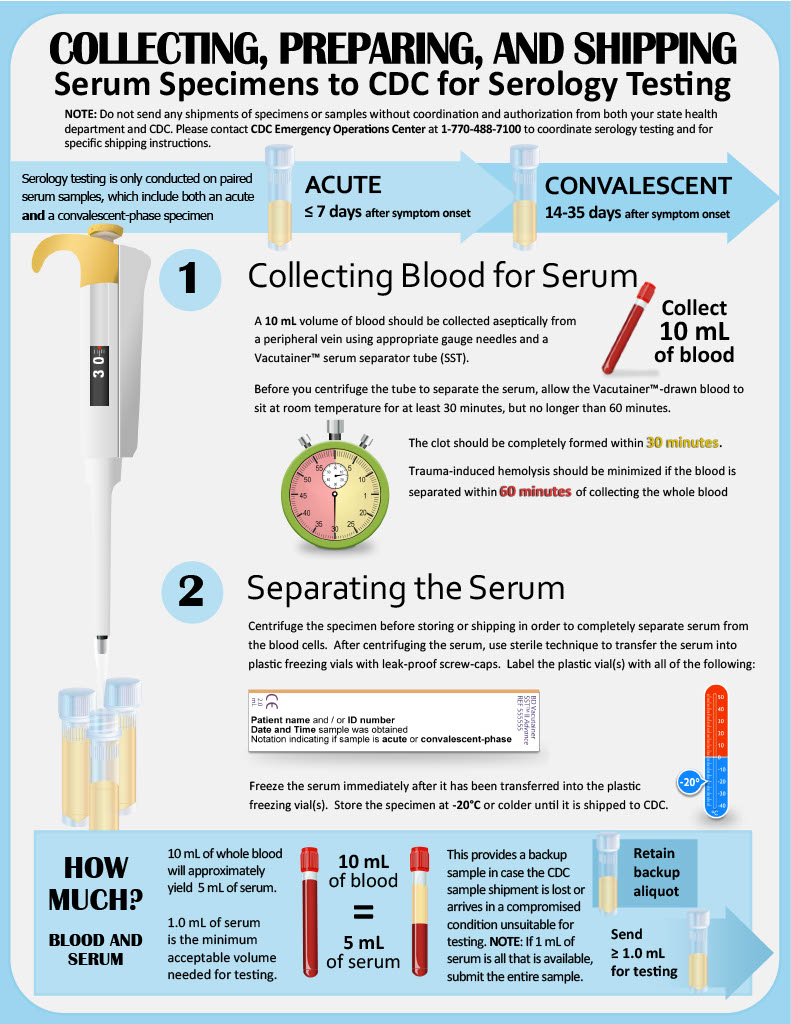
Be sure to label specimens appropriately so that labs can process serum specimen using Biosafety Level (BSL)-2 practices. Do not send blood culture bottles or whole blood.
Download or print this handout for easy reference when submitting blood or serum to CDC:
Tissue biopsies
Cutaneous anthrax
A full thickness biopsy of a papule or vesicle, including adjacent skin, can be used to diagnose cutaneous anthrax. This biopsy should be taken preferably before the patient has started antibiotic treatment.
If the patient has not started antibiotics or antibiotics have been started within 24 hours, do both of the following:
- Take a full thickness punch biopsy specimen for culture and real-time PCR
- Take one full thickness punch biopsy sample from the papule or vesicle (include adjacent skin) for histopathology, special stains, and IHC.
If the patient is on antibiotics at the time of presentation:
- Take one full thickness punch biopsy sample from the papule or vesicle (include adjacent skin) for histopathology, special stains, and IHC.
- Place the sample into 10% buffered formalin for fixation. Do not freeze.
Testing from this biopsy may include histopathology, special stains, and immunohistochemistry (IHC).
Inhalation anthrax
A bronchial or pleural biopsy should be obtained for patients with symptoms of inhalation anthrax.
- If the biopsy samples are formalin-fixed, they should be shipped to CDC at room temperature. Do not freeze.
- If the biopsy samples are fresh-frozen, they should be stored at -70°C and shipped to CDC using dry ice.
- Biopsy specimens should be accompanied by supporting documents, including:
- A brief clinical history and description of the lesion
- A chronology of the presentation of the lesion(s)
- A description of the treatment course (with duration and dosage)
- The date of biopsy in relation to the initiation of antibiotic treatment
- A photograph, digital image, or diagram of the biopsy sites
Testing from this biopsy may include histopathology, special stains, and IHC.
Lesion swabs
Cutaneous anthrax
Always collect 2 separate swabs, 1 for real-time PCR and 1 for culture. The specific location of swab sampling will depend on the stage of the lesion.
- Vesicular stage: In a sterile manner, collect vesicular fluid on sterile dry swabs from previously unopened vesicles.
- Eschar stage: Collect the eschar material by carefully lifting the eschar's outer edge; inserting a sterile moist swab (pre-moistened with sterile saline); and rotating the swab slowly for 2-3 seconds beneath the edge of the eschar before removing it.
- Ulcer stage: If no vesicle or eschar is present, swab the base of the ulcer using a sterile moist swab (pre-moistened with sterile saline).
For samples intended for culture or both culture and real-time PCR, ship samples using cold packs and store at 2 to 8°C. For samples intended for real-time PCR testing only, ship on dry ice and store at -70°C.
Gastrointestinal anthrax
Always collect 2 separate swabs, 1 for real-time PCR, and 1 for culture. The specific location of swab sampling will depend on the stage of the lesion.
- Oropharyngeal: Use a swab pre-moistened with sterile saline to aseptically swab the surface and edge of suspected lesions. Lesions may be present in the oropharynx or buccal cavity or on the tongue, tonsils, or posterior pharyngeal wall.
- Rectal: Use a sterile dry swab to collect a rectal swab.
For samples intended for culture or both culture and real-time PCR, ship samples using cold packs and store at 2 to 8°C. For real-time PCR testing only, ship on dry ice and store at -70°C.
Collecting pleural or ascites fluid collections for inhalation or gastrointestinal anthrax
- Collect more than 1 mL of pleural fluid into a sterile container for culture, real-time polymerase chain reaction (PCR), and anthrax LF toxin testing.
- For optimum testing results, pleural fluid specimens should be stored at 2-8°C for no more than 24 hours.
- Ascites fluid can be obtained for patients with symptoms of gastrointestinal or inhalation anthrax.
- Collect the appropriate volume of ascites fluid according to local hospital protocol, as well as what's needed for culture, PCR, and anthrax LF toxin testing.
Submitting specimens
Laboratory and clinical staff must follow specific instructions for collecting and processing samples that require anthrax testing. Follow all packaging and shipping regulations and requirements for anthrax specimens to protect people from exposure.
Specimen packaging
Laboratory staff must handle, package, and label samples in accordance with regulations to ensure they and others are kept safe from potential exposure to anthrax. You must follow the following specific steps to package and ship samples for anthrax testing:
Steps to take
- Insert absorbent material, then place specimen vialsInsert absorbent material (such as absorbent sheets) into a sealable plastic bag, then place the plastic vial(s) containing serum specimens in the bag (bag #1). Seal the bag.
- Line a leakproof secondary packaging containerLine a leakproof secondary packaging container, such as an appropriate plastic screw-top canister (shipping canister), with absorbent material. Use enough absorbent material to absorb the entire contents of the plastic vials in case of a leak or spill.
- Place into shipping canister, use biohazard labelPlace the sealed plastic bag into the shipping canister. Place a biohazard label on the outer surface of the shipping container.
- Place dry ice into the overpackPlace dry ice into a polystyrene foam-lined box (the overpack). Use at least 6 pounds (about 3kg) of dry ice for each day of shipping time; at least 12 pounds (about 6 kg) is required for overnight shipment (2 days).
- Calculate package weightDivide the weight of the ice in pounds by 2 to get the approximate weight in kg.
- Place shipping canister into overpackPlace the shipping canister into the overpack.
- Add itemized list of contents and required formPlace an itemized list of contents and the CDC Form 50.34 inside a second plastic bag (bag #2).
- Seal and place bagSeal and place the bag inside the overpack.
Specimen shipping
The U.S. Department of Transportation Hazardous Materials Regulations and the International Air Transport Association (IATA) Dangerous Goods Regulations state that the following labels and markings should be placed on one side of the overpack:
- "UN 3373 Biological substance, Category B" marking
- "Miscellaneous Class 9" label (dry ice label with 9 at the bottom of the diamond)
- This label should include the dry ice marking: "UN 1845 Carbon dioxide, solid (dry ice)" where you must list the weight of the dry ice (in kg) included in the box.
- Divide the weight of the ice in pounds by 2 to get the approximate weight in kilograms.
- "OVERPACK:" This indicates that secondary packaging has been placed in an outer box with dry ice.
- Name and telephone number of person responsible for shipment. This person must be knowledgeable about the shipment and know how to remediate in case of spill or leakage.
- Two sets of "Double up Arrows": Place one set on the same side of the box as the shipping labels, and another set on the opposite side of the box.
Resources
- Printable fact sheet: Collecting, preparing, and shipping serum specimens to CDC for serology testing
- Submitting Specimens to CDC Infectious Diseases Laboratories
- Bacillus anthracis Identification and Antimicrobial Susceptibility Testing (AST)
- Bacillus anthracis Lethal Factor Detection (Qualitative)- CLIA CDC-10568
- Bacillus anthracis study – Non-CLIA
- Infectious Diseases Pathology Branch (IDPB)
- Overpack is defined by the U.S. Department of Transportation in 49 CFR 171.8, Hazardous Materials Regulations as an enclosure that is used by a single consignor to provide protection or convenience in handling of a package or to consolidate two or more packages.
- U.S. Department of Transportation Hazardous Materials Regulations
- International Air Transport Association (IATA) Dangerous Goods Regulations