Mining Topic: Respirable Dust
What is the hazard?
During the extraction, transport, and processing of coal, ore, or stone in underground and surface mining operations, significant amounts of airborne respirable dust can be generated and expose workers.
How are mineworkers affected?
Inhalation of respirable coal dust can lead to coal workers' pneumoconiosis (CWP), a potentially disabling lung disease. Inhalation of respirable silica dust can lead to silicosis, another disabling lung disease. The most severe form of these diseases, progressive massive fibrosis (PMF), can be fatal. Data from NIOSH’s Coal Workers’ Health Surveillance Program (CWHSP) indicates that beginning in 2000 the prevalence of CWP has increased following a 30-year downward trend. Also, recent findings indicate that unprecedented levels of PMF have been observed in clinics in Kentucky and Virginia, after the prevalence of PMF had fallen to 0.08% among all miners examined by NIOSH in the CWHSP in the late 1990s. Once contracted, these lung diseases cannot be cured so the key is prevention through reduced dust exposure.
What is the NIOSH Mining program approach to the problem?
Reducing respiratory diseases in miners directly addresses the mining research program’s Strategic Goal 1, which targets reductions in occupational illnesses. To achieve this objective, research is conducted to identify and develop improved dust control technologies, which can then be implemented by industry to reduce mine workers' respirable dust exposure. Four key components of this dust research program include:
- intramural engineering control research
- development of improved dust monitoring capabilities
- technology transfer
- funding of extramural research projects
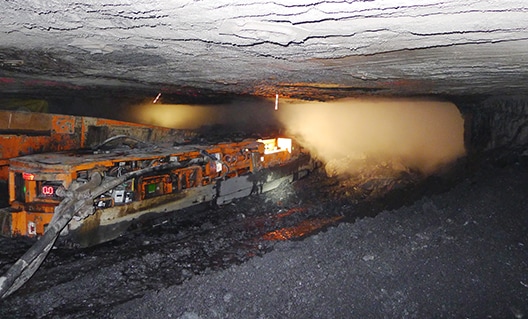
A continuous miner machine generates dust while cutting coal from the coal face.
NIOSH’s Pittsburgh Mining Research Division (PMRD) conducts ongoing intramural research that addresses respirable dust control problems in both the coal and metal/nonmetal mining industries. Links to active research projects can be found through the link in the Fast Find box at the top of the page. MSHA compliance sampling data, mine-site observations, and stakeholder input are used to identify occupations at high risk for exposure to elevated dust levels. Laboratory and/or mine-site research is then conducted to identify and evaluate dust control technologies for these high-risk occupations. The unique, full-scale dust laboratories in Pittsburgh are used by PMRD researchers to scientifically evaluate technologies under controlled conditions that are not available at operating mine sites. Control technologies proven successful in the laboratory then undergo final evaluation at operating mine sites to demonstrate in-mine capability and feasibility.
Real-time monitoring of respirable dust exposures enables mine operators to identify potential overexposures and implement interventions to prevent these overexposures. The personal dust monitor (PDM) is a gravimetric-based dust monitor that provides real-time dust readouts to the miner and was developed by PMRD through intramural and extramural research. Extensive PMRD laboratory and in-mine testing have demonstrated that the PDM is an accurate dust sampler suitable for underground use. Since 2016, MSHA has required mine operators to use the PDM for compliance dust sampling as part of its most recent respirable dust regulation.
To assist with the monitoring of respirable silica dust in coal mining operations, PMRD researchers have developed a sampling and field-based analytical technique that can quantify respirable silica levels at the mine site after sampling has been completed. A gravimetric sample is taken and the filter is placed in a portable FTIR sampling instrument that analyzes the sample. PMRD-developed software (FAST) interprets the instrument output and provides the silica content within a few minutes.
PMRD researchers have also developed an assessment technique that places a video camera and real-time dust monitor on a worker to record work tasks and associated dust levels. This “Helmet-CAM” method uses PMRD-developed software (EVADE) to combine the video and dust file so the worker can view the files and identify the tasks that generate the most dust. Engineering controls and/or changes in work procedures can then be implemented to reduce dust exposures.
The inclusion of the PDM in the new MSHA dust rule, growing industry interest in field-based silica analysis, and wide adoption of Helmet-CAM by industry are research-to-practice success stories that demonstrate the ongoing impact of NIOSH research.
As part of technology transfer efforts, handbooks have been published that summarize successful dust control technologies and include: Best Practices for Dust Control in Coal Mining, Best Practices for Dust Control in Metal/Nonmetal Mining, and the second edition of the Dust Control Handbook for Industrial Minerals Mining and Processing. Mine operators can use these handbooks to identify basic dust control technologies that can be utilized industry-wide, as well as controls more suitable to specific operating conditions. In addition, specific research findings are presented at conferences and published in journals to transfer the most recent research results to industry in a timely manner.
The NIOSH Mining program funds extramural research through Requests for Proposals (RFP) or Broad Agency Announcements (BAA) in areas that can have a direct impact on the reduction of dust levels in mining operations. Resulting from a RFP, a recently completed NIOSH-funded contract designed a canopy-air-curtain dust control for use on shuttle cars and ram cars. In-mine testing by NIOSH indicated that this technology successfully reduced the ram car operator's respirable dust exposure. Recent BAA contracts have been awarded to address the development of improved respirable coal and silica dust monitors and to characterize respirable dust generated by modern mining techiques.
- Advancing Exposure Monitoring for Airborne Particulates in Mining
- Best Practices for Dust Control in Coal Mining
- Best Practices for Dust Control in Metal/Nonmetal Mining
- Comparison of MERV 16 and HEPA Filters for Cab Filtration of Underground Mining Equipment
- Design, Testing, and Modeling of Environmental Enclosures for Controlling Worker Exposure to Airborne Contaminants
- Developing and Improving Respirable Dust Controls in Coal Mines
- Development of a Roof Bolter Canopy Air Curtain for Respirable Dust Control
- Dust Control Handbook for Industrial Minerals Mining and Processing. Second edition.
- Emerging Respirable Dust Sensing and Control for M/NM Mining
- Evaluation of Face Dust Concentrations at Mines Using Deep-Cutting Practices
- Examination of a Newly Developed Mobile Dry Scrubber (DS) for Coal Mine Dust Control Applications
- Faces of Black Lung
- Here Comes The Helmet-CAM: A Recent Advance In Technology Can Improve How Mine Operators Investigate and Assess Respirable Dust.
- Impact on Respirable Dust Levels When Operating a Flooded-bed Scrubber in 20-foot Cuts
- Investigating Mining Practices and Respirable Crystalline Silica Exposures in Underground Coal Mines
- Laboratory and Field Performance of a Continuously Measuring Personal Respirable Dust Monitor
- Testing a Revised Inlet for the Personal Dust Monitor