



Key points
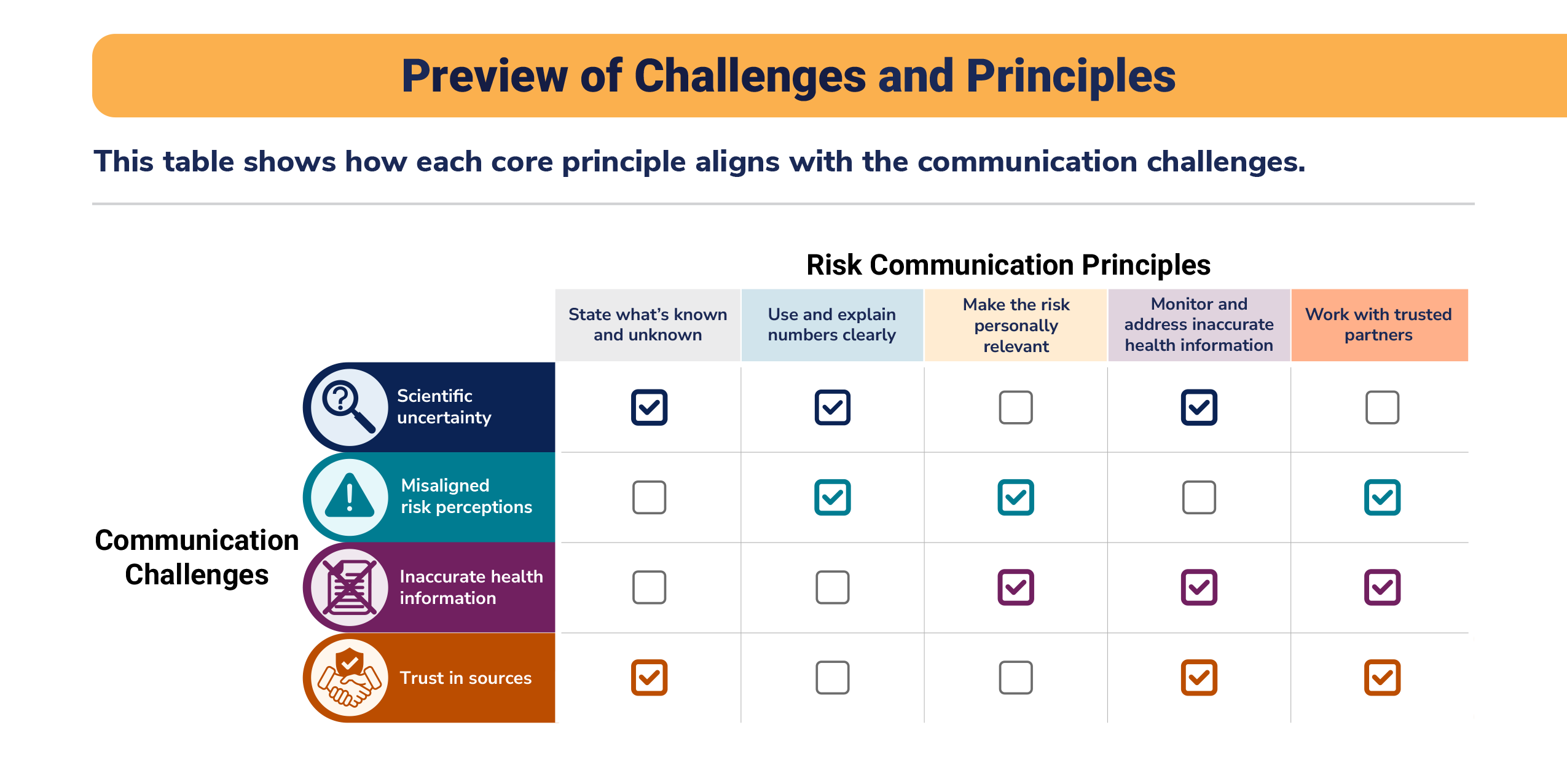
- Effective risk communication rests on five principles: acknowledging what's known/unknown, using and explaining numbers clearly, making risks personally relevant, monitoring and addressing inaccurate health information, and partnering with trusted messengers.
- This page describes each core principle and provides tips on how to apply the principle.

Understanding and Applying Core Risk Communication Principles
A recent literature review of risk communication science confirms these five core principles are critical to public health risk communication:
- State what is known and still unknown.
- Use and explain numbers clearly.
- Make the risk personally relevant.
- Monitor and address inaccurate health information.
- Work with trusted partners and messengers.
State What's Known and Still Unknown
Acknowledge uncertainty from the start. In situations where the science is incomplete or evolving, it's important to set the stage for changing guidance.
Tips
- Acknowledge uncertainty from the start and state when new information will be available. Tell your audience they'll get updates as new information becomes available and explain where they can find that information.
- Emphasize people's decision-making power in the face of uncertainty. When possible, recommend ways people can manage their worry and protect themselves and those they care about.
- Normalize the uncertainty. Explain what you have done or are doing to reduce the uncertainty.
Use and Explain Numbers Clearly
Most adults struggle with numeracy, and this can be compounded when people are experiencing stress or presented with new information. To help audiences understand your message, use both numbers and descriptive words to convey risk. Using descriptive information alone to convey risk (e.g. "low chance") is an ineffective communication strategy. That's because different people perceive their own risk differently. For one person, "low chance" may mean 1 in 100; for another person, the same phrase may mean 1 in 10.
When people see descriptions about risk that don't include numbers, they tend to think the threat is larger than it actually is. This is why it's important to pair descriptive information with numeric information.
Tips
- Use "natural frequencies" and consistent denominators. People find it easier to grasp risk when they see numbers as natural frequencies, like "1 in 100 chance," instead of percentages, like "1% chance." When comparing two or more risks, use the same denominator to make the comparison clearer, like "1 in 100 chance" versus "2 in 100 chance."
- Consider presenting both perspectives or "frames." When the goal of your communication is to educate your audience so they can make an informed decision, consider using both a positive frame and negative frame when presenting numerical information. In other words, present both sides of the coin (e.g., 4 in 10 older adults did not receive a pneumococcal vaccine; this also means that 6 in 10 did). This is often a good strategy when uncertainty exists around the behavior about which you are communicating. If a goal is to persuade people to take action, presenting the negative frame is often the more effective approach.
- Avoid using "relative risk" information. Phrases like "doubles the risk" or "increases your chances by 50%" convey that a behavior is risky, but don't tell the audience the actual or absolute risk. Presenting risk using relative terms can be misleading. To avoid this, present risk using absolute numbers and terms. For example, "This behavior increases your risk from 1 in 100 to 2 in 100" helps the reader understand that the risk is doubled but still very small. Presenting absolute risk information gives the audience a clearer understanding of the risk.
- Put numbers in context. Not everyone is comfortable thinking in terms of data. One way to overcome this barrier is to make the data speak to your audience by describing it in a more familiar context. When a number or concept is not what your audience may be accustomed to seeing, consider providing an equivalent example that is more familiar. For example, Apple's CEO Steve Jobs once described the iPod's 5GB storage capacity as "1,000 songs in your pocket." Bridge the data gap by making the information relatable to everyday life.
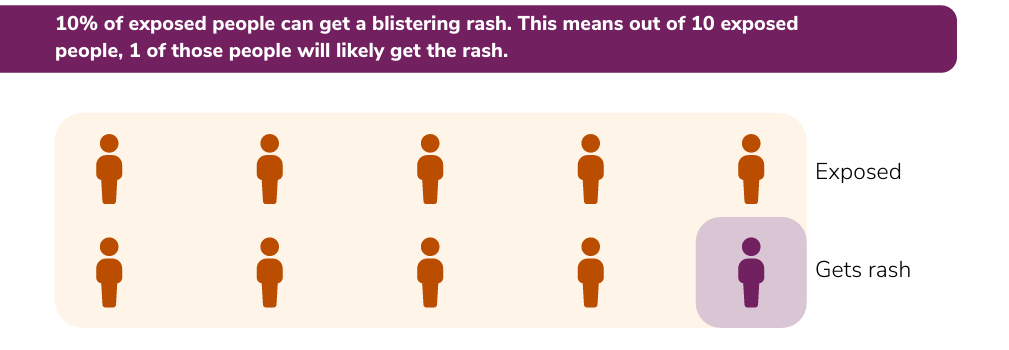
- Use visuals to supplement numeric risk information. Supplementing your risk communication with visuals—like bar graphs or infographics—can increase your audience's understanding of numerical information. Remember that visuals aren't meant to replace written information about risk but rather to enhance it. When creating visuals, consider simple designs, which often do a better job of conveying risk than complex visuals.
- Use color thoughtfully and ensure an adequate color contrast. To ensure that those who see colors differently can understand your graphic, use techniques like "double encoding," which uses two features (e.g., color and shape) to represent a single variable on your graphic. For example, a graphic that is double encoded might use a blue box for one variable and a yellow circle for another variable.
The following example demonstrates how to apply these tips, including using visuals, to a public health message:
Make Risk Personally Relevant
If your audience doesn't relate to the information you're sharing, they may ignore it. Use personal narratives and conversational language to connect with your audience. Personal narratives or stories and a conversational tone can humanize the information being shared, bringing about emotional responses that deepen the audience's personal connection with the message.
Consider narratives that show the audience how someone like them resolved a conflict or used information to protect their health. Acknowledge and validate people's feelings and fears, and they may be more likely to listen.
Tips
- Express empathy. When a message validates people's feelings and fears, they're more likely to pay attention to that message and act on it. In other words, if you help people feel heard and understood, they're more likely to listen.
- Solicit feedback from key community members or people with lived experience. Have community members who can relate to the public health concern you're addressing help shape and review the communication. People with lived experience can bring unique insights, and involving people in the community can help ensure your messaging is appropriate for different audiences.
- Emphasize personal choice. People are more likely to ignore or reject messages that feel threatening to them or tell them what to do. Even if your goal is to persuade your audience to take action, it's important to help them feel in control (for example, "decide what's right for you and your family"). However, this approach may not be suitable for all communities or public health situations, especially when the threat is large and certain.
Monitor and Address Inaccurate Health Information
False or inaccurate information about a public health threat can complicate communications or mislead people. As you detect audience's questions, concerns, and information voids, try to fill them. Filling information gaps as you detect them can help stop inaccurate health information from taking root.
When possible, prepare your audience for future encounters with inaccurate health information by helping them anticipate the possibility of misleading claims. You cannot always prevent audience exposure to inaccurate information, but you can help your audience by letting them know that problematic sources exist and that some information they can encounter is false. Importantly, not all false information needs to be addressed. Monitor and, when needed, address false information to prevent the spread of inaccurate health information.
Tips
- Decide whether to address the inaccurate health information. Not all inaccurate information or rumors can or should be addressed. Decide whether to take action based on the potential consequences of the rumor or inaccuracy of information and the prevalence of the inaccurate information, as well as the potential consequences of addressing or not addressing the inaccurate information.
- Prepare your team to address and manage inaccurate information. Think ahead—it's important to create a plan for managing inaccurate health information in advance. The plan should include strategies for identifying false and inaccurate information. Get out ahead of rumors by swiftly filling information gaps wherever possible. Consider what questions audiences might have and answer them.
- Communicate with empathy. People generally want accurate information, but they sometimes accept inaccurate health information while searching for accurate information. Rumors can take hold particularly in times of perceived danger and concern. Respond to your audience with empathy and caring.
- Use the right communication channels. Engage with community members to learn more about where they get their information (and potential inaccurate health information) on health threats. Use communication channels that your audience knows. Consider which channel would be most effective (i.e., through trusted partners or health care providers vs. social media). Correcting inaccurate health information isn't helpful if your corrections don't reach audiences affected by the inaccurate health information in the first place.
Work with Trusted Partners and Messengers
The person or organization that delivers the message can affect trust in the information and uptake of public health messaging. Working with trusted partners and messengers (e.g., health care providers, community members, representatives from local organizations) can help build and maintain trust.
Tips
- Identify a pool of potential partners and messengers. Trusted partners and messengers are people who community members regard as credible sources of information. Start by looking for people directly involved with their communities who already have a network or following. Consider demographics, social identities, and preferences when identifying trusted partners and messengers.
- Work with partners to achieve agreement on goals and definition of audience. Where is your audience on the journey from awareness to understanding to decision-making and action? Depending on your answer to these questions, you may look for partners and messengers who are best suited to introduce new ideas and knowledge (for example, a person with direct knowledge of or experience with an issue) or you may look at who your audience turns to for norm-setting and values affirmation (for example, someone who used to be a skeptic but had a personal experience that led them to change their beliefs).
- Equip partners and messengers with information and tools. Provide talking points and answers to frequently asked questions—along with the supporting studies and science—so that partners and messengers can communicate effectively about the issue in their own words.
This page was last updated on this date. Updates may include minor edits, image changes, or other modifications to page content.
The information on this page was last reviewed by subject matter experts to ensure accuracy.