



Key points
- The page shows how you can build messages that apply core risk communication principles to address the communication challenge.
- Sample messages on this page illustrate this approach, with labels identifying core principles and added messaging strategies.

Using the PHRC Guide in Message Construction
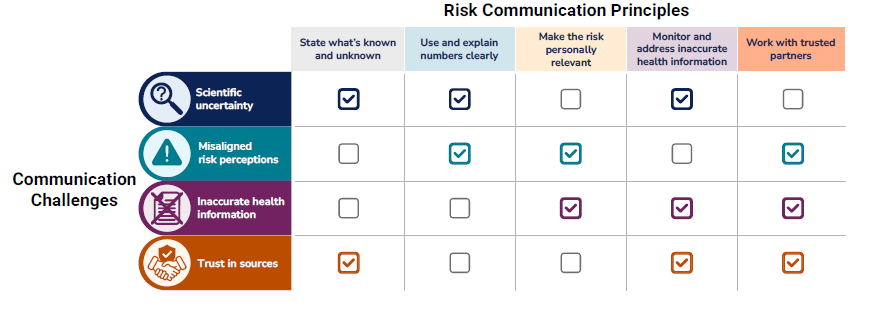
In an ideal world, we would apply all of the risk communication principles all the time, but with limited time and resources, this is not always realistic. The table below shows which principles to emphasize in your messages depending on which communication challenge you are facing.
By using the information in the PHRC guide and summary table, you can craft messages that emphasize the aligned core risk communication principles. The examples below illustrate this exercise and provide sample messaging. The core principles and additional message strategies are labeled using italics to make it easy to identify their use in the examples.
Messaging to Address Scientific Uncertainty
To address the challenge of scientific uncertainty, consider emphasizing the following principles.
- State what's known and unknown
- Use and explain numbers clearly
- Monitor and address inaccurate health information
Example: In the last day, more than 12 people in Generic County have reported symptoms of food poisoning, such as diarrhea, stomach pain, nausea, vomiting, and fever [state what's known]. Five people have been hospitalized [use and explain numbers clearly]. Food poisoning can be very serious, especially for young children, older adults, and people with compromised immune systems. Based on what we know now, you should see a doctor if you have any severe symptoms of food poisoning. For more information about food poisoning symptoms, visit [url] [monitor and address inaccurate health information].
Health officials are currently doing laboratory testing to understand what is making people sick and whether the cases are connected [state what's unknown]. We are also asking people what they ate to figure out the source of the illnesses. It is common for officials to need time to determine the cause of these illnesses [normalize uncertainty].
We know that many of you may be concerned [express empathy]. We are working to get the information you need to keep you and your loved ones safe. As we learn about additional cases or the source of the illnesses, we'll give you updates. We're committed to sharing what we learn with you as quickly as possible. Visit [url] for updates.
Messaging to Address Misaligned Risk Perceptions

To address the challenge of misaligned risk perceptions, consider emphasizing the following principles:
- Use and explain numbers clearly
- Make the risk personally relevant
- Work with trusted partners and messengers
Example: Studies by X show that drinking alcohol may increase your risk of X cancer [work with trusted partners]. Each year, about 20,000 U.S. adults die from X cancer. That's around the number of people in our whole county [use and explain numbers clearly]! Those at most risk are adults over the age of 55 who consume alcohol. The risk of alcohol-related cancers may also be influenced by genetic factors [make the risk personally relevant]. Talk with your doctor about your risk factors for alcohol-related cancer.
Messaging to Address Inaccurate Health Information
To address the challenge of inaccurate health information, consider emphasizing the following principles:
- Make the risk personally relevant
- Monitor and address inaccurate health information
- Work with trusted partners and messengers
Example: Hi. This is Dr. Jane Doe with the Generic County Health Department. Thank you for inviting me to Talk HEALTH 105.7 Radio [work with trusted partners] to update you on the new animal flu X and to answer your questions [monitor and address inaccurate health information]. The health of Generic County residents is our highest priority.
We are working closely with X on this investigation. Health officials who have tracked animal flu for decades say that the risk to people remains low [work with trusted partners]. Only 2 people in the United States have tested positive for animal flu X.
Now I know this is a new flu virus, and some listeners may be concerned, that's understandable [express empathy]. Based on what we know today – the risk of most people getting animal flu X is very low. Right now, the animal flu X virus only spreads between infected animals, or from infected animals to humans. There have not been any confirmed cases of the virus spreading between humans [monitor and address inaccurate health information]. Public health officials are investigating every case to confirm the source and to limit the spread. We are also watching for any changes in how the virus behaves, because changes or mutations can happen with new viruses [normalize uncertainty].
As we learn more information or if the risk to people changes, Generic County Health Department will inform the public by posting updates on our website. In the meantime, to stay safe, avoid direct contact with wild animals and any animals (wild or domestic) that look sick or dead [make the risk personally relevant].
Messaging to Address Trust in Sources

To address the challenge of varying levels of trust in sources, consider emphasizing the following principles:
- State what is known and unknown
- Monitor and address inaccurate health information
- Work with trusted partners and messengers
Example: We know many people are concerned about how exposure to Chemical X may affect your health [monitor and address inaccurate health information]. That's why we're working with the local Agency for Chemical Studies to investigate Chemical X and its impact on our health in our community [work with trusted partners].
So far, we know Chemical X exposure (for example, from some food containers, cookware, and cleaning products) may be linked to:
- Higher cholesterol levels
- Weaker immune systems
- Changes in liver function
We need more research to better understand how Chemical X affects health. For example, we don't yet know what levels of Chemical X are safe and what levels can lead to health effects [state what's known and unknown]. Our partner, the Agency for Chemical Studies, is currently leading an integrated, multi-year toxicology study on the effects of Chemical X exposure, but answers to these complex questions will take time [normalize uncertainty]. We expect to have preliminary data by X.
Like you, we are eager to get answers and are committed to providing you with up-to-date information. Visit [link] for the latest information on our community progress on understanding Chemical X in our town.
Using PHRC in Your Work

This guide is based on the latest risk communication science literature, conversations with health communicators, and input from experts. Use the PHRC summary table any time you are communicating about an emerging, ongoing, or evolving public health risk, and leverage the PHRC guide as a resource when discussing message strategy with colleagues and leadership.
This page was last updated on this date. Updates may include minor edits, image changes, or other modifications to page content.
The information on this page was last reviewed by subject matter experts to ensure accuracy.