



At a glance
Access to real-time data on the number of available beds in local hospitals is critical to strengthen public health responses, protect communities and save lives.
Why the effort matters
Strengthening core public health data for rapid, accurate decision making is a primary public health data goal. The Public Health Data Strategy includes milestones to expand data feeds in important areas of public health. One milestone is the increase of automated data feeds on hospital bed capacity. While these data are a relatively new addition to the nation's public health data sources, the possibilities are exciting.
Understanding emergency department, acute care and intensive care bed use provides situational awareness for hospitals, healthcare providers, patient transportation companies and local and state public health departments. This information is important during public health emergencies and in day-to-day patient care.
Imagine a wildfire or other natural disaster with many casualties. Rather than calling every hospital in the area to determine which has room and for how many people, emergency operations center staff can log into a system that updates automatically and see in near real-time which hospitals have capacity to take on patients. The ability to quickly find information and triage the injured can be lifesaving. The faster someone receives the care they need, the better their health outcome is likely to be.
If a hospital must evacuate because of a fire, a chemical leak or some other threat to patient safety, the ability to log onto an automated system can save time and allow staff to quickly move patients out of danger. A hospital bed capacity data system that connects multiple hospitals can also help with daily patient transport across a state or a region, identifying the hospital that has space, which may not be the nearest hospital.
The progress
During the pandemic, hospitals were required to report COVID-19 and influenza hospital admissions, hospital capacity or hospital occupancy data to HHS through CDC's National Healthcare Safety Network. This data source helped communities understand the stress on hospital systems, where best to direct resources and how many people were sick at any given time. An important outcome of this effort has been the development of national standards for core bed capacity definitions to standardize the reporting across hospitals and jurisdictions. The U.S. Situational Awareness Framework for Reporting (US SAFR) Implementation Guide (IG) establishes a standardized approach to support public health decision-making during emergencies. Publication of the US SAFR IG in 2026 will facilitate faster data exchange between healthcare facilities and public health authorities, strengthening the nation's emergency preparedness and response capabilities.
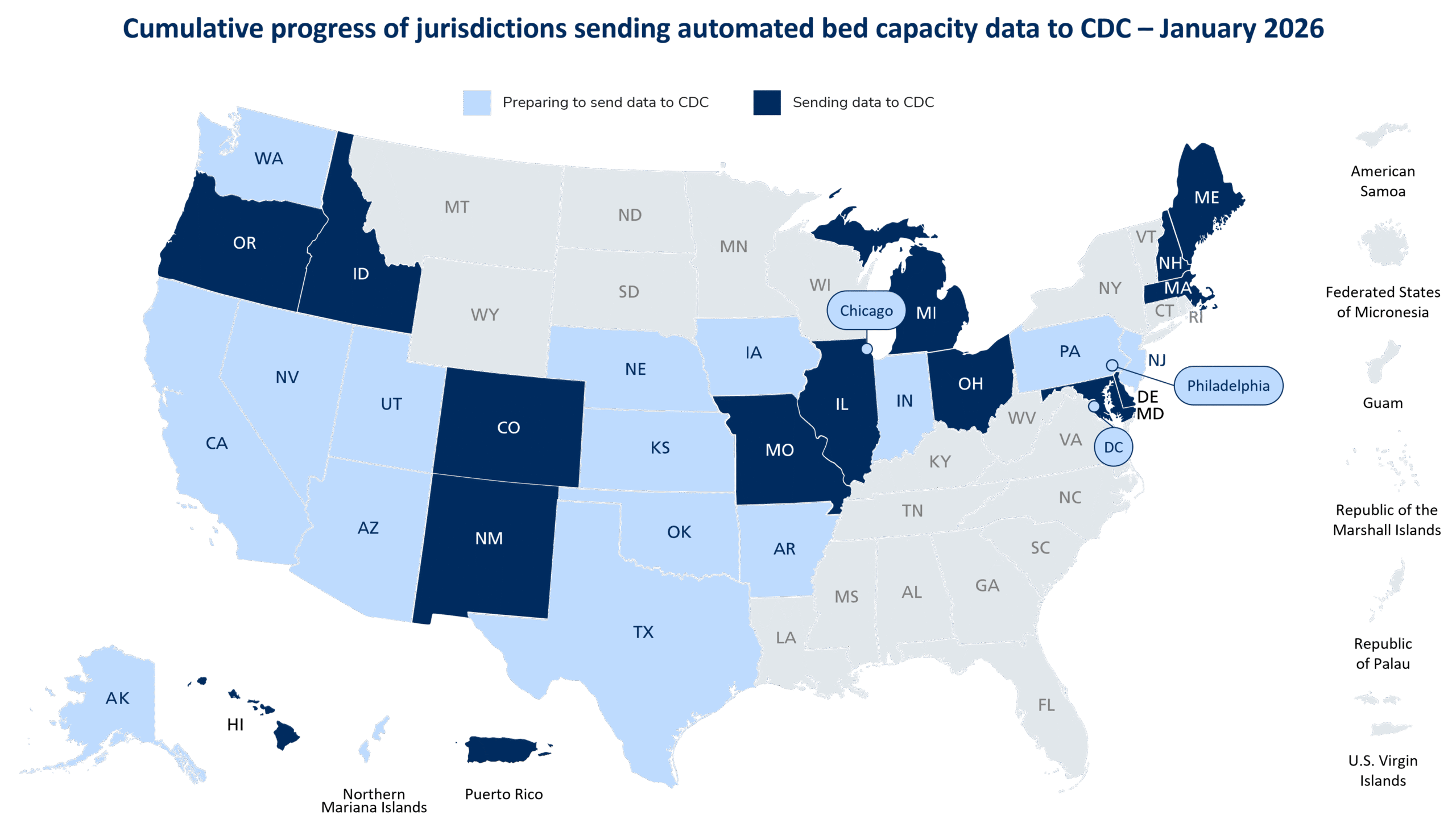
Starting in 2022, Oregon, Hawaii and Massachusetts began piloting state-wide automated data feeds for hospital bed capacity. In 2024, funds to support the development of hospital bed capacity data systems became available through CDC's Epidemiology and Laboratory Capacity program. The goal was to build a real-time picture of hospital bed capacity across the nation. As of January 2026, fifteen jurisdictions — Colorado, Delaware, Hawaii, Idaho, Illinois, Massachusetts, Maryland, Maine, Michigan, Missouri, New Hampshire, New Mexico, Ohio, Oregon and Puerto Rico — were sending bed capacity data to CDC.
State health departments, individual hospitals and hospital associations are partnering to develop bed capacity systems in their jurisdictions. These stakeholders work together to establish a governance framework that ensures consistent data use, security and reporting. Learn more about the effort here: Hospital Bed Capacity Project | NHSN |CDC
The value of having these systems available nationwide is well recognized. Public health emergencies and the need to transport patients do not stop at state borders. The goal is to establish and maintain standardized hospital bed capacity data systems across the country, ultimately improving patient safety, protecting health and providing more timely care.
What users are saying
"We are so excited about the potential for this [bed capacity] system and its ability to provide us near real-time data, 24/7. It's data that can be used by a variety of organizations across the state of Hawaii. We've never had that level of transparency before." – Hilton Raethel, president and CEO, Healthcare Association of Hawaii
"Since 2009, Oregon has leveraged hospital capacity tools to inform responses to H1N1, Ebola and seasonal threats. By using an automated data feed directly from hospitals, the [bed capacity] system supports near real-time decision-making for preparedness, response and recovery — including patient movement, mass casualty incidents and future outbreaks — and allows for healthcare efficiency and better patient outcomes." – Nick May, Health Security Preparedness and Response Information Systems Coordinator, Oregon Heath Authority