



Key points
- HHS and partner agencies are working to improve prevention efforts and emergency response for missing autistic individuals.
- Families should use layered safety measures, increase supervision during periods of stress, transition, or change, and consider personal tracking technology when appropriate.
- If a loved one goes missing, call 911 right away and say they are autistic.
- Responders should treat wandering as time-critical and search water hazards first.
- Agencies support using MEP alerts in IPAWS when urgent risk criteria are met, using autism-specific safety information in public alerts to guide search efforts and improve the likelihood of a safe recovery.
Commitment to improving national safety protocols
Secretary Kennedy and the Interagency Autism Coordinating Committee (IACC) are committed to improving national safety protocols for people with autism.
A call to action: protecting autistic children from drowning
HHS Secretary Robert F. Kennedy Jr. and National Autism Coordinator Diana Diaz Harrison share important water safety reminders for families and caregivers of children with autism, including steps to prevent wandering and drowning.
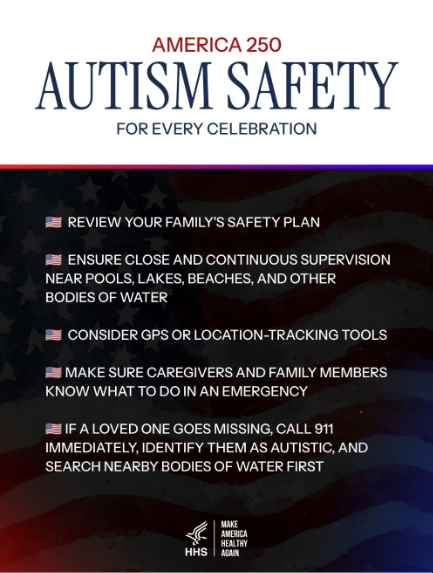
Autism safety for every celebration
- Review your family's safety plan.
- Ensure close and continuous supervision near pools, lakes, beaches, and other bodies of water.
- Consider GPS or location-tracking tools
- Make sure caregivers and family members know what to do in an emergency
- If a loved one goes missing, call 911 immediately, identify them as autistic, and search nearby bodies of water.
Multi-agency partners in protection
The U.S. Department of Health and Human Services (HHS) is working with the Federal Emergency Management Agency (FEMA), the U.S. Department of Justice (DOJ), the U.S. Department of Homeland Security (DHS), to strengthen emergency response for autistic individuals who wander or elope and are at immediate risk of harm.
These efforts support the consistent use of the Missing and Endangered Persons (MEP) Alert category within the Integrated Public Alert and Warning System (IPAWS) when an autistic individual who is missing meets established criteria indicating a time-sensitive risk to their safety.
Evidence-based response practices
The initiative promotes evidence-based response practices, including:
- Rapid activation of appropriate public alerts for qualifying cases.
- Recognition that wandering involving autistic individuals with limited communication, impaired safety awareness, or inability to respond to verbal commands should be treated as a time-critical emergency.
- Immediate prioritization of searches near water hazards—including ponds, retention basins, drainage structures, rivers, lakes, and residential pools—as well as nearby high-traffic roadways.
- Consistent guidance and training for first responders, emergency managers, and public safety agencies.
- Increased public awareness to support timely and safe recovery of missing autistic individuals.
Saving lives through better coordination
By strengthening coordination among federal, state, and local partners, HHS seeks to improve emergency response, reduce preventable injuries and deaths, and ensure that autistic individuals who wander receive a rapid, coordinated, and evidence-informed search response.
This page was last updated on this date. Updates may include minor edits, image changes, or other modifications to page content.
The information on this page was last reviewed by subject matter experts to ensure accuracy.