



What to know
- OutbreakNet Enhanced (OBNE) is a CDC program that supports state and local health departments.
- The goal of the program is to improve capacity to detect, investigate, control, and respond to enteric disease outbreaks.
- OBNE started in August 2015 with 11 participating sites and has since expanded to 29.
Highlights
In 2024, OBNE sites focused on maintaining their capacity to conduct effective, timely, and complete enteric disease surveillance and outbreak investigations. Sites prioritized projects that allowed them to better handle the increased burden on resources and staff. OBNE projects included assessing needs, training staff, reinforcing outbreak response fundamentals, and learning to use new surveillance systems and technology.
Success stories were published to the OBNE website to highlight efforts and strategies implemented during challenging and unique outbreak investigations. Such stories included New Hampshire's "Person-to-person outbreak masquerades as foodborne outbreak" and "Louisiana Peels Back Salmonella Investigation". OBNE sites also showcased their work at national meetings and conferences. This included the Council of State and Territorial Epidemiologists (CSTE) Conference and the Integrated Foodborne Outbreak Response and Management (InFORM) Conference.
Program performance
OBNE performance metrics have been collected since 2016 to document the burden, timeliness, and completeness of enteric disease outbreak activities. Sites report metrics annually on both laboratory and epidemiologic aspects of investigations. Metrics are reported for Salmonella, Shiga toxin-producing E. coli (STEC), and Listeria (SSL), and optional metrics for Shigella and Campylobacter. The metrics are analyzed and revised as needed to best meet program needs
Select 2024 SSL Metrics
- Over 60,000 cases reported
- Over 1,200 clusters detected
- Attempted interviews with an average of 94% of cases
Figure 1
Since 2016, OBNE sites have continued decreasing the time (in days) from case report to initial interview attempt for SSL cases.
Through these interviews, OBNE sites obtained exposure history for 77% of cases.
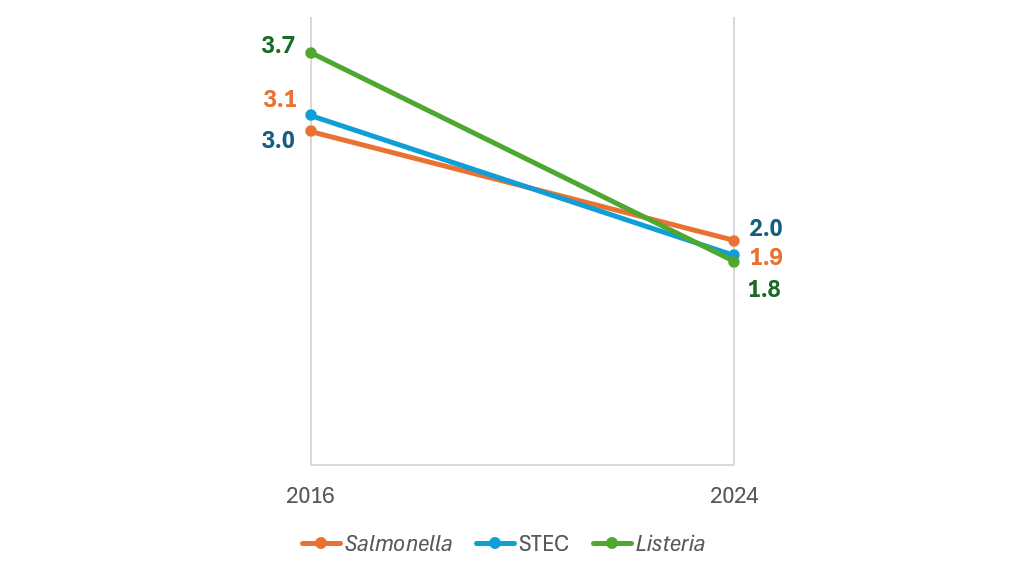
Figure 2
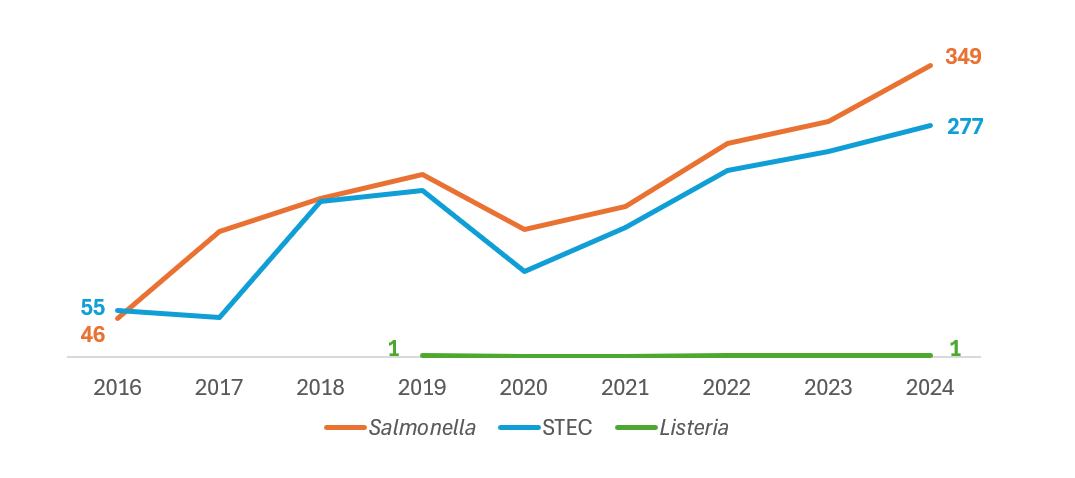
From 2016* to 2024, OBNE sites saw an increase in the average number of probable cases reported for Salmonella and STEC. Average reporting for Listeria has remained level from 2019* to 2024.
The increase in probable cases is likely the result of expanded use of culture-independent diagnostic tests (CIDTs), which place a large burden on laboratory staff. OBNE sites received 32,433 preliminary positive clinical specimens or samples in 2024.
*Listeria reporting for this metric began in 2019.