



What to know
- Below are confirmed norovirus outbreaks submitted to CaliciNet and updated monthly.
- Participating public health laboratories electronically submit genotype information for norovirus and basic epidemiology data from norovirus outbreaks to the CaliciNet database.
- The data on norovirus strains are compared with existing norovirus sequences in the CaliciNet database.
Genotype distribution of norovirus outbreaks
September 1, 2025 – September 30, 2026 (n=160)
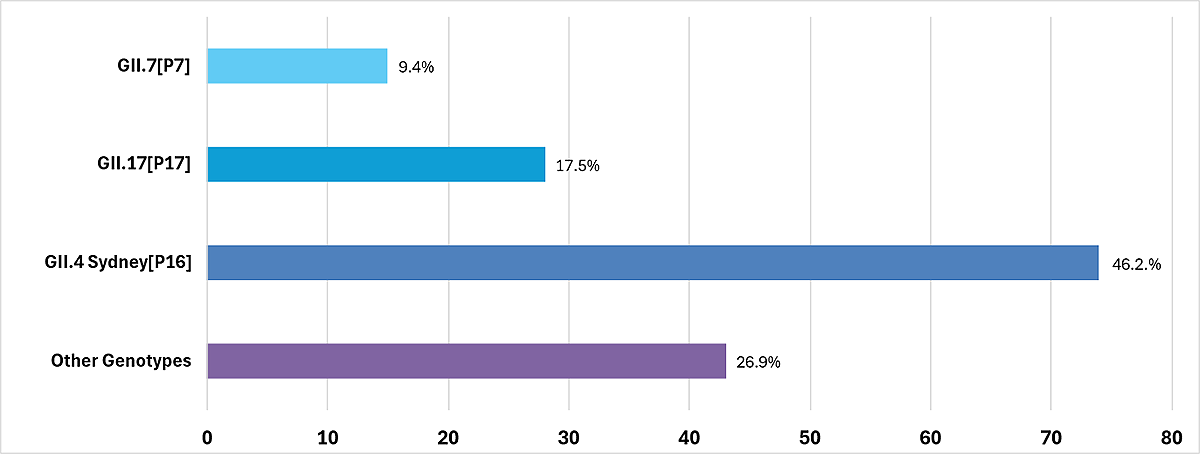
Data Table: September 1, 2025 – September 30, 2026 (n=160)
| Genotype | Number of Outbreaks |
|---|---|
| GII.4 Sydney[P16] | 74 |
| GII.17[P17] | 28 |
| GII.7[P7] | 15 |
| Other Genotypes | 43 |
The Other Genotypes category includes genotypes from outbreaks that each make up less than 5% of the total number of outbreaks. These genotypes are: GI.1[P1] (3.1%), GI.2[P2] (1.3%), GI.3[P3] (3.8%), GI.3[P13] (2.5%), GI.5[P5] (1.3%), GI.6[P11] (1.9%), GI.7[P7] (1.3%), GII.1[P33] (2.5%), GII.2[P2] (0.6%), GII.3[P12] (1.9%), GII.6[P7] (1.9%), GII.9[P7] (3.1%).
Data Table: September 1, 2024 – August 31, 2025 (n=409)
| Genotype | Number of Outbreaks |
|---|---|
| GII.17[P17] | 304 |
| GII.4 Sydney[P16] | 43 |
| GII.6[P7] | 16 |
| Other Genotypes | 46 |
Dual typing for norovirus
Dual typing for norovirus is being implemented by laboratories participating in CaliciNet.
Dual typing is RT-PCR amplification of a partial region of both the polymerase gene and the capsid gene (region B-C) in a single reaction for genogroup I or genogroup II noroviruses.
This page was last updated on this date. Updates may include minor edits, image changes, or other modifications to page content.
The information on this page was last reviewed by subject matter experts to ensure accuracy.