



About
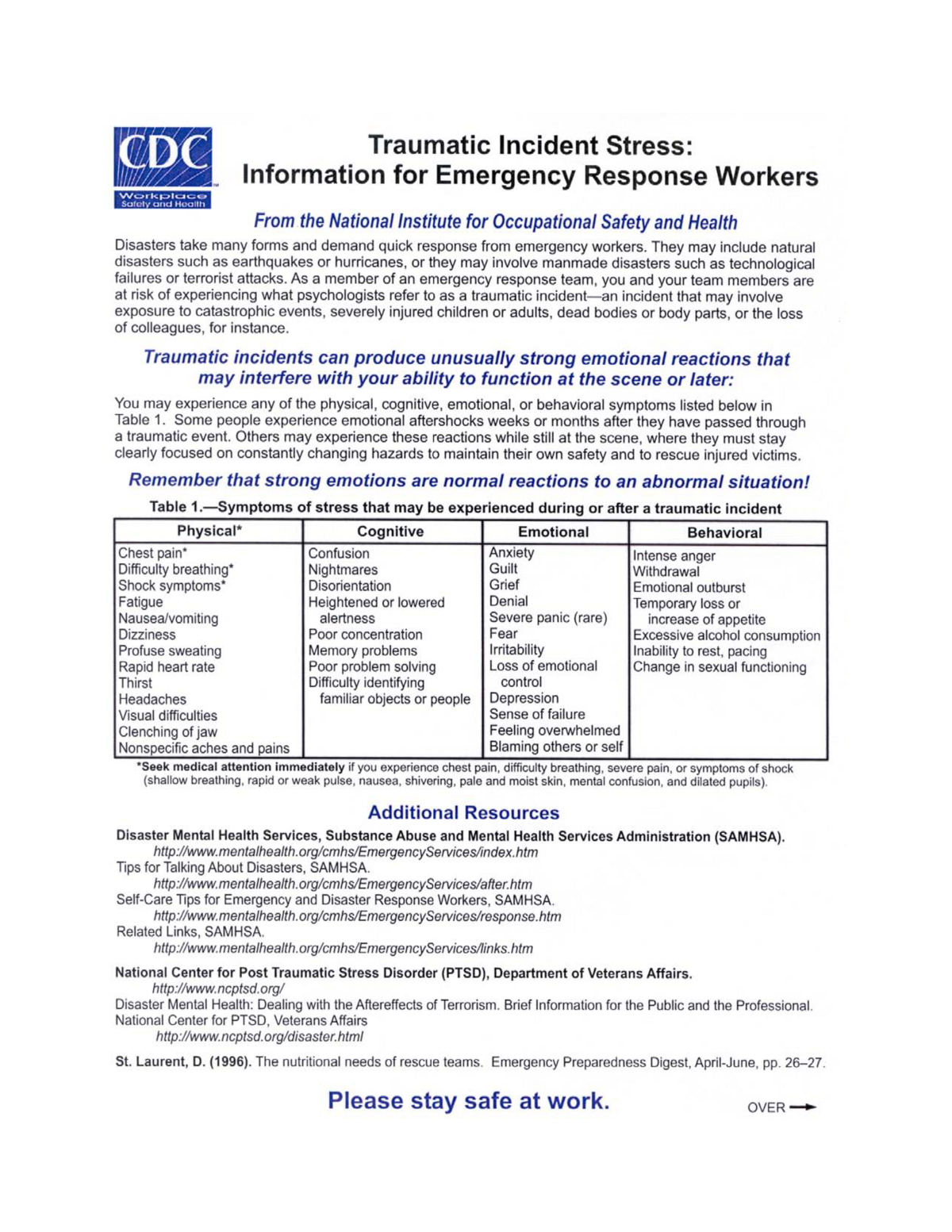
Disasters take many forms and demand quick response from emergency workers. They may include natural disasters such as earthquakes or hurricanes, or they may involve manmade disasters such as technological failures or terrorist attacks. As a member of an emergency response team, you and your team members are at risk of experiencing what psychologists refer to as a traumatic incident - an incident that may involve exposure to catastrophic events, severely injured children or adults, dead bodies or body parts, or the loss of colleagues, for instance. You may experience any of the physical, cognitive, emotional, or behavioral symptoms listed in the document. Some people experience emotional aftershocks weeks or months after they have passed through a traumatic event. Others may experience these reactions while still at the scene, where they must stay clearly focused on constantly changing hazards to maintain their own safety and to rescue injured victims.
Additional languages
Suggested citation
NIOSH [2002]. Traumatic incident stress: Information for emergency response workers. By Kowalski KM. Pittsburgh, PA: U.S. Department of Health and Human Services, Centers for Disease Control and Prevention, National Institute for Occupational Safety and Health, DHHS (NIOSH) Publication No. 2002-107.