



Key points
- Prevention through Design (PtD) depends on the prevention priorities in the Hierarchy of Controls.
- It goes beyond these priorities by providing a concrete process for applying them in the workplace.
Overview
PtD is most effective in early planning and design stages. It can also be a valuable risk management approach in later stages, such as re-design, retrofit, and continual improvement.
Working with others who are experienced in the field and its hazards can be helpful when controlling hazards. This joint process of managing workplace hazard risks corresponds to the term "design" in PtD.
Defining
PtD is a proactive approach that includes safety measures in the design of work equipment, tools, operations, and spaces. The PtD approach starts with the most effective hazard controls in the Hierarchy of Controls. It then provides a practical design process to help reach these hazard controls.
Approach
Risk management and system safety
PtD is a collaborative and structured way to manage workplace hazard risks. Teams work together to review designs, identify hazards, assess risk levels, and explore safer options. Companies can make simple changes like having different departments review and approve work process designs. These actions encourage teamwork and can lead to collaborative meetings when needed.
System safety offers another approach to managing risk in complex operations, especially in critical industries like aerospace and nuclear. These industries prioritize protecting facilities, equipment, and the larger community. However, many workplaces can also benefit from simpler, practical versions of system safety.
The ANSI/ASSP Z590.3 Prevention through Design standard
The American National Standards Institute (ANSI) and the American Society of Safety Professionals (ASSP) publish and maintain the ANSI/ASSP Z590.3 Prevention through Design Consensus Standard. The Z590.3 standard committee consists of a wide range of experts, including those at NIOSH, who are dedicated to protecting workers. The standard offers risk management processes in line with the long-standing field of system safety, though simplified to focus on worker protection.
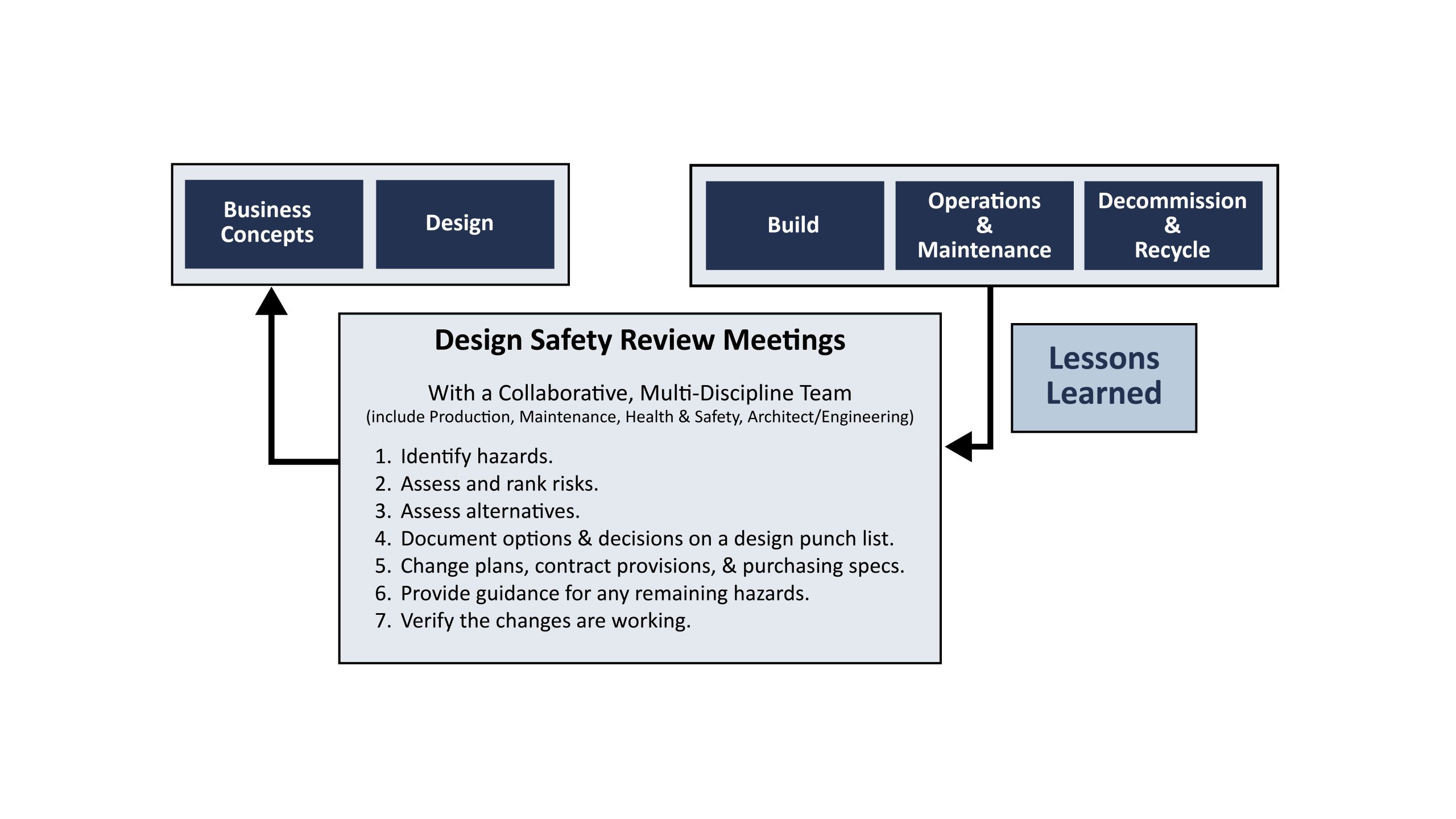
The Z590.3 standard uses methods that can help protect workers in all kinds of workplaces. The "Design Safety Review" process in the standard shows how PtD works. In Design Safety Review meetings, workers, managers, designers, safety experts, and others share their lessons learned from experience and prior learning. A blending of hazard control and business expertise can then lead to more effective and practical hazard interventions. Figure 1 shows the Design Safety Review process.
Changing culture to preventive thinking
Beyond the priorities and the process, PtD is a way of thinking. Adopting a more preventive mindset can lead to new or better solutions to workplace hazard controls.
The following PtD priorities and processes stimulate preventive thinking:
- Move up the Hierarchy of Controls (aiming for little to no hazard exposure).
- Use more passive controls (requiring little to no human actions once implemented).
- Work together with those in different types of jobs.
- Use Design Safety Reviews to manage risk (ANSI/ASSP Z590.3).
The business case for PtD
In all parts of a business, people are a limited resource, offering creativity, planning, quality, productivity, safety, and more. Protecting them is essential.
Managers may face initial costs when applying actions at the top of the Hierarchy of Controls. However, using higher-level controls can reduce required protective actions, supplies, and program maintenance activities. This approach can lead to lower long-term operating costs by reducing ongoing tasks and purchases.
Using higher-level controls can help save money in the long term for other business goals. A benefit-cost analysis and return on investment estimates give the basis, or business case, for informed decision-making. Understanding the non-financial business case can be just as important.
The AIHA business case in EHS Tool
The American Industrial Hygiene Association (AIHA) Business Case in Environmental, Health, and Safety (EHS) Tool gives simple methods to estimate risks and risk-reduction in line with PtD and the Hierarchy of Controls. The free tool also helps estimate the non-financial and financial business case for recommendations to management.
Two videos on the AIHA website show how the tool works, using an actual PtD case study as an example. Figure 2 shows the step-by-step flow of this simplified business case tool.
