



What to know
Summary
Over 5,000 construction workers die from suicide each year.1234 They are more than twice as likely to die from suicide than other male workers and are five times more likely to die from suicide than from a workplace injury.14 An evidence-based framework designed for the unique organization and culture of the U.S. construction industry may help companies support construction workers on the job.
The COMPASS (Construction Organizations Mobilizing for Peer Support & Suicide Safety) framework was developed to help construction contractors assess, develop, and strengthen their suicide awareness and prevention programs. COMPASS is a scalable, low-cost, evidence-based framework that addresses factors associated with suicide among construction workers. Companies of varying sizes, cultures, and organizational structures can adapt the framework to build and expand mental health programs and services over time.
Program development
COMPASS provides construction contractors with an adaptable framework for implementing and maintaining a program to support mental health and help prevent suicide in their workforce. The COMPASS framework was inspired by the "MATES in Construction" program, an evidence-based suicide prevention program developed by the Australian construction industry. Research found MATES effective in:
- encouraging help seeking and help offering
- empowering peers and leaders to offer more effective help
- improving navigation to mental health services and resources in the event of a mental health crisis56
Research for the COMPASS program development was funded through two NIOSH Centers: the Healthier Workforce Center of the Midwest, a Center of Excellence for Total Worker Health®, and CPWR-The Center for Construction Research and Training. The COMPASS framework was developed by university-based worker health programs in Missouri and Iowa with the active support of contractors, labor unions, the Associated General Contractors of Missouri, and CPWR.
Training
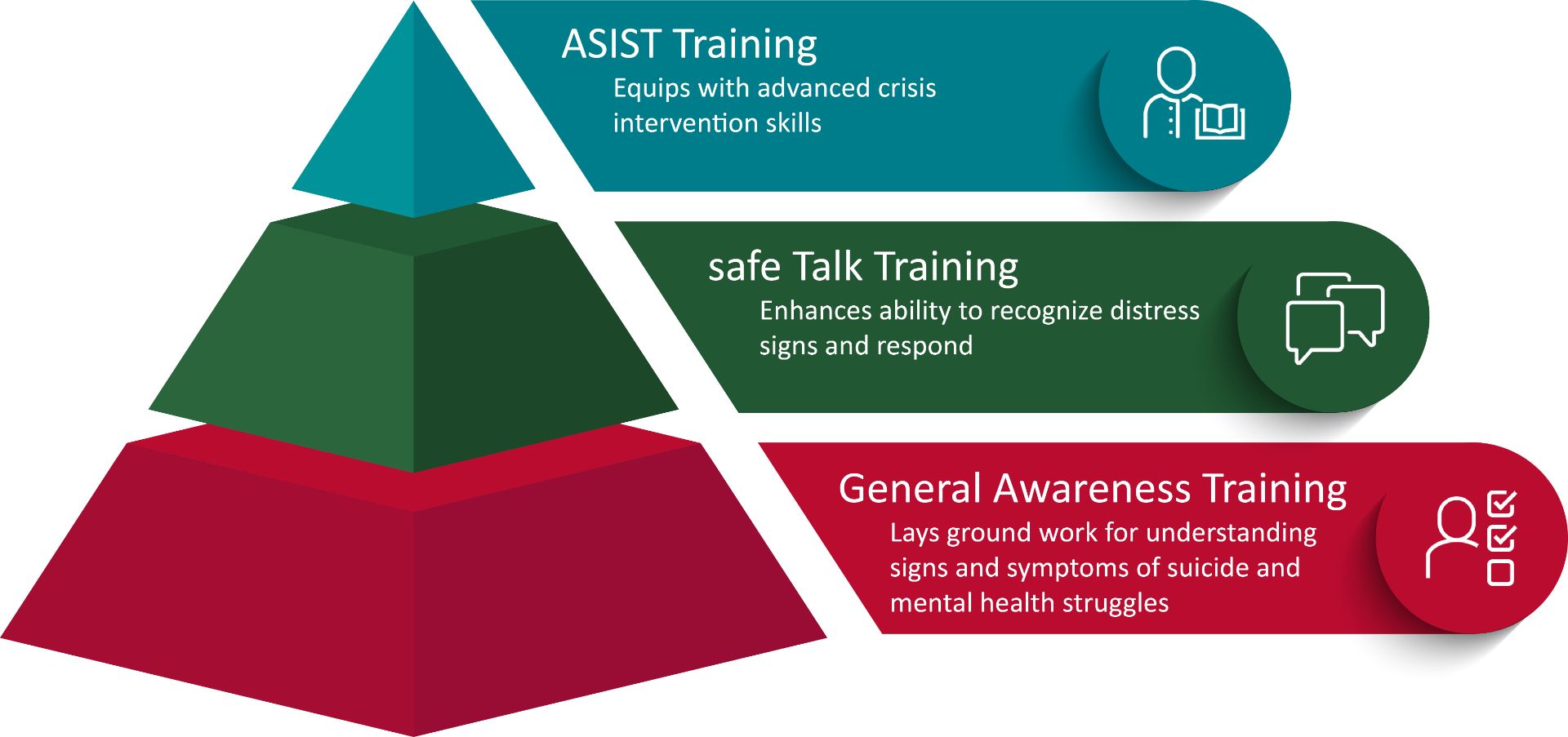
COMPASS adapts key elements of MATES, including its three levels of suicide prevention training. First, general awareness training is used to increase knowledge and awareness of suicide prevention by educating everyone employed by a contractor, or all workers on a specific job site. The General Awareness Training can be delivered as a 1-hour presentation or as five short toolbox talks. The second level is safeTALK, a 4-hour training for volunteer "peer connectors" whose role is to interact with their coworkers and connect them with needed help. The third is Applied Suicide Intervention Skills Training, which equips a smaller number of personnel with the skills to work with peer connectors and provide further evaluation and referral for workers in need of help. These three levels of training are meant to:
- raise awareness and reduce stigma
- encourage workers to seek help for mental health issues
- establish a peer-based "gatekeeper" network on worksites
Together, these resources can encourage workers to offer help to colleagues in need and improve referrals to mental health and other services needed by workers.
Additional program elements
In addition to three levels of training, the COMPASS framework includes other key steps for contractors to help build a mental health and suicide prevention program:
- Commit to prevention: Have company leaders visibly support mental health and suicide prevention
- Engage union partners: Encourage unions to support and participate in the program
- Assess readiness: Determine if the organization is prepared for implementation
- Evaluate current programs: Assess current efforts, including identifying gaps and assessing quality of existing mental health care
- Review postvention plan: Ensure a plan for responding to suicide events
Employers are encouraged to evaluate existing health benefits, including the availability and quality of Member Assistance Programs and Employee Assistance Programs. If necessary, employers can develop additional resources to help workers navigate mental health support services and improve use of existing programs. Regular program review and maintenance is important, as is flexibility to respond to expansion of the workforce.
Program status
Preliminary evaluation of COMPASS in a regional construction contractor showed that, for those participating in the training components, the framework is7:
- acceptable to workers
- appropriate for the industry
- feasible to implement
- can be maintained as a viable system within construction contractors
The next phase of this effort includes implementing and evaluating COMPASS at additional regional contractors in the St. Louis area. COMPASS was implemented at three contractor locations so far. The study team is currently looking for more contractors to partner with. For contractors outside the St. Louis area, the study team can provide consultations on implementing the COMPASS framework at their company by completing this online form.
Need Help? Know Someone Who Does?
Resources
- Resources to Prevent Suicide Deaths in Construction
- Talking About Suicide in the Construction Industry
- Hard Hat Courage: Confronting Suicide in Construction
- Resources for Mental Health, Suicide Prevention, and Substance Misuse
Read more from NIOSH: Partnering to Prevent Suicide in the Construction Industry – Building Hope and a Road to Recovery
Author Information
Bradley Evanoff, MD, MPH is a Professor of Occupational and Environmental Medicine at Washington University in St. Louis.
Sami Tayeb, MA is a Clinical Research Coordinator at Washington University in St. Louis.
Jamie C. Osborne, MPH is a Health Scientist in the NIOSH Office of the Director.
Emily J. Haas, PhD is the Associate Director for Science in the NIOSH Division of Safety Research and Co-coordinator for the NIOSH Construction Program in the Office of Construction Safety and Health.
Christina Socias-Morales, DrPH is a Research Epidemiologist in the NIOSH Division of Safety Research and Co-Coordinator for the Construction Program in the NIOSH Office of Construction Safety and Health.
Diane Rohlman, PhD is a Professor of Occupational and Environmental Health at the University of Iowa.
Samy Hamdan, MSOT is a PhD Candidate in the Program in Occupational Therapy at Washington University in St. Louis.
Ryan Lindsay, EdD, MSW, LCSW is a Professor of Practice at Washington University in St. Louis.
This page was last updated on this date. Updates may include minor edits, image changes, or other modifications to page content.
The information on this page was last reviewed by subject matter experts to ensure accuracy.
- Dufoe, D., Trueblood, A., Brooks, R. D., & Harris, W. (2025, April). Construction worker injuries, overdoses, and suicides. CPWR—The Center for Construction Research and Training. https://www.cpwr.com/wp-content/uploads/DataBulletin-April2025.pdf
- Harris W, Trueblood AB, Yohannes T, Rodman CP, Rinehart R. Suicides among construction workers in the United States, 2021. Am J Ind Med. 2025;68 Suppl 1:S144-S151. doi:10.1002/ajim.23632. Available from: https://pubmed.ncbi.nlm.nih.gov/38989775/
- Sussell AL, Yeoman K, Nixon CT, Scott KA, Robinson TS, Poplin GS. US Workers' Self-Reported Mental Health Outcomes by Industry and Occupation. JAMA Netw Open. 2025;8(6):e2514212. doi:10.1001/jamanetworkopen.2025.14212. Available from: https://jamanetwork.com/journals/jamanetworkopen/fullarticle/2835060
- Sussell A, Peterson C, Li J, Miniño A, Scott KA, Stone DM. Suicide Rates by Industry and Occupation - National Vital Statistics System, United States, 2021. MMWR Morb Mortal Wkly Rep. 2023;72(50):1346-1350. Published 2023 Dec 15. doi:10.15585/mmwr.mm7250a2. Available from: https://pubmed.ncbi.nlm.nih.gov/38096122/
- Gullestrup J, King T, Thomas SL, LaMontagne AD. Effectiveness of the Australian MATES in Construction Suicide Prevention Program: a systematic review. Health Promot Int. 2023;38(4):daad082. doi:10.1093/heapro/daad082. Available from: https://pubmed.ncbi.nlm.nih.gov/37647522/
- Doran, C. M., Wittenhagen, L., Heffernan, E., Meurk, C. (2021). The MATES Case Management Model: Presenting Problems and Referral Pathways for a Novel Peer-Led Approach to Addressing Suicide in the Construction Industry. International Journal of Environmental Research and Public Health, 18(13). https://doi.org/10.3390/ijerph18136740.
- Evanoff, B., Kinghorn, A., Henrichs, J., Tayeb, S., & Rohlman, D. (2025, May). Peer support programs to promote mental health among construction workers. CPWR—The Center for Construction Research and Training. https://www.cpwr.com/wp-content/uploads/SS2025-Peer_Support_Mental_Health_Construction_Workers.pdf